Section: Module 3: Structure and Bonding | Organic Chemistry 1 | NextGenU.org

  • Instructional Goals covered in this module:
    • Understand the relationship between the structure, bonding, reactivity, and stability of organic molecules.
    • After reading the resources and participating in the activities in this module, you will become familiar with the presentation of benign breast disorders, their work-up, treatment, and management.

    • Module 3: Lesson 1: Review of Structure and Bonding

      Student Learning Outcomes:

      Upon completion of this lesson, you will be able to:

      • Describe the four quantum numbers and identify the ranges of possible values for each number.
      • Describe the stability and energy of bonding and antibonding orbitals.
      • Describe the electron configuration directly from the quantum numbers and Hund's rule.
      • Explain how adding a double or triple bond affects a molecule's electron density and molecular orbitals.
      • Describe the significance of electron density in conjugation and resonance.
      • Identify the hybridization of an atom within a complex molecule.

      Approximate time required for the readings for this lesson (at 144 words/minute): 3 hours and 39 minutes.

      Required Learning Resources and Activities
    • Read the entire webpage. (15 minutes)

      LibreTexts Chemistry - 2022

    • Read the entire webpage. (30 minutes)

      Pressbooks - Rice University - 2022

    • Read the entire webpage. (5 minutes)

      LibreTexts Chemistry - 2022

    • Read the entire webpage. (23 minutes)

      LibreTexts Chemistry - 2020

    • Module 3: Lesson 2: Chemical Bonding Theory

      Student Learning Outcomes:

      Upon completion of this lesson, you will be able to:

      • Use the common methods of drawing structures that originate from the Lewis structures (General Chemistry): expanded formula, condensed formula, and skeletal structures.
      • Use the octet rule and bonds/lone pairs.

      Approximate time required for the readings for this lesson (at 144 words/minute): 45 minutes.

      Required Learning Resources and Activities
    • Read the entire webpage. (15 minutes)

      Michigan State University - 2013

    • Module 3: Lesson 3: Chemical Bonds

      Student Learning Outcomes:

      Upon completion of this lesson, you will be able to:

      • Draw organic structures using formal charges.
      • Distinguish single, double, and triple bonds in hydrocarbons and high-energy intermediate species (i.e., carbocation, carbanion, carbon radical).
      • Identify the formation of ionic and covalent bonds.

      Approximate time required for the readings for this lesson (at 144 words/minute): 1 hour and 3 minutes.

      Required Learning Resources and Activities
    • Read the entire webpage. (21 minutes)

    • Module 3: Lesson 4: Resonance

      Student Learning Outcomes:

      Upon completion of this lesson, you will be able to:

      • Distinguish the contribution of electron pairs to the repulsive forces that govern the geometry of individual molecules.
      • Appraise the contributions of resonance to hybrids and energy.
      • Apply the concept of formal charges to distinguish suitable resonance structures.

      Approximate time required for the readings for this lesson (at 144 words/minute): 1 hour.

      Required Learning Resources and Activities
    • Read the entire webpage. (20 minutes)

      Chemistry Libre texts - 2020

    • Module 3: Lesson 5: Review of Molecular Orbital Theory

      Student Learning Outcomes:

      Upon completion of this lesson, you will be able to:

      • Describe the stability and energy of bonding and antibonding orbitals.
      • Explain how adding a double or triple bond affects a molecule's electron density and molecular orbitals.
      • Order the different orbital types based on strength.
      • Describe the relationship between conjugation and thermodynamic stability.
      • Contrast conjugated pi bonds and isolated pi bonds.

      Approximate time required for the readings for this lesson (at 144 words/minute): 3 hours and 18 minutes.

      Required Learning Resources and Activities
    • Read the entire webpage. (48 minutes)

      Chemistry Libre Text - 2022

    • Read the entire webpage. (18 minutes)

    • Module 3: Lesson 6: Hybridization

      Student Learning Outcomes:

      Upon completion of this lesson, you will be able to:

      • Evaluate the percentage of s character present in a given hybridization level, such as sp2.
      • Describe the relationship between electron density and resonance structures.
      • Identify the hybridization of an atom within a complex molecule.
      • Identify sp3 hybridized carbons in a conjugated system.

      Approximate time required for the readings for this lesson (at 144 words/minute): 27 minutes.

      Required Learning Resources and Activities
    • Read the content under the heading "Hybridization." (9 minutes)

      Chemistry libre texts - 2022

    • Module 3: Lesson 7: Acidity of Organic Molecules

      Student Learning Outcomes:

      Upon completion of this lesson, you will be able to:

      • Identify common functional groups that act as acids or bases.
      • Describe how electrons move in reactions by learning about electron-donating and electron-withdrawing groups.

      Approximate time required for the readings for this lesson (at 144 words/minute): 36 minutes.

      Required Learning Resources and Activities
    • Read the entire webpage. (5 minutes)

      Kwantlen Polytechnic University

    • Module 3: Lesson 8: Bond Length and Strength

      Student Learning Outcomes:

      Upon completion of this lesson, you will be able to:

      • Determine bond order, bond length, and bond strength from Lewis structures.
      • Apply the periodic table trends to relate bond strength to bond order.

      Approximate time required for the readings for this lesson (at 144 words/minute): 2 hours and 23 minutes.

      Required Learning Resources and Activities
    • Read the content under the heading "Bond Length." (4 minutes)

      Chemistry Libre texts - 2014

    • General Instructions

      In this activity, you will be given a series of questions. These questions will involve identifying the placement of formal charges, discussing resonance, and discussing hybridization. The link to a chemistry drawing tool is provided; you should explore the features and familiarize yourself with the functions before starting the activity. Note that you are not required to share the structures or mechanisms you drew when sharing your responses.

      Step 1 - Review

      Review the material from this module, paying particular attention to formal charges, resonance structures, hybridization, and electron mechanisms.

       Step 2 - Respond

      Answer the following questions:

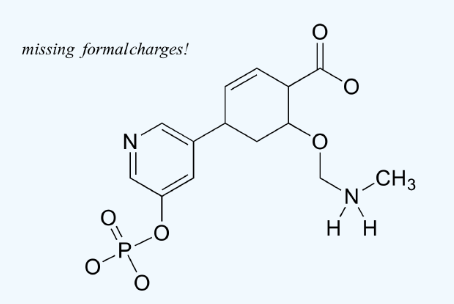
      1. Examine the molecular structure below. The structure should have a net charge of -2. Where would you place the formal charges? Explain your reasoning.

      2. Benzene is a common organic solvent previously used in gasoline; it is no longer used for this purpose, however, because it is now known to be a carcinogen. The benzene molecule (C6H6) consists of a regular hexagon of carbon atoms, each of which is also bonded to a hydrogen atom. Use the concept of resonance to describe the bonding in benzene. You can use the chemistry tool to draw and visualize the resonance structures to help you.

      3. Based on resonance conformation, which structure is more stable?


      4. Determine the hybridization (sp, sp2, sp3) of the indicated atom and indicate the atom's shape from the Lewis structures below:

        1.   The Carbon

        2. The Oxygen

      Step 3: Share 

      To share your work, click the “Add a new discussion topic” button under this post and paste your work into the “Message” box. Make sure to reference others’ intellectual property when necessary. All references should follow 7th Edition APA formatting. For further instructions, see the resource on the Himmelfarb Health Sciences Library: APA citation resource (N.B.: references are excluded from word counts). Note that you do not need to share your drawings done in the Chemistry tool, but you can discuss them if needed.

      Step 4: Interact 

      To complete the activity, evaluate and categorize the work from one of your peers based on items A - E of the rubric below. Provide a rationale for your grade and comments or suggestions for improvement. To post a reply, click “Reply” on a particular discussion, write your feedback, then click “Post to forum.” You can use the list below as an example:

      Item A is  .…. because….  My suggestions for improvement are….
      Item B is  .…. because….  My suggestions for improvement are….
      Item C is  .…. because….  My suggestions for improvement are….
      Item D is  .…. because….  My suggestions for improvement are….
      Item E is  .…. because….  My suggestions for improvement are….

      OPTIONAL Step 5: Interact (10 minutes)

      If you would like to, you can reply to your peers' posts in a respectful and professional manner. Ensure that your post engages your peers' ideas by including a reflection on their comments, sharing ideas of other potential difficulties and parties involved, or asking thought-provoking questions. If a peer comments on your posting, please reply. To post a reply, click “Reply” on a particular discussion, write your feedback and then click on “Post to forum.”


    • quiz icon
      Quiz: Module 3

      To access the quiz, click on the name of the quiz provided above. On the following screen, click the attempt quiz button to view the case studies and respond to the questions.

      TO PASS THIS QUIZ YOU MUST OBTAIN A SCORE OF 80%.
      Not available unless: The activity Quiz: Module 2 is marked complete