

Section: Module 1: Introduction to Psychiatry: Interviews, Symptoms, Classification of Diseases, and Common Medication | Management of Mental Health Disorders in Primary Care | NextGenU.org
-
 Competencies covered in this module:
- Recognize symptoms of mental illness in conducting a psychiatric interview.
- Classify and diagnose mental disorders in adults, adolescents, and children.
- Utilize information on psychiatric drugs to effectively treat mental illnesses.
-
Students mustView
Read the content under the heading "Introduction." (11 minutes)
Frontiers in Psychiatry - 2020
-
Students mustView
Read the entire chapter. (45 minutes)
FDP School of health sciences - 2020
-
Students mustView
Read the content under the headings from " Introduction" until " Judgement" on pages 8-31. (40 minutes)
-
Students mustView
Read the entire chapter. (8 minutes)
FDP School of health sciences - 2020
-
Read this to gain a better understanding of the diagnostic/ classification criteria for the different mental health disorders according to the DSM-5 Manual. (3 minutes)
American Psychiatric Association - 2021
-
Download this fact sheet to find out more about the changes in the new edition, updated disorders, and general information about the DSM–5. (45 minutes)
American Psychiatric Association - 2021
-
Students mustView
Read the entire chapter. (23 minutes)
FDP School of health sciences - 2020
-
Students mustView
Read the entire article. (15 minutes)
PubMed Central - World Psychiatry Journal - 2009
-
Students mustView
Read the following sections of the document: (37 minutes)
-Outline
-Introduction
-Polypharmacy and risk of medicines
-Specific drug classes
-ConclusionSagePub - 2018
-
Students mustView
Read entire article. (13 minutes)
Medicine - Elsevier Journal - 2016
-
Students mustViewStart discussions: 1
In this activity, you will analyze a psychiatric interview case study and discuss key components related to the learning outcomes of the activity.
Step 1. Analyze (45 minutes)
Analyze the fictional case study below.
Case:
A physician conducts separate psychiatric interviews with two patient referrals. During the interview, each patient appears to have signs and symptoms of specific psychiatric disorders. The first patient displays a tough misdemeanor making it difficult to extract needed information regarding diagnosis. On the other hand, the second patient maintains a calm appearance, although he is already requesting the physician to prescribe him some medications in the middle of the psychiatric interview. The profile of each patient is summarized below.
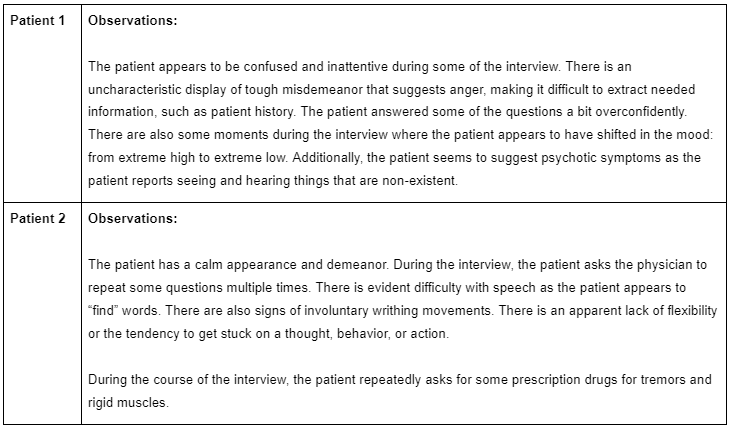
Step 2. Respond (180 minutes)
After analyzing the case, respond by writing a 300-600-word brief report that covers the following:
- Comparison of the levels of speech thought, perception, and cognitive disturbances of the two patients.
- Discussion of various psychiatric interview techniques and strategies that can be used on each of the patients, including extraction of the necessary information for diagnosis.
- Risks, dangers, and outcomes of potentially inappropriate prescriptions.
- One clinical case example where techniques and strategies mentioned can be applied.
Step 3. Share (10 minutes)
To share your work, click on the “Add a new discussion topic” button under this post and paste your work into the “Message” box. Then click “Post to forum.” Make sure to reference others’ intellectual property when necessary. All references should follow 7th Edition APA formatting. For further instructions, see the resource on the Himmelfarb Health Sciences Library: APA citation resource (N.B. references are excluded from word counts).OPTIONAL Step 4: Interact (10 minutes)
If you would like to, you can reply to your peers' posts in a respectful and professional manner. Ensure that your post engages your peers' ideas by including a reflection on their comments, sharing ideas of other potential difficulties and parties involved, or asking thought-provoking questions. If a peer comments on your posting, please reply. To post a reply, click “Reply” on a particular discussion, write your feedback and then click on “Post to forum.”
-
Quiz: Module 1
To access the quiz, click on the name of the quiz provided above. On the following screen, click the "Preview quiz now" button to respond to the questions.
TO PASS THIS QUIZ,YOU MUST OBTAIN A SCORE OF 80%