

Section: Module 1: Introduction to Structural Racism and Health Equity | Dismantling Structural Racism to Advance Health Equity | NextGenU.org
-
Competencies covered in this module:

- Discuss how social inequities, oppression, and structural racism impact health and impede progress toward achieving health equity at organizational, community, and societal levels.
- Develop a practice of humility, self-reflection, and dialogue in regards to structural racism and its impact on health outcomes.
-
Students mustMark as done
Watch the entire video to better understand the module’s content. (18 minutes)
-
Students mustMark as done
Read the sections on Health Equity: Key Concepts and Related Definitions (2 minutes)
Journal of Public Health Management and Practice (JPHMP) - 2021
-
Students mustMark as done
Read the section on "KEY CONCEPTS Conceptualizing Race and Structural Racism" (2 minutes)
The American Journal of Psychiatry - 2021
-
Students mustMark as done
Read the sections on Introduction, Definitions and Health Inequities (3 minutes)
American Academy of Family Physicians - 2019
-
Students mustMark as done
Read the sections titled "The Root Causes of Health Inequity" until "Structural Inequities" (8 minutes)
National Library of Medicine - 2017
-
Students mustMark as done
Read the entire section on Response (5 minutes)
Center for the Study of Social Policy - 2021
-
Students mustViewStart discussions: 1
In this activity, you will analyze key concepts that influence health equity at different levels of the socio-ecological model.
Step 1: Identify
Research and identify an example of a health equity issue that affects the type of health care you would receive or access in your country or region.
Step 2: Respond
Based on the learning materials provided and the example you have identified, prepare a 300 - 350 word discussion illustrating how social inequities, oppression, and structural racism affect health equity and determinants of health impact your selected health issue.
Step 3: Share
To share your work, click on the “Add a new discussion topic” button under this post and paste your work into the “Message” box. Make sure to reference others’ intellectual property when necessary. All references should follow 7th Edition APA formatting. For further instructions, see the resource on the Himmelfarb Health Sciences Library: APA citation resource (N.B. references are excluded from word counts).
Step 4: Interact
To complete the activity, you will need to reply to at least two posts made by your peers in a respectful and professional manner. Be sure that your post engages your peers' ideas by including a reflection on their comments, sharing ideas on other potential difficulties and parties involved, or asking thought-provoking questions. If a peer comments on your posting, please reply. To post a reply, click “Reply” on a particular discussion, write your feedback and then click on “Post to forum.”
-
Read the rections "Achieving Health Equity by Addressing the Social Determinants of Health" and "Our Framework" (3 minutes)
CDC - 2022
-
Students mustView
Read the entire article. (19 minutes)
Journal of Health Care for the Poor and Underserved - 1998
-
Students mustView
Read the entire toolkit. (25 minutes)
2020
-
Students mustView
Read the entire webpage. (3 minutes)
SUNY Cortland - 2001
-
Students mustView
Read the entire webpage. (4 minutes)
The University of Edinburgh - 2019
-
Students mustViewStart discussions: 1
In this activity, you will apply essential concepts and recommendations regarding cultural humility, self-reflection, and dialogue in the context of racism and health.
Step 1: Review and Reflect
Review the relevant learning materials for this lesson and complete the structural competence self-assessment checklist included below.
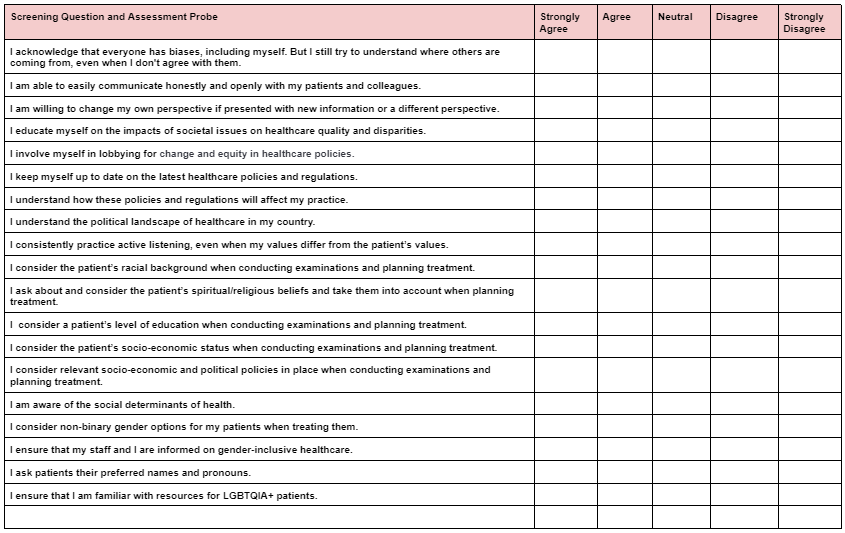
Step 2: Respond
Based on the self-assessment results, prepare a reflection piece of 300 - 350 words identifying any personal strengths and weaknesses. Discuss how you plan to continue developing your structural humility, dialogue or communication skills, self-reflection skills, and skills to respond and relate to others of different ethnicities, cultures, and socio-economic backgrounds. You will discuss the importance of developing these skills for your practice and/or professional development to ensure health equity.
Step 3: Share
To share your work, click on the “Add a new discussion topic” button under this post and paste your work into the “Message” box. Make sure to reference others’ intellectual property when necessary. All references should follow 7th Edition APA formatting. For further instructions, see the resource on the Himmelfarb Health Sciences Library: APA citation resource (N.B. references are excluded from word counts).
OPTIONAL Step 4: Interact (10 minutes)
If you would like to, you can reply to your peers' posts in a respectful and professional manner. Ensure that your post engages your peers' ideas by including a reflection on their comments, sharing ideas of other potential difficulties and parties involved, or asking thought-provoking questions. If a peer comments on your posting, please reply. To post a reply, click “Reply” on a particular discussion, write your feedback and then click on “Post to forum.”