You do not have permission to view discussions in this forum.
-
-
Students mustStudent must submit this questionnaire to complete it
-
Students mustViewReceive a grade
Show More-


Welcome to the Organic Chemistry 1 course, part of the Pre-Health Sciences Training Certificate series. This course is designed to provide learners interested in health-related programs and preparing for the MCAT with a comprehensive overview of fundamental principles in organic chemistry.
Throughout this course, you will cover topics such as organic compound nomenclature and functional groups, stereochemistry, structure and bonding, free radical reactions, substitution and elimination pathways, alkenes and alkynes, and alcohol structure, synthesis, and reactivity. Additionally, you will be introduced to synthetic strategies in organic chemistry. By the end of this course, you will have a strong foundation in the principles of organic chemistry that will help you to succeed in your future studies and careers.
The Organic Chemistry 1 course is sponsored in part by the International Development Research Centre and the University of the Incarnate Word School of Osteopathic Medicine. Like all NextGenU.org courses, it is competency-based, using competencies based on the Association of American Medical Colleges’ Medical College Admission Test. It uses learning resources from accredited, academic, professional, and world-class organizations and universities, such as Rice University. This course was designed by Alixandria Ali, BSc; Samantha Baboolal, BSc; Pablo Baldiviezo, MD, MSc, DiplEd; Sherian Bachan, MSc, BSc; Felix Emeka Anyiam, MPH, MScPH, DataSc; Marco Aurelio Hernandez, PhD, MSc, BSc; Kabiru Gulma, BPharm, PhD, MSc, MBA; Reisha Narine, MSc, BSc; and Aduke Williams, BA; Tristan Aaron Wild, BMSc (Hons): and Mayura Panjalingam, BSc, PhD Candidate (Hons).
For publications on the efficacy of NextGenU.org’s courses, see NextGenU.org’s publication page.
There are nine (9) modules to complete, which provide an introduction to:
Module 1: Organic Compounds - Nomenclature and Functional Groups
Module 2: Stereochemistry
Module 3: Structure and Bonding
Module 4: Free Radical Reactions
Module 5: Mechanisms of Substitution and Elimination Pathways
Module 6: Alkenes
Module 7: Alkynes
Module 8: Alcohol - Structure, Synthesis, Reactivity
Module 9: Introduction to Synthetic StrategyThe completion time for this course is estimated at 49 hours, comprising 10 hours of learning resources, 20 hours of studying and assimilation of the content, and 19 hours of participating in learning activities and quizzes to assist learners in synthesizing learning materials. This course is equivalent to 1 credit hour in the U.S. undergraduate/ bachelor’s degree system.
The course requires the completion of all quizzes, discussion forums, and practical activities to receive a course certificate. Practice quizzes are available throughout the course and contain ten multiple-choice questions each. After completing each module, quiz, and learning activity, at the end of the course, you will have access to a final exam consisting of 40 multiple-choice questions and a chance to evaluate this course. Participants have up to three opportunities to take the final exam and achieve the required passing score of >=70%. Once you have passed the final exam and completed the evaluations, you can download a certificate of completion from NextGenU.org and our course’s co-sponsoring organizations.
We keep your personal information confidential, never sell any of your information, and only use anonymized data for research purposes. Also, we are happy to report your testing information and share your work with anyone (your school, employer, etc.) at your request.
Engaging with this Course:
This free course is for students who have graduated from high school and want to prepare to become a health professional and/or pass the MCAT exam. You may also browse this free course for your personal enrichment. There are no requirements.
To obtain a certificate, a learner must first register for the course and then successfully complete the following:
- The pre-test,
- All the reading requirements,
- All quizzes and pass with 80% with unlimited attempts,
- All case scenarios,
- All discussion forums,
- The final exam with a minimum of 80% and a maximum of 3 attempts, and
- The self and course evaluation forms.
To obtain credit:
- Complete all requirements listed above for the certificate, and
- Your learning institution or workplace should approve the partner-university-sponsored NextGenU.org course for educational credit, as they usually would for their learner taking a course anywhere.
NextGenU.org is happy to provide your institution with the following:
- A link to the description of the course training so they can see all of its components, including the co-sponsoring institution,
- Your grade on the final exam,
- Your work products (e.g., discussion forum responses) and any other required or optional shared materials you produce and authorize to share with them,
- Your evaluations -- course and self-assessments, and
- A copy of your certificate of completion with the co-sponsoring organizations listed.
To obtain a degree, NextGenU.org co-sponsors degree programs with institutional partners. To obtain a full degree co-sponsored with NextGenU.org, registrants must be enrolled in a degree program as a student of a NextGenU.org institutional partner. If you think your institution might be interested in offering a degree with NextGenU.org, contact us.
We hope you will find this a rewarding learning experience, and we count on your assessment and feedback to help us improve this training for future students.
Here are the next steps to take the course and earn a certificate:
- Complete the registration form,
- Take the pre-test, and
- Begin the course with Module 1: Organic Compounds - Nomenclature and Functional Groups. In each lesson, read the description, complete all required readings and any required activity, as well as take the corresponding quizzes.
-
 Instructional Goals covered in this module:
- Understand how to name compounds according to IUPAC rules and distinguish different functional groups and their properties.
-
Students mustView
Read the content under the headings "Functional Groups," "The Role of Functional Groups," and "Functional Groups and Reactivity." (5 minutes)
UEN Digital Press with Pressbooks Open Educational Resources for Utah
-
-
Students mustView
Read the section on alkanes. (20 minutes)
Virtual Textbook of Organic Chemistry Michigan State University - 2013
-
Students mustView
Read the entire webpage. (13 minutes)
Virtual Textbook of Organic Chemistry Michigan State University - 2013
-
Students mustView
Read the entire webpage. (15 minutes)
Kwantlen Polytechnic University - 2021
-
Students mustView
Read the content under the headings "The IUPAC Systematic Approach to Nomenclature" and "Cycloalkanes." (4 minutes)
Virtual Textbook of Organic Chemistry Michigan State University
-
Students mustView
Read the entire webpage. (6 minutes)
Kwantlen Polytechnic University
-
-
-
Students mustViewStart discussions: 1
General Instructions
In this activity, you will be given a series of questions. These questions will involve naming alkenes from their molecular structure, drawing structures from given names, examining energy diagrams of different conformations, and investigating stability based on conformation. The link to a chemistry drawing tool is provided; you should explore the features and familiarize yourself with the functions before starting the activity. Note that you are not required to share the structures or mechanisms you drew when sharing your responses.
Step 1 - Review
Review the material from this module, paying particular attention to the different representations used for alkanes and factors affecting stability.
Step 2 - Respond
Answer the following questions:
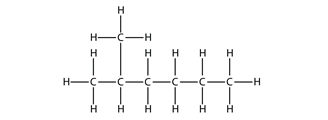
Explain the process of naming alkanes using the IUPAC rules for the structures below:
Using the chemistry tool, draw the structures for the alkanes below and explain the process you used in determining the structure:
2, 3 dimethyl-heptane
3-ethyl-2-methyl-heptane
1, 2-dimethylcyclohexane
Examine the information presented and discuss the points below:
What does this graph aim to represent?
Why is the eclipsed formation more stable?
Why is there rapid rotation at room temperature?
Cis/Trans nomenclature can be used to describe the relative positioning of substituents on molecules with more complex ring structures. Examine the molecular structure provided below:
Are the OH and the adjacent methyl group cis or trans to each other?
What can you deduce about the relative positions of the indicated hydrogens?
Which of these chair conformations are the most stable and why?
Step 3: Share
You are required to share your answers to Questions 1, 3, 4, and 5.
To share your work, click the “Add a new discussion topic” button under this post and paste your work into the “Message” box. Make sure to reference others’ intellectual property when necessary. All references should follow 7th Edition APA formatting. For further instructions, see the resource on the Himmelfarb Health Sciences Library: APA citation resource (N.B.: references are excluded from word counts).Step 4: Interact
To complete the activity, evaluate and categorize the work from one of your peers based on items A - E of the rubric below. Provide a rationale for your grade and comments or suggestions for improvement. To post a reply, click “Reply” on a particular discussion, write your feedback, and click “Post to forum.” You can use the list below as an example:
Item A is .…. because…. My suggestions for improvement are….
Item B is .…. because…. My suggestions for improvement are…
Item C is .…. because…. My suggestions for improvement are….
Item D is .…. because…. My suggestions for improvement are….
Item E is .…. because…. My suggestions for improvement are….OPTIONAL Step 5: Interact (10 minutes)
If you would like to, you can reply to your peers' posts in a respectful and professional manner. Ensure that your post engages your peers' ideas by including a reflection on their comments, sharing ideas of other potential difficulties and parties involved, or asking thought-provoking questions. If a peer comments on your posting, please reply. To post a reply, click “Reply” on a particular discussion, write your feedback and then click on “Post to forum.”
-
Quiz: Module 1
To access the quiz, click on the name of the quiz provided above. On the following screen, click the attempt quiz button to view the case studies and respond to the questions.
TO PASS THIS QUIZ YOU MUST OBTAIN A SCORE OF 80%.
-
 Instructional Goals covered in this module:
- Understand the spatial arrangement, properties, and reactivity of stereoisomers.
-
Students mustView
Read the entire webpage. (7 minutes)
Kwantlen Polytechnic University
-
Students mustView
Read the entire webpage. (11 minutes)
Kwantlen Polytechnic University - 2021
-
Students mustView
Read the entire webpage. (15 minutes)
Kwantlen Polytechnic University
-
Students mustView
Read the entire webpage. (3 minutes)
Kwantlen Polytechnic University
-
Students mustView
Read the entire webpage. (10 minutes)
Kwantlen Polytechnic University
-
Students mustViewStart discussions: 1
General Instructions
In this activity, you will be given a series of questions. These questions will involve identifying molecular relationships, explaining Fischer projections, and identifying isomers from a given structure. The link to a chemistry drawing tool is provided; you should explore the features and familiarize yourself with the functions before starting the activity. Note that you are not required to share the structures or mechanisms you drew when sharing your responses.
Step 1 - Review
Review the material from this module, paying particular attention to chirality, stereogenicity, and Fischer projections.
Step 2 - Respond
Answer the following questions:
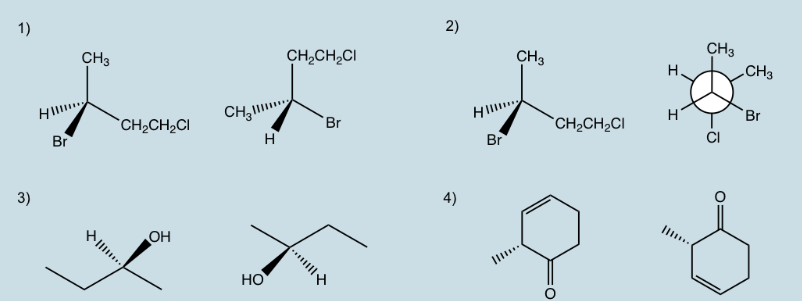
Determine the relationship for each pair of molecules (enantiomers, identical, constitutional isomers, non-isomer) and provide brief explanations of the reasoning behind your answers.
When drawing Fischer Projections, if the lowest priority group is on a horizontal bond (as in the following structure), we determine the priority decrease direction, then reverse the answer to the opposite way to get the final configuration. In your own words, explain why this procedure is followed.
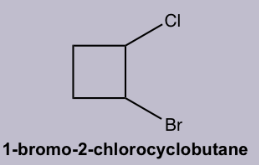
Use the chemistry tool to draw the structures of all the stereoisomers for 1-bromo-2-chlorocyclobutane. Then, describe your approach and indicate the relationship between the stereoisomers.
Step 3: Share
To share your work, click the “Add a new discussion topic” button under this post and paste your work into the “Message” box. Make sure to reference others’ intellectual property when necessary. All references should follow 7th Edition APA formatting. For further instructions, see the resource on the Himmelfarb Health Sciences Library: APA citation resource (N.B.: references are excluded from word counts). You do not need to share your drawings in the Chemistry tool, but you can discuss them if required.
Step 4: Interact
To complete the activity, evaluate and categorize the work from one of your peers based on items A - E of the rubric below. Provide a rationale for your grade and comments or suggestions for improvement. To post a reply, click “Reply” on a particular discussion, write your feedback and click “Post to forum.” You can use the list below as an example:
Item A is .…. because…. My suggestions for improvement are….
Item B is .…. because…. My suggestions for improvement are….
Item C is .…. because…. My suggestions for improvement are….
Item D is .…. because…. My suggestions for improvement are….
Item E is .…. because…. My suggestions for improvement are….OPTIONAL Step 5: Interact (10 minutes)
If you would like to, you can reply to your peers' posts in a respectful and professional manner. Ensure that your post engages your peers' ideas by including a reflection on their comments, sharing ideas of other potential difficulties and parties involved, or asking thought-provoking questions. If a peer comments on your posting, please reply. To post a reply, click “Reply” on a particular discussion, write your feedback and then click on “Post to forum.”
-
Quiz: Module 2
To access the quiz, click on the name of the quiz provided above. On the following screen, click the attempt quiz button to view the case studies and respond to the questions.
TO PASS THIS QUIZ YOU MUST OBTAIN A SCORE OF 80%.
-
 Instructional Goals covered in this module:
- Understand the relationship between the structure, bonding, reactivity, and stability of organic molecules.
-
Students mustView
Read the entire webpage. (15 minutes)
LibreTexts Chemistry - 2022
-
Students mustView
Read the entire webpage. (30 minutes)
Pressbooks - Rice University - 2022
-
Students mustView
Read the entire webpage. (5 minutes)
LibreTexts Chemistry - 2022
-
-
Students mustView
Read the entire webpage. (15 minutes)
Michigan State University - 2013
-
-
-
Students mustView
Read the entire webpage. (48 minutes)
Chemistry Libre Text - 2022
-
Students mustView
Read the entire webpage. (18 minutes)
-
Students mustView
Read the content under the heading "Hybridization." (9 minutes)
Chemistry libre texts - 2022
-
Students mustView
Read the entire webpage. (5 minutes)
Kwantlen Polytechnic University
-
Students mustView
Read the entire webpage. (7 minutes)
Chemistry Libre texts - 2022
-
Students mustMark as done
Read the content under the heading "Bond Length." (4 minutes)
Chemistry Libre texts - 2014
-
Students mustViewStart discussions: 1
General Instructions
In this activity, you will be given a series of questions. These questions will involve identifying the placement of formal charges, discussing resonance, and discussing hybridization. The link to a chemistry drawing tool is provided; you should explore the features and familiarize yourself with the functions before starting the activity. Note that you are not required to share the structures or mechanisms you drew when sharing your responses.
Step 1 - Review
Review the material from this module, paying particular attention to formal charges, resonance structures, hybridization, and electron mechanisms.
Step 2 - Respond
Answer the following questions:
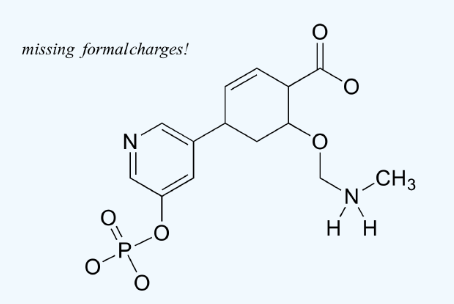
Examine the molecular structure below. The structure should have a net charge of -2. Where would you place the formal charges? Explain your reasoning.
Benzene is a common organic solvent previously used in gasoline; it is no longer used for this purpose, however, because it is now known to be a carcinogen. The benzene molecule (C6H6) consists of a regular hexagon of carbon atoms, each of which is also bonded to a hydrogen atom. Use the concept of resonance to describe the bonding in benzene. You can use the chemistry tool to draw and visualize the resonance structures to help you.
Based on resonance conformation, which structure is more stable?
Determine the hybridization (sp, sp2, sp3) of the indicated atom and indicate the atom's shape from the Lewis structures below:
The Carbon
The Oxygen
Step 3: Share
To share your work, click the “Add a new discussion topic” button under this post and paste your work into the “Message” box. Make sure to reference others’ intellectual property when necessary. All references should follow 7th Edition APA formatting. For further instructions, see the resource on the Himmelfarb Health Sciences Library: APA citation resource (N.B.: references are excluded from word counts). Note that you do not need to share your drawings done in the Chemistry tool, but you can discuss them if needed.
Step 4: Interact
To complete the activity, evaluate and categorize the work from one of your peers based on items A - E of the rubric below. Provide a rationale for your grade and comments or suggestions for improvement. To post a reply, click “Reply” on a particular discussion, write your feedback, then click “Post to forum.” You can use the list below as an example:
Item A is .…. because…. My suggestions for improvement are….
Item B is .…. because…. My suggestions for improvement are….
Item C is .…. because…. My suggestions for improvement are….
Item D is .…. because…. My suggestions for improvement are….
Item E is .…. because…. My suggestions for improvement are….OPTIONAL Step 5: Interact (10 minutes)
If you would like to, you can reply to your peers' posts in a respectful and professional manner. Ensure that your post engages your peers' ideas by including a reflection on their comments, sharing ideas of other potential difficulties and parties involved, or asking thought-provoking questions. If a peer comments on your posting, please reply. To post a reply, click “Reply” on a particular discussion, write your feedback and then click on “Post to forum.”
-
Quiz: Module 3
To access the quiz, click on the name of the quiz provided above. On the following screen, click the attempt quiz button to view the case studies and respond to the questions.
TO PASS THIS QUIZ YOU MUST OBTAIN A SCORE OF 80%.
-
 Instructional Goals covered in this module:
- Understand the reactivity of the free radical reactions of alkanes.
-
Students mustMark as done
Read the content under the heading "Organic Radicals." (15 minutes)
Michigan State University Online textbook - 2013
-
Students mustView
Read sections 1-4 under "Organic Chemicals." (5 minutes)
Kwantlen Polytechnic University
-
Students mustView
Read the entire section. (10 minutes)
Kwantlen Polytechnic University
-
Students mustView
Read the entire section. (3 minutes)
Kwantlen Polytechnic University - 2021
-
Students mustView
Read the entire section. (5 minutes)
Kwantlen Polytechnic University - 2021
-
Students mustView
Read the entire section. (2 minutes)
Kwantlen Polytechnic University - 2021
-
Students mustViewStart discussions: 1
General Instructions
In this activity, you will be given a series of questions. These questions will involve calculating reaction energy, explaining radical stability, and discussing mechanisms of propagation. The link to a chemistry drawing tool is provided; you should explore the features and familiarize yourself with the functions before starting the activity. Note that you are not required to share the structures or mechanisms you drew when sharing your responses.
Step 1 - Review
Review the material from this module, paying particular attention to propagation, resonance, radicals, and halogenation.
Step 2 - Respond
Answer the following questions:
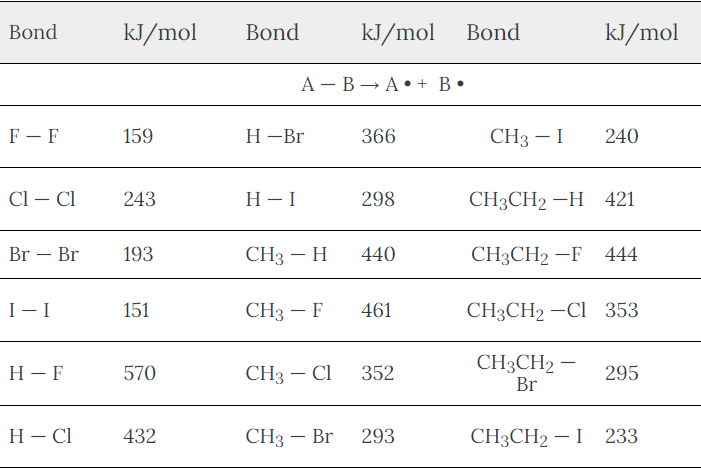
Refer to the bond energies in the table below and calculate the reaction energy for the propagation step of the mono-chlorination of methane. Explain your method.
The resonance effect is responsible for the stability of the benzylic radical. Explain resonance as it applies to the benzylic radical. Be sure to include the movement of the electron.
You can use the chemistry tool to draw out the resonance mechanism to help you explain.The experiment results of the bromination reaction of (±)-3-methylhexane indicate that the racemic mixture of R and S 3-bromo-3-methylhexane were obtained with the bromination. Explain the stereochemistry of the propagation steps in the mechanism for this reaction. You can use the Chemistry tool to draw out the resonance mechanism to help you explain.
Step 3: Share
To share your work, click the “Add a new discussion topic” button under this post and paste your work into the “Message” box. Make sure to reference others’ intellectual property when necessary. All references should follow 7th Edition APA formatting. For further instructions, see the resource on the Himmelfarb Health Sciences Library: APA citation resource (N.B.: references are excluded from word counts). Note that you do not need to share your drawings done in the Chemistry tool, but you can discuss them if needed.
Step 4: Interact
To complete the activity, evaluate and categorize the work from one of your peers based on items A - E of the rubric below. Provide a rationale for your grade and comments or suggestions for improvement. To post a reply, click “Reply” on a particular discussion, write your feedback, then click “Post to forum.” You can use the list below as an example:
Item A is .…. because…. My suggestions for improvement are….
Item B is .…. because…. My suggestions for improvement are….
Item C is .…. because…. My suggestions for improvement are….
Item D is .…. because…. My suggestions for improvement are….
Item E is .…. because…. My suggestions for improvement are….OPTIONAL Step 5: Interact (10 minutes)
If you would like to, you can reply to your peers' posts in a respectful and professional manner. Ensure that your post engages your peers' ideas by including a reflection on their comments, sharing ideas of other potential difficulties and parties involved, or asking thought-provoking questions. If a peer comments on your posting, please reply. To post a reply, click “Reply” on a particular discussion, write your feedback and then click on “Post to forum.”
-
Quiz: Module 4
To access the quiz, click on the name of the quiz provided above. On the following screen, click the attempt quiz button to respond to the questions.
TO PASS THIS QUIZ YOU MUST OBTAIN A SCORE OF 80%.
-
 Instructional Goals covered in this module:
- Understand the mechanisms of substitution and elimination reactions.
-
Students mustView
Read the entire section. (6 minutes)
Kwantlen Polytechnic University
-
Students mustView
Read the content under the headings "SN2 Reaction Mechanism," "Energy Diagram," and "Stereochemistry." (10 minutes)
Kwantlen Polytechnic University - 2021
-
Students mustView
Read the entire section. (10 minutes)
Kwantlen Polytechnic University - 2021
-
Students mustView
Read the content under the heading "SN1 Reaction Mechanism." (15 minutes)
Kwantlen Polytechnic University - 2021
-
Students mustView
Read the entire section. (10 minutes)
Kwantlen Polytechnic University
-
Students mustView
Read the entire section. (9 minutes)
Kwantlen Polytechnic University
-
Students mustView
Read the entire section. (5 minutes)
Kwantlen Polytechnic University
-
Students mustView
Read the entire section. (20 minutes)
Kwantlen Polytechnic University - 2021
-
Students mustView
Read the entire section. (7 minutes)
Kwantlen Polytechnic University
-
Students mustView
Read the entire section. (10 minutes)
Kwantlen Polytechnic University
-
Students mustViewStart discussions: 1
General Instructions
In this activity, you will be given a series of questions. These questions will involve discussing SN1 and SN2 mechanisms, interpreting energy profile diagrams, discussing E1 and E2 mechanisms, and distinguishing between Hofmann and Zaitsev’s rule. The link to a chemistry drawing tool is provided; you should explore the features and familiarize yourself with the functions before starting the activity. Note that you are not required to share the structures or mechanisms you drew when sharing your responses.
Step 1 - Review
Review the material from this module, paying particular attention to SN1, SN2, E1, and E2 reaction mechanisms.
Step 2 - Respond
Answer the following questions:
What does the energy profile diagram below tell us about the reaction between CH3Br and OH- ?
Use the following questions to prompt your discussion:Is this SN1 or SN2?
What does it tell us about the energy of the products and reactants?
What does T.S. represent? What is its significance?
Explain the steps of the reaction mechanism that would be involved. You can practice drawing the mechanism in the chemistry tool.
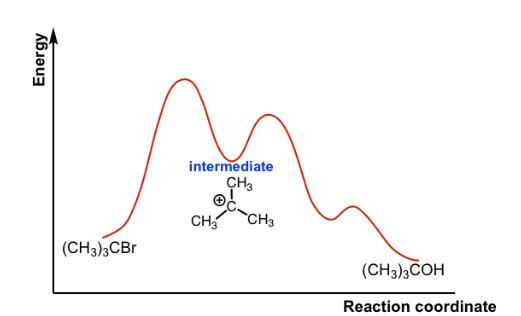
What does the energy profile diagram below tell us about the reaction between (CH3)3CBr and H2O?
Use the following questions to prompt your discussion:Is this SN1 or SN2?
What does it tell us about the energy of the products and reactants?
What is “intermediate”? What is its significance?
Explain the steps of the reaction mechanism that would be involved. You can practice drawing the mechanism in the chemistry tool.
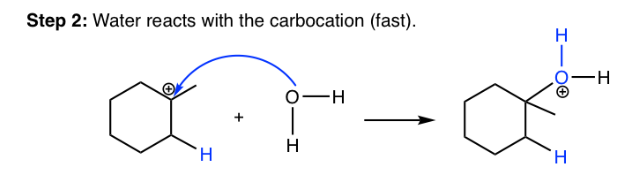
Name and describe the mechanism for the reaction below. You can practice drawing the mechanism in the chemistry tool.
Examine the two reactions presented below and answer the questions that follow.
Distinguish which equation follows the Hofmann rule and which follows Zaitsev’s rule with a brief explanation of your reasoning.
What are the conditions needed for each reaction to follow its respective rule?
For the equation that follows the Hofmann rule, describe the mechanism. You can practice drawing the mechanism in the chemistry tool.
Step 3: Share
To share your work, click the “Add a new discussion topic” button under this post and paste your work into the “Message” box. Make sure to reference others’ intellectual property when necessary. All references should follow 7th Edition APA formatting. For further instructions, see the resource on the Himmelfarb Health Sciences Library: APA citation resource (N.B.: references are excluded from word counts). Note that you do not need to share your drawings done in the Chemistry tool, but you can discuss them if needed.
Step 4: Interact
To complete the activity, evaluate and categorize the work from one of your peers based on items A - E of the rubric below. Provide a rationale for your grade and comments or suggestions for improvement. To post a reply, click “Reply” on a particular discussion, write your feedback, then click “Post to forum.” You can use the list below as an example:
Item A is .…. because…. My suggestions for improvement are….
Item B is .…. because…. My suggestions for improvement are….
Item C is .…. because…. My suggestions for improvement are….
Item D is .…. because…. My suggestions for improvement are….
Item E is .…. because…. My suggestions for improvement are….OPTIONAL Step 5: Interact (10 minutes)
If you would like to, you can reply to your peers' posts in a respectful and professional manner. Ensure that your post engages your peers' ideas by including a reflection on their comments, sharing ideas of other potential difficulties and parties involved, or asking thought-provoking questions. If a peer comments on your posting, please reply. To post a reply, click “Reply” on a particular discussion, write your feedback and then click on “Post to forum.”
-
Quiz: Module 5
To access the quiz, click on the name of the quiz provided above. On the following screen, click the attempt quiz button to respond to the questions.
TO PASS THIS QUIZ YOU MUST OBTAIN A SCORE OF 80%.
-
 Instructional Goals covered in this module:
- Understand the reactivity and stereochemistry of alkenes.
-
Students mustView
Read the section on alkenes. (5 minutes)
Virtual Textbook of Organic Chemistry Michigan State University - 2013
-
Students mustView
Read the entire section. (15 minutes)
Kwantlen Polytechnic University
-
Students mustView
Read the entire section. (10 minutes)
Kwantlen Polytechnic University - 2021
-
Students mustView
Read the entire section. (5 minutes)
Kwantlen Polytechnic University - 2021
-
Students mustView
Read the entire section. (15 minutes)
Kwantlen Polytechnic University - 2021
-
Students mustView
Read the entire section. (5 minutes)
Kwantlen Polytechnic University - 2021
-
Students mustView
Read the entire section. (15 minutes)
Kwantlen Polytechnic University - 2021
-
Students mustView
Read the entire section. (15 minutes)
Kwantlen Polytechnic University - 2021
-
Students mustViewStart discussions: 1
General Instructions
In this activity, you will be given a series of questions. These questions will involve explaining reaction mechanisms that involve alcohols, explaining the stereochemistry of reactions, and discussing Markovnikov’s rule. The link to a chemistry drawing tool is provided; you should explore the features and familiarize yourself with the functions before starting the activity. Note that you are not required to share the structures or mechanisms you drew when sharing your responses.
Step 1 - Review
Review the material from this module, paying particular attention to the different mechanisms of alkene reactions, Markovnikov’s rule, and stereochemistry.
Step 2 - Respond
Answer the following questions:
Examine the reaction below and answer the questions
What is the name of this reaction?
What type of mechanism does this reaction follow? (SN1, SN2, E1, E2)
What are the names of the reactants and products?
Explain each step of the mechanism of this reaction.
Explain the mechanism of this reaction:
You can practice drawing the mechanism in the chemistry tool.Below are the first two steps of a reaction mechanism:
What reaction is this?
Explain what happens between the 2o and 3o carbocations. Why is this necessary?
Complete the reaction by describing what happens in step 3 of the mechanism and include an explanation on the stability of the end product or products. You can practice drawing the mechanism in the chemistry tool.
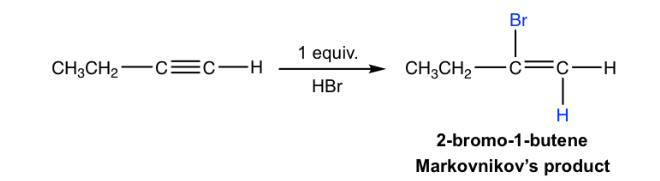
The mechanism of the addition reaction on an alkene involves two steps. Look at the reaction below and answer the questions that follow.
Is the product shown the only product of this reaction?
If there are multiple products, which is the major product and why? If there is only one product, explain why.
Are carbocations formed in this reaction?
Describe the mechanism of this reaction. You can practice drawing the mechanism in the chemistry tool.
Examine the reaction below. The second step of the mechanism is also provided. Explain the entire mechanism and be sure to mention the rules that may apply. You can practice drawing the mechanism in the chemistry tool.
Examine the reaction below.
Explain the mechanism with reference to anti-Markovnikov regioselectivity.
Step 3: Share
To share your work, click the “Add a new discussion topic” button under this post and paste your work into the “Message” box. Make sure to reference others’ intellectual property when necessary. All references should follow 7th Edition APA formatting. For further instructions, see the resource on the Himmelfarb Health Sciences Library: APA citation resource (N.B.: references are excluded from word counts). Note that you do not need to share your drawings done in the Chemistry tool, but you can discuss them if needed.
Step 4: Interact
To complete the activity, evaluate and categorize the work from one of your peers based on items A - E of the rubric below. Provide a rationale for your grade and comments or suggestions for improvement. To post a reply, click “Reply” on a particular discussion, write your feedback, then click “Post to forum.” You can use the list below as an example:
Item A is .…. because…. My suggestions for improvement are….
Item B is .…. because…. My suggestions for improvement are….
Item C is .…. because…. My suggestions for improvement are….
Item D is .…. because…. My suggestions for improvement are….
Item E is .…. because…. My suggestions for improvement are….OPTIONAL Step 5: Interact (10 minutes)
If you would like to, you can reply to your peers' posts in a respectful and professional manner. Ensure that your post engages your peers' ideas by including a reflection on their comments, sharing ideas of other potential difficulties and parties involved, or asking thought-provoking questions. If a peer comments on your posting, please reply. To post a reply, click “Reply” on a particular discussion, write your feedback and then click on “Post to forum.”
-
Quiz: Module 6
To access the quiz, click on the name of the quiz provided above. On the following screen, click the attempt quiz button to respond to the questions.
TO PASS THIS QUIZ YOU MUST OBTAIN A SCORE OF 80%.
-
 Instructional Goals covered in this module:
- Understand the nomenclature, synthesis, and reaction mechanisms of alkynes.
-
Students mustView
Read the section on alkynes. (5 minutes)
Virtual Textbook of Organic Chemistry Michigan State University - 2013
-
Students mustView
Read the entire section. (11 minutes)
Kwantlen Polytechnic University - 2021
-
Students mustViewStart discussions: 1
General Instructions
In this activity, you will be given a series of questions. These questions will involve explaining mechanisms for alkyne reactions and discussing regioselectivity and tautomerism. The link to a chemistry drawing tool is provided; you should explore the features and familiarize yourself with the functions before starting the activity. Note that you are not required to share the structures or mechanisms you drew when sharing your responses.
Step 1 - Review
Review the material from this module, paying particular attention to the different mechanisms of alkyne reactions, Markovnikov’s rule, and the use of catalysts.
Step 2 - Respond
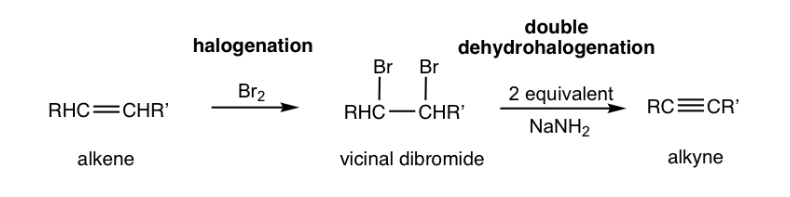
Answer the following questions:Alkynes can be synthesized by the following scheme:
With reference to the scheme, design the synthesis route of 1-pentyne from 1-pentene and explain its mechanism. You can practice drawing the mechanism in the chemistry tool.Explain the use of platinum or palladium catalysts in hydrogenation reactions of alkynes. Are there any special conditions required when using these catalysts?
Internal alkyne can be converted into trans-alkene using sodium (or lithium) in liquid ammonia. Explain the mechanism of this type of reaction. The general scheme is provided below. You can practice drawing the mechanism in the chemistry tool.
Look at the reaction below and answer the questions that follow
What is the name of this reaction?
Explain the mechanism of the reaction. You can practice drawing the mechanism in the chemistry tool.
Explain the regioselectivity that occurs to give the final product.
Hydroboration oxidation reactions result in tautomerization. Examine the incomplete reaction scheme below.
Complete the reaction mechanism for both pathways and explain what happens. You can practice drawing the mechanism in the chemistry tool.
Explain the concept of tautomerism and why it occurs here.
To share your work, click the “Add a new discussion topic” button under this post and paste your work into the “Message” box. Make sure to reference others’ intellectual property when necessary. All references should follow 7th Edition APA formatting. For further instructions, see the resource on the Himmelfarb Health Sciences Library: APA citation resource (N.B.: references are excluded from word counts). Note that you do not need to share your drawings done in the Chemistry tool, but you can discuss them if needed.
Step 4: Interact
To complete the activity, evaluate and categorize the work from one of your peers based on items A - E of the rubric below. Provide a rationale for your grade and comments or suggestions for improvement. To post a reply, click “Reply” on a particular discussion, write your feedback, then click “Post to forum.” You can use the list below as an example:
Item A is .…. because…. My suggestions for improvement are….
Item B is .…. because…. My suggestions for improvement are….
Item C is .…. because…. My suggestions for improvement are….
Item D is .…. because…. My suggestions for improvement are….
Item E is .…. because…. My suggestions for improvement are….OPTIONAL Step 5: Interact (10 minutes)
If you would like to, you can reply to your peers' posts in a respectful and professional manner. Ensure that your post engages your peers' ideas by including a reflection on their comments, sharing ideas of other potential difficulties and parties involved, or asking thought-provoking questions. If a peer comments on your posting, please reply. To post a reply, click “Reply” on a particular discussion, write your feedback and then click on “Post to forum.”
-
Quiz: Module 7
To access the quiz, click on the name of the quiz provided above. On the following screen, click the attempt quiz button to respond to the questions.
TO PASS THIS QUIZ YOU MUST OBTAIN A SCORE OF 5/6
-
 Instructional Goals covered in this module:
- Understand the nomenclature, properties, synthesis, and reaction mechanisms of alcohols.
-
Students mustView
Read the entire webpage. (30 minutes)
Chemistry libre texts - 2021
-
Students mustView
Read the entire webpage. (13 minutes)
Chemistry libre texts
-
Students mustView
Read the entire section. (4 minutes)
Chemistry libre texts
-
Students mustView
Read the entire webpage. (8 minutes)
Chemistry libre texts - 2021
-
Students mustView
Read the entire webpage. (9 minutes)
Chemistry libre texts - 2021
-
Students mustView
Read the entire webpage. (16 minutes)
Chemistry libre texts - 2021
-
Students mustView
Read the entire webpage. (20 minutes)
Chemistry libre texts - 2013
-
Students mustView
Read the entire webpage. (14 minutes)
Virtual Textbook of Organic Chemistry Michigan State - 2013
-
Students mustView
Read the content under the heading "Using Ether as Protective Groups." (5 minutes)
Virtual Textbook of Organic Chemistry Michigan State - 2013
-
Students mustViewStart discussions: 1
General Instructions
In this activity, you will be given a series of questions. These questions will involve discussing the acidity of phenols, explaining mechanisms for reactions of aldehydes and ketones, and discussing Gringard reagents and ethers. The link to a chemistry drawing tool is provided; you should explore the features and familiarize yourself with the functions before starting the activity. Note that you are not required to share the structures or mechanisms you drew when sharing your responses.
Step 1 - Review
Review the material from this module, paying particular attention to the different mechanisms of alcohol formation, resonance effects, Gringard reagent, and the breakdown of alcohols.
Step 2 - Respond
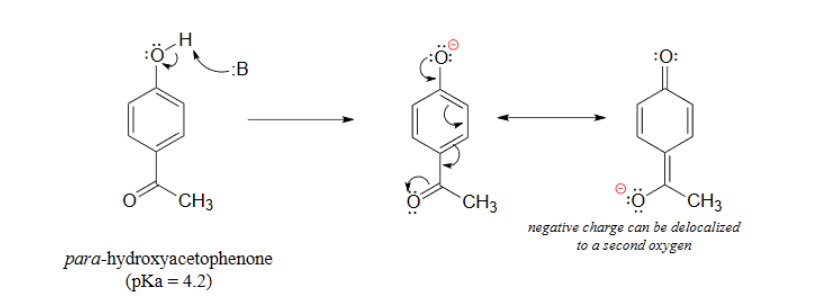
Answer the following questions:Use the following schemes to explain why:
Phenol is more acidic than cyclohexanol
Substituted phenols are more acidic than non-substituted phenols
Aldehydes and ketones can be reduced by either NaBH4 or LiAlH4. Explain the role of NaBH4 and LiAlH4 and the mechanism for the reaction. You can practice drawing the mechanism in the chemistry tool.
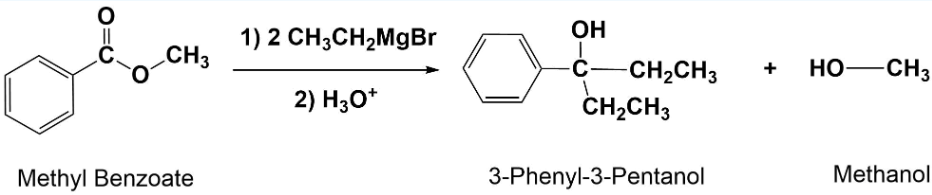
The following reaction requires a specific type of reagent to produce the desired product.
What is the general name given to these types of reagents (hint: specific to the production of alcohols)?
Explain the general mechanism for these reactions. You can practice drawing the mechanism in the chemistry tool.
The end product of an oxidation reaction is presented in the structure below:
What was the starting product? How did you deduce this?
Explain the mechanism of this reaction. You can practice drawing the mechanism in the chemistry tool.
Alcohols can act as both nucleophiles and electrophiles.
Why do alcohols act as nucleophiles and electrophiles?
Provide an example of a reaction where alcohol has a nucleophilic role and explain the mechanism. You can practice drawing the mechanism in the chemistry tool.
Provide an example of a reaction where alcohol has an electrophilic role and explain the mechanism. You can practice drawing the mechanism in the chemistry tool.
Ethers can be used to protect alcohol functional groups.
Why would it be necessary to protect an OH group?
Explain Williamson's substitution.
Step 3: Share
To share your work, click the “Add a new discussion topic” button under this post and paste your work into the “Message” box. Make sure to reference others’ intellectual property when necessary. All references should follow 7th Edition APA formatting. For further instructions, see the resource on the Himmelfarb Health Sciences Library: APA citation resource (N.B.: references are excluded from word counts). Note that you do not need to share your drawings done in the Chemistry tool, but you can discuss them if needed.
Step 4: Interact
To complete the activity, evaluate and categorize the work from one of your peers based on items A - E of the rubric below. Provide a rationale for your grade and comments or suggestions for improvement. To post a reply, click “Reply” on a particular discussion, write your feedback, then “Post to forum.” You can use the list below as an example:
Item A is .…. because…. My suggestions for improvement are….
Item B is .…. because…. My suggestions for improvement are….
Item C is .…. because…. My suggestions for improvement are….
Item D is .…. because…. My suggestions for improvement are….
Item E is .…. because…. My suggestions for improvement are….OPTIONAL Step 5: Interact (10 minutes)
If you would like to, you can reply to your peers' posts in a respectful and professional manner. Ensure that your post engages your peers' ideas by including a reflection on their comments, sharing ideas of other potential difficulties and parties involved, or asking thought-provoking questions. If a peer comments on your posting, please reply. To post a reply, click “Reply” on a particular discussion, write your feedback and then click on “Post to forum.”
-
Quiz: Module 8
To access the quiz, click on the name of the quiz provided above. On the following screen, click the attempt quiz button to respond to the questions.
TO PASS THIS QUIZ YOU MUST OBTAIN A SCORE OF 80%.
-
 Instructional Goals covered in this module:
- Through the knowledge of organic reaction/reaction mechanisms, understand the best methods for the efficient synthesis of complex molecules and apply retrosynthetic analysis to determine the roles of selectivity (chemo-, regio-, and stereoselectivity) to complex molecule synthesis.
-
Students mustView
Read the entire section. (22 minutes)
Virtual Textbook of Organic Chemistry Michigan State and Organic synthesis - 2013
-
Students mustView
Read the entire article. (15 minutes)
Article by Walkup, Robert D. Department of Chemistry and Biochemistry, Texas Tech University, Lubbock, Texas - 2018
-
Students mustView
Read the entire webpage. (4 minutes)
Kwantlen Polytechnic University - 2021
-
Students mustView
Watch the entire video. (6 minutes)
Oxford Academic (Oxford University Press) - 2013
-
Students mustViewStart discussions: 1
General Instructions
In this activity, you will be given a series of questions. These questions will involve retrosynthetic analysis and investigating stereochemistry and chemoselectivity. The link to a chemistry drawing tool is provided; you should explore the features and familiarize yourself with the functions before starting the activity. Note that you are not required to share the structures or mechanisms you drew when sharing your responses.
Step 1 - Review
Review the material from this module, paying particular attention to retrosynthetic analysis, chemoselectivity, and stereoselectivity.
Step 2 - RespondAnswer the following questions:
Explain the method/steps you would use to plan a multi-step synthesis. Are any steps more important than others? Why?
Explain the importance of considering chemoselectivity and stereoselectivity when planning a synthesis and provide an example of a reaction that highlights the importance of these considerations.
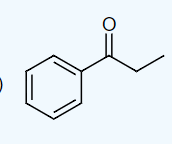
Design a synthetic route for the following product and explain the mechanism involved:
You can practice drawing the mechanism in the chemistry tool.
Step 3: Share
To share your work, click the “Add a new discussion topic” button under this post and paste your work into the “Message” box. Make sure to reference others’ intellectual property when necessary. All references should follow 7th Edition APA formatting. For further instructions, see the resource on the Himmelfarb Health Sciences Library: APA citation resource (N.B.: references are excluded from word counts). Note that you do not need to share your drawings done in the Chemistry tool, but you can discuss them if needed.
Step 4: Interact
To complete the activity, evaluate and categorize the work from one of your peers based on items A - E of the rubric below. Provide a rationale for your grade and comments or suggestions for improvement. To post a reply, click “Reply” on a particular discussion, write your feedback, then click “Post to forum.” You can use the list below as an example:Item A is .…. because…. My suggestions for improvement are….
Item B is .…. because…. My suggestions for improvement are….
Item C is .…. because…. My suggestions for improvement are….
Item D is .…. because…. My suggestions for improvement are….
Item E is .…. because…. My suggestions for improvement are….OPTIONAL Step 5: Interact (10 minutes)
If you would like to, you can reply to your peers' posts in a respectful and professional manner. Ensure that your post engages your peers' ideas by including a reflection on their comments, sharing ideas of other potential difficulties and parties involved, or asking thought-provoking questions. If a peer comments on your posting, please reply. To post a reply, click “Reply” on a particular discussion, write your feedback and then click on “Post to forum.”
-
Quiz: Module 9
To access the quiz, click on the name of the quiz provided above. On the following screen, click the attempt quiz button to respond to the questions.
TO PASS THIS QUIZ YOU MUST OBTAIN A SCORE OF 4/5
-

To take the final exam, you must complete all quizzes and complete all the required activities.
To access the exam, click on the name of the exam provided below. On the following screen, click the attempt quiz button to respond to the questions.
-
Final Exam Quiz
To take the final exam, you must complete all quizzes and complete all the required activities. The final exam consists of 40 questions, and you will have 40 minutes to complete it. When the time is over, you will have two minutes to submit your attempt before it expires, and your progress is discarded. You will not be able to answer additional questions in the grace period.
To access the exam, click on the name of the exam provided above. On the following screen, click the attempt quiz button to respond to the questions.
-
-
 In this section, you can provide feedback about this course to help us make NextGenU.org better. Once evaluations are completed, you will be able to download your certificate of completion.
-
Course Evaluation Questionnaire
-
Self Evaluation Questionnaire
-
-
-
Students mustMark as done
-
-