You do not have permission to view discussions in this forum.
-
Introduction
Show More Show LessThe course Humanism in Health and Healthcare provides foundational theoretical and practical knowledge and skills to help address the complex and multi-dimensional nature of health and illness. This course offers you the opportunity to plan practice humanistic techniques to assist patients during times of illness or stress and provides humanistic strategies to help you work collaboratively with patients to ensure positive outcomes and health behavior changes.
-
Students mustStudent must submit this questionnaire to complete it
-
Students mustViewReceive a grade
Show More-


The course Humanism in Health and Healthcare provides foundational theoretical and practical knowledge and skills to help address the complex and multi-dimensional nature of health and illness. This course offers you the opportunity to plan practice humanistic techniques to assist patients during times of illness or stress and provides humanistic strategies to help you work collaboratively with patients to ensure positive outcomes and health behavior changes.
This Humanism in Health and Healthcare course was developed in partnership with the Oakland University -- William Beaumont School of Medicine and The Arnold P. Gold Foundation. Like all NextGenU.org courses, it is competency-based, using competencies from the American Association of Colleges of Nursing, the Association of American Medical Colleges, and the National Board of Osteopathic Medical Examiners.
This course was redesigned in 2022 by Anthony Schlaff MD, MPH; Magali Collonnaz MD, MPH, MSc; Pablo Baldiviezo Rodriguez, MD, MSc, DiplEd; Reisha Narine, MSc; Sherian Bachan, MSc; Seema Persaud, MSc. The original course developers were Jason Adam Wasserman, Ph.D., and Stephen Loftus, Ph.D.; additional content creators are Ashley Inez Garzaniti, MSIV; Nathan Loudon, MSIV; Matthew Drogowski, MD; Dorothy Levine, MD; Lesley Miller, MD; and Hedy S. Wald, Ph.D.
There are 13 modules to complete, which include:
- Module 1. History of Medicine, Modernism, and the Emergence of the Biomedical Model
- Module 2. The Epidemiological Transition and the Humanistic (Re)turn
- Module 3. Medicalization and social control
- Module 4. The Biopsychosocial Model
- Module 5. The Birth of Bioethics and the Evolution of Humanism
- Module 6. The Science of Empathy
- Module 7. Building Empathy: Practices of the Senses
- Module 8.. Empathy in Practice: Narrative Medicine/Narrative Communication
- Module 9. Self Care: Caring for Self to Care for Others
- Module 10. Problems of Otherness and Dilemmas of Difference
- Module 11. Marginalization*
- Module 12. From Cultural Competency to Cultural Humility: Habits of Respectful Curiosity
- Module 13. The Future of Humanism in Health and Health Care
*For module 11, you are to choose at least five lessons to complete from those available, based on your interests as well as your educational and professional needs)
The completion time for this course is estimated to be 69 hours which includes 39 hours of didactics and curated resources and 30 hours of work participating in activities and quizzes to assist the student in the synthesis of the materials. This course is equivalent to 2 credit hours.
At the end of each module, there is a practice quiz with multiple-choice questions. At the end of the course, after you’ve completed each lesson, quiz, and learning activity, you’ll have access to a final exam with multiple-choice questions and a chance to evaluate this course. Once you’ve passed that last test, you will be able to download a certificate of completion from NextGenU.org. We keep all of your personal information confidential, never sell any of your information, and only use anonymized data for research purposes. We are also happy to report your testing information and share your work with anyone (your school, employer, etc.) at your request.
Engaging with this Course:
This free course is primarily intended for public health students, public health professionals, medical students, and clinicians who would like to learn more about prevention and health promotion, as well as the importance of working collaboratively with patients to ensure that their individual needs are met. Clinicians and non-clinicians can take the course as there are resources listed as suitable for both audiences.
To obtain a certificate, a learner must successfully complete:
- all the reading requirements,
- all required quizzes and pass with 70% having unlimited attempts,
- all discussion forums
- all peer activities
- all reflection activities
- a final examination
- the self and course evaluation forms.
NextGenU.org is happy to provide your institution with
- a link to and description of the course training, so they can see all its components, including the cosponsoring universities and other professional organization cosponsors;
- your grade on the final exam;
- your work products (e.g. case study activities), and any other required or optional shared materials that you produce and authorize to share with them;
- your evaluations -- course, and self-assessments;
- a copy of your certificate of completion.
To obtain a degree, NextGenU.org co-sponsors degree programs with institutional partners. To obtain a full degree co-sponsored with NextGenU.org, registrants must be enrolled in a degree program as a student of a NextGenU.org institutional partner. If you think that your institution might be interested in offering a degree with NextGenU.org, contact us.
We hope that you will find this a rewarding learning experience, and we count on your assessment and feedback to help us improve this training for future students.
Here are the next steps to take the course for credit:
- Complete the registration form.
- Take the pre-test.
- Begin the course with Module 1: Introduction to Global Mental Health. In each lesson, read the description, complete all required readings and any required activity, and take the corresponding quizzes.
This course meets nationally approved standards of education developed for the addiction/substance use disorders counseling profession. This course's participants are assured that the continuing education (CE) credits provided will be accepted toward national credentialing by the NAADAC Certification Commission for Addiction Professionals (NCC AP), as well as by many of the individual state licensing/certification bodies in the addiction and other helping professions.
*The previous version of this course is also available here for your reference but is not available for registration. Only students that were registered prior to November 25th, 2022 may complete it.
-
 Competencies covered in this module:
Knowledge for Practice (AAMC)
Demonstrate knowledge of established and evolving biomedical, clinical, epidemiological, and social-behavioral sciences, as well as the application of this knowledge to patient care (AAMC 2)
Apply principles of epidemiological sciences to the identification of health problems, risk factors, treatment strategies, resources, and disease prevention/health promotion efforts for patients and populations (AAMC 2.4)Systems-Based Practice (AAMC)
- Demonstrate an awareness of and responsiveness to the larger context and system of health care, as well as the ability to call effectively on other resources in the system to provide optimal health care. (AAMC 6)
- Advocate for quality patient care and optimal patient care systems (AAMC 6.4)
Professionalism (AACOM)
- Knowledge - Demonstrate knowledge of the behavioral and social sciences that provide the foundation for the professional competency, including medical ethics, social accountability and responsibility, and commitment to professional virtues and responsibilities. ( AACOM V.)
Systems-Based Practice
- Demonstrate an understanding of how patient care and professional practices affect other healthcare professionals, healthcare organizations, and society. (AACOM VII.)
- Demonstrate an understanding of how current issues in the world are affecting health care delivery to patients and the community.
(AACN)
- Demonstrate an appreciation of the history of and contemporary issues in nursing and their impact on current nursing practice. ( AACN VIII.5)
- Synthesize theories and concepts from liberal education to build an understanding of the human experience.
-
Students mustView
Read the content under the headings "Introduction: origin narratives of the medical humanities", "The studia humanitatis and the crisis of American medicine", and "Conclusion: innovation through tradition". (49 minutes)
J Med Humanit - 2016
-
Students mustView
Read the content under the headings Introduction, Discussion, and Conclusion. (9 minutes)
Perspectives on Medical Education - 2018
-
 Competencies covered in this module:
Knowledge for Practice (AAMC)
Demonstrate knowledge of established and evolving biomedical, clinical, epidemiological, and social-behavioral sciences, as well as the application of this knowledge to patient care.
Apply principles of epidemiological sciences to the identification of health problems, risk factors, treatment strategies, resources, and disease prevention/health promotion efforts for patients and populations ( AAMC 2.4 )Practice-Based Learning and Improvement (AACOM.)
- Describe and apply systematic methods to improve population health. (AACOM VI.)
- Identify the determinants of populations’ health.
- Identify sources of disparities in populations’ health and access to care.
Public Health Systems Competencies(AACOM.)
- Assesses and addresses the determinants of health and illness factors contributing to health promotion and disease prevention (AACOM XII.)
(AACN)
- Demonstrate an appreciation of the history of and contemporary issues in nursing and their impact on current nursing practice. (AACN VIII.5)
- Synthesize theories and concepts from liberal education to build an understanding of the human experience.
-
Students mustView
Read the entire article. (8 minutes)
IS Global: Barcelona Insitute for Public Health - 2017
-
Students mustView
Read the following sections: Introduction, Development of models with stages of transition, and Divergence from the western transition model. (18 minutes)
Epidemiology and Infection - 2018
-
Students mustViewStart discussions: 1
General Instructions
In this learning activity you will select one of the identified outbreaks and discuss how shifts in the epidemiological profile of disease have caused shifts in the structure and function of the healthcare system.
Step 1: Select and Reflect
Select one of the public health emergencies below and reflect on how the diseases’ epidemiological profiles have caused shifts in the structure and function of health care systems.
- COVID-19
- Ebola
- Monkey Pox
Step 2: Respond
Using supporting data, to back your arguments, prepare a 400-500 words written piece which discusses the epidemiological transition of the selected disease and how it caused shifts in the healthcare system. Ensure that your response includes the following:
- Resources, that is, distribution of human and physical resources; ability to increase capacity to cope with a sudden surge in demand; and motivated and well-supported workforce.
- Service delivery, that is, alternative and flexible approaches to delivering care.
- The role of humanism in health care (i.e., how it may improve patient care and personal satisfaction, especially during challenging times).
Step 3: Share
To share your work, click on the “Add a new discussion topic” button under this post and paste your work into the “Message” box. Make sure to reference others’ intellectual property when necessary. All references should follow 7th Edition APA formatting. For further instructions, see the resource on the Himmelfarb Health Sciences Library: APA citation resource (N.B.: references are excluded from word counts).
Step 4: Interact
To complete the activity, you will need to reply to at least two posts made by your peers in a respectful and professional manner. Be sure that your post engages your peers' ideas by including a reflection on their comments, sharing ideas on other potential difficulties and parties involved, or asking thought-provoking questions. If a peer comments on your posting, please reply. To post a reply, click “Reply” on a particular discussion, write your feedback and then click on “Post to forum.”
OPTIONAL Step 5: Interact (10 minutes)
If you would like to, you can reply to your peers' posts in a respectful and professional manner. Ensure that your post engages your peers' ideas by including a reflection on their comments, sharing ideas of other potential difficulties and parties involved, or asking thought-provoking questions. If a peer comments on your posting, please reply. To post a reply, click “Reply” on a particular discussion, write your feedback and then click on “Post to forum.”
-
Students mustView
Read the content under the following sections: Introduction, Humanism in Medical Education and Practice, and Discussion. (14 minutes)
Frontiers - 2021
-
Students mustViewReceive a gradeReceive a passing grade
To access the quiz, click on the name of the quiz provided above. On the following screen, click the attempt quiz button to respond to the questions.
-
Please read the entire article. (34 minutes)
Journal of Healthcare, Science, and the Humanities - 2012
-
 Competencies covered in this module:
Knowledge for Practice (AAMC)
Demonstrate knowledge of established and evolving biomedical, clinical, epidemiological, and social-behavioural sciences, as well as the application of this knowledge to patient care. (AAMC 2)
Apply principles of social-behavioural sciences to provision of patient care, including assessment of the impact of psycho-social and cultural influences on health, disease, care seeking, care compliance, and barriers to and attitudes toward care. (AAMC 2.5)Professionalism (AAMC)
- Demonstrate a commitment to carrying out professional responsibilities and an adherence to ethical principles. (AAMC 5)
- Demonstrate a commitment to ethical principles pertaining to provision or withholding of care, confidentiality, informed consent, and business practices, including compliance with relevant laws, policies, and regulations. (AAMC 5.6)
Professionalism: Ethics
- Demonstrate knowledge of and the ability to apply ethical principles in the practice and research of osteopathic medicine, particularly in the areas of provision or withholding of clinical care, confidentiality of patient information, informed consent, business practices, the conduct of research, and the reporting of research results. (AACOM V. 6)
(AACN)
- Engage in ethical reasoning and actions to provide leadership in promoting advocacy, collaboration, and social justice as a socially responsible citizen. (AACN I. 6)
-
Students mustView
Read the content under the following sections: Background, Results, and Discussion. (23 minutes)
International Journal of Health Policy and Management - 2020
-
Read the entire article. (20 minutes)
Journal of General and Family Medicine - 2017
-
Students mustView
Read the content under the headings, from "Introduction" to "The Dual Relationship Between Overdiagnosis and Medicalisation." (17 minutes)
Published by Kerman University of Medical Sciences in the International Journal of Health Policy and Management - 2016
-
Read the content under the following sections: Abstract, Introduction, Various effects of medicalization and over‑medicalization, and Over‑medicalization: a pragmatic approach. (10 minutes)
Medicine, Health Care and Philosophy - 2018
-
 Competencies covered in this module:
Knowledge for Practice (AAMC)
Demonstrate knowledge of established and evolving biomedical, clinical, epidemiological, and social-behavioral sciences, as well as the application of this knowledge to patient care. (AAMC 2)
Apply principles of epidemiological sciences to the identification of health problems, risk factors, treatment strategies, resources, and disease prevention/health promotion efforts for patients and populations. (AAMC 2.4)Medical Knowledge (AACOM)
- Articulate basic biomedical science and epidemiological and clinical science principles related to patient presentation. (AACOM II. 1)
- Demonstrate an appreciation of the history of and contemporary issues in nursing and their impact on current nursing practice. (AACN VIII. 5)
-
Students mustView
Read the entire article from "Abstract" to "A Question of Method and Discipline: The Future of the Biopsychosocial Model through the Lens of Adolescence Medicine." (24 minutes)
National Center for Biotechnology Information (NCBI) - 2017
-
Students mustViewReceive a gradeReceive a passing grade
To access the quiz, click on the name of the quiz provided above. On the following screen, click the attempt quiz button to respond to the questions.
-
Read the content under the headings from "1. Engel’s biopsychosocial model" until " Updating the science and philosophy of the BPSM." (27 minutes)
Archives de Philosophie Volume 83 Issue 4 - 2020
-
 Competencies covered in this module:
Professionalism (AAMC)
Demonstrate a commitment to carrying out professional responsibilities and an adherence to ethical principles. (AAMC 5)
Demonstrate respect for patient privacy and autonomy. (AAMC 5.3)
Demonstrate a commitment to ethical principles pertaining to provision or withholding of care, confidentiality, informed consent, and business practices, including compliance with relevant laws, policies, and regulations. (AAMC 5.6)Professionalism: Knowledge (AACOM)
- Demonstrate knowledge of the behavioral and social sciences that provide the foundation for the professionalism competency, including medical ethics, social accountability and responsibility, and commitment to professional virtues and responsibilities. (AACOM V. 1)
- Demonstrate social accountability and responsibility (i.e. the welfare of the patient or society should supersede the physician’s self-interest). (AACOM V. 1c)
Professionalism: Ethics (AACOM)
- Demonstrate knowledge of and the ability to apply ethical principles in the practice and research of osteopathic medicine, particularly in the areas of provision or withholding of clinical care, confidentiality of patient information, informed consent, business practices, the conduct of research, and the reporting of research results. (AACOM V. 6)
- Apply the ethical principles of autonomy, beneficence, non-malfeasance, fidelity, justice, and utility. (AACOM V. 6f)
(AACN)
- Engage in ethical reasoning and actions to provide leadership in promoting advocacy, collaboration, and social justice as a socially responsible citizen. (AACN I. 6)
-
Students mustView
Read the entire webpage. (27 minutes)
National Center for Biotechnology Information (NCBI) - 2018
-
Students mustView
Read the content under the headings "Abstract", "Introduction","Results" "Discussion", and "Conclusion." (37 minutes)
National Center for Biotechnology Information (NCBI) - 2018
-
 Competencies covered in this module:
Patient Care (AAMC)
Provide patient-centered care that is compassionate, appropriate, and effective for the treatment of health problems and the promotion of health.
Counsel and educate patients and their families to empower them to participate in their care and enable shared decision-making.Knowledge for Practice (AAMC)
- Demonstrate knowledge of established and evolving biomedical, clinical, epidemiological, and social-behavioral sciences, as well as the application of this knowledge to patient care.
- Apply principles of social-behavioral sciences to the provision of patient care, including assessment of the impact of psychosocial and cultural influences on health, disease, care seeking, care compliance, and barriers to and attitudes toward care.
Interpersonal and Communication Skills (AAMC)
- Demonstrate interpersonal and communication skills that result in the effective exchange of information and collaboration with patients, their families, and health professionals.
- Demonstrate insight and understanding about emotions and human responses to emotions that allow one to develop and manage interpersonal interactions.
Osteopathic Principles and Practices (AACOM)
- Approach the patient with recognition of the entire clinical context, including mind-body and psychosocial interrelationships.
- Recognize and treat each patient as a whole person, integrating body, mind, and spirit.
- Demonstrate caring, compassionate, and empathetic behavior during the application of OMT in the clinical setting.
- Diagnose clinical conditions and plan patient care.
- Consider the patient’s perspective and values in diagnostic decision-making.
Patient Care (AACOM)
- Form a patient-centered, interprofessional, evidence-based management plan.
- Elicit the patient’s perspective on the current situation and modify the diagnostic and treatment plan as appropriate in response to the patient’s needs and preference.
- Recognize and respond appropriately to the ethical dimensions of clinical decision-making.
Interpersonal and Communication Skills (AACOM)
- Establish and maintain the physician-patient relationship.
- Explore the psychosocial, occupational, and biomechanical environment in which the patient lives and/or in which health care is administered.
- Conduct a patient-centered interview that includes the following.
- Communicate in a manner that demonstrates sensitivity to gender as well as to racial and cultural diversity.
Professionalism: Humanistic Behavior (AACOM)
- Demonstrate humanistic behavior, including respect, compassion, probity, honesty, and trustworthiness.
- Provide polite, considerate, and compassionate treatment to every patient.
(AACN)
- I.1: Integrate theories and concepts from liberal education into nursing practice.
- I.2: Synthesize theories and concepts from liberal education to build an understanding of the human experience.
- VIII.3: Promote the image of nursing by modeling the values and articulating the nursing profession's knowledge, skills, and attitudes.
-
Students mustMark as done
Read the entire article. (24 minutes)
Journal of the Royal Society of Medicine - 2020
-
Students mustView
Read the entire article. (14 minutes)
Journal of Patient Experience - 2017
-
Students mustViewStart discussions: 1
General Instructions
In this learning activity, you will read and analyze the case scenario below and answer questions as it relates to empathy and sympathy in the medical setting.
Case Scenario
You are a doctor in a small town. You have been seeing patients all day; it is now your last appointment for the day. A 34-year-old woman presents to her primary care physician with fatigue and flu-like symptoms for the past two weeks. She reports that her temperature has been elevated to 37°C and has reduced energy levels and a poor appetite. She has also developed a rash on her chest and her body feels especially achy. She is generally feeling quite unwell. After completing a physical examination and ordering some blood tests, the doctor sits down with the patient to explain the results.
The tests indicate that the patient has a rare and aggressive form of cancer that has already spread throughout her body. There is no cure and the prognosis is poor, with most patients only surviving for a few months after diagnosis. As the doctor, you must remain professional and stoic, but you cannot help but feel empathy for the patient and their situation. You sit down with the patient and their family and can see the pain in their eyes. You can feel their grief, and you know that they are struggling. You take a deep breath and try to be as present as possible. You explain the situation to the patient and her family and provide them with information about treatment options and end-of-life care. You listen to their stories, and you offer them your condolences. You try to be as understanding and compassionate as possible.
Step 1: Reflect
Read and reflect on the case scenario below as it relates to sympathy and empathy in a medical setting.
Step 2: Respond
Based on the case scenario above, prepare a 300-400 words written response that answers the following key questions:
- What is empathy and how was it portrayed in the scenario above?
- What is sympathy and how was it portrayed in the scenario above?
- How is empathy critical to medical practice, and why is it particularly important after the epidemiological transition?
- How do you maintain professionalism and appropriate expression of empathy when breaking bad news?
Step 3: Share
To share your work, click on the “Add a new discussion topic” button under this post and paste your work into the “Message” box. Make sure to reference others’ intellectual property when necessary. All references should follow 7th Edition APA formatting. For further instructions, see the resource on the Himmelfarb Health Sciences Library: APA citation resource (N.B.: references are excluded from word counts).
Step 4: Interact
To complete the activity, you will need to reply to at least two posts made by your peers in a respectful and professional manner. Be sure that your post engages your peers' ideas by including a reflection on their comments, sharing ideas on other potential difficulties and parties involved, or asking thought-provoking questions. If a peer comments on your posting, please reply. To post a reply, click “Reply” on a particular discussion, write your feedback and then click on “Post to forum.”
OPTIONAL Step 5: Interact (10 minutes)
If you would like to, you can reply to your peers' posts in a respectful and professional manner. Ensure that your post engages your peers' ideas by including a reflection on their comments, sharing ideas of other potential difficulties and parties involved, or asking thought-provoking questions. If a peer comments on your posting, please reply. To post a reply, click “Reply” on a particular discussion, write your feedback and then click on “Post to forum.”
-
Students mustView
Read the entire article. (22 minutes)
Healthcare Journal - 2020
-
Students mustViewReceive a gradeReceive a passing grade
To access the quiz, click on the name of the quiz provided above. On the following screen, click the attempt quiz button to respond to the questions.
-
 Competencies covered in this module:
Knowledge for Practice (AAMC)
Demonstrate knowledge of established and evolving biomedical, clinical, epidemiological, and social-behavioral sciences, as well as the application of this knowledge to patient care.
Apply principles of social-behavioral sciences to the provision of patient care, including assessment of the impact of psychosocial and cultural influences on health, disease, care seeking, care compliance, and barriers to and attitudes toward care.Interpersonal and Communication Skills (AAMC)
- Demonstrate interpersonal and communication skills that result in the effective exchange of information and collaboration with patients, their families, and health professionals.
- Demonstrate sensitivity, honesty, and compassion in difficult conversations, including those about death, end of life, adverse events, bad news, disclosure of errors, and other sensitive topics.
Professionalism (AAMC)
- Demonstrate a commitment to carrying out professional responsibilities and an adherence to ethical principles.
- Demonstrate compassion, integrity, and respect for others.
Personal and Professional Development (AAMC)
- Demonstrate the qualities required to sustain lifelong personal and professional growth.
- 8.1 Develop the ability to use self-awareness of knowledge, skills, and emotional limitations to engage in appropriate help-seeking behaviors.
- 8.2 Demonstrate healthy coping mechanisms to respond to stress.
- 8.3 Manage conflict between personal and professional responsibilities.
- 8.8 Recognize that ambiguity is part of clinical health care and respond by utilizing appropriate resources in dealing with uncertainty.
Osteopathic Principles and Practices (AACOM)
- Approach the patient with recognition of the entire clinical context, including mind-body and psychosocial interrelationships.
- Recognize and treat each patient as a whole person, integrating body, mind, and spirit.
Professionalism - Knowledge (AACOM)
- Demonstrate knowledge of the behavioral and social sciences that provide the foundation for the professionalism competency, including medical ethics, social accountability and responsibility, and commitment to professional virtues and responsibilities.
- a. Explain why a physician must demonstrate honesty, integrity, and respect for the patient in every interaction.
- b. Recognize personal values, attitudes, and biases as they influence patient care.
- c. Demonstrate social accountability and responsibility (i.e., the welfare of the patient or society should supersede the physician’s self-interest).
- d. Assess the context of a patient’s social and economic situation, capacity for self-care, and ability to participate in shared decision-making.
Professionalism- Humanistic Behavior- (AACOM)
- Demonstrate humanistic behavior, including respect, compassion, probity, honesty, and trustworthiness.
- Provide polite, considerate, and compassionate treatment to every patient.
Professional and Personal Self-Care (AACOM)
- Demonstrate understanding that he/she is a representative of the osteopathic profession and is capable of making valuable contributions as a member of this society; lead by example; provide for personal care and well-being by utilizing principles of wellness and disease prevention in the conduct of professional and personal life.
- Ensure that his/her mental, physical, or health condition does not have a negative impact on patient care or welfare.
- Identify personal sources of stress and apply appropriate interventions.
(AACN)
- Required I: Liberal Education for Baccalaureate Generalist Nursing Practice
- Integrate theories and concepts from liberal education into nursing practice.
- Synthesize theories and concepts from liberal education to build an understanding of the human experience.
- Demonstrate tolerance for the ambiguity and unpredictability of the world and its effect on the healthcare system.
-
Students mustView
Read the entire article. (28 minutes)
Academic Medicine - 2015
-
Students mustViewStart discussions: 1General Instructions:
In this learning activity, you will select a story or illness from Health Story Collaborative.
Step 1: Select & Reflect
Select a story of illness from the Health Story Collaborative and apply the three exercises described in the previous reading by Blackie and Wear.
You are required to deeply reflect on the selected story by doing the following:- Read deeply
- Engage in moral inquiry
- Draw out their illustrations, particularly of illness and the experiences of healthcare that are represented
Based on your selection above, prepare a 400-500 words written piece reflecting on the following key points:- Describe how the story you read closely has impacted your assumptions about the illness experience.
- Describe any empathic connections with the author that you sensed in yourself while reading it.
- How do you imagine this type of close reading activity might shape your interactions with your current or future patients?
- How does the selected story help you understand or appreciate the diversity and complexities of human conditions?
To submit your work, click on the “Add a new discussion topic” button under this post and paste your work into the “Message” box. Make sure to reference others’ intellectual property when necessary. All references should follow 7th Edition APA formatting. For further instructions, see the resource on the Himmelfarb Health Sciences Library: APA citation resource (N.B.: references are excluded from word counts).OPTIONAL Step 4: Interact (10 minutes)
If you would like to, you can reply to your peers' posts in a respectful and professional manner. Ensure that your post engages your peers' ideas by including a reflection on their comments, sharing ideas of other potential difficulties and parties involved, or asking thought-provoking questions. If a peer comments on your posting, please reply. To post a reply, click “Reply” on a particular discussion, write your feedback and then click on “Post to forum.”
-
Students mustView
Read the entire article. (17 minutes)
American Scientist - 2020
-
Students mustViewStart discussions: 1
Health care workers learn to probe the intimate depths of an individual often through a dispassionate, scientific lens and language: measuring and interpreting blood serum chemistries, taking a history of illicit drug use, episodes of heart disease within the family. These questions are important for understanding the biomedical aspects of disease, but humanistic healthcare requires understanding the social, psychological, affective, and existential aspects of illness as well. Art can help us expand the boundaries of our exploration beyond the body further, to the individual beyond the pathology. The artist Hrair Sarkissian describes their piece ’Last Scene’ (2016) as “a series of 47 photographs of places in The Netherlands that were chosen by terminally ill patients to go and see as their last wish. The project centers on the power of a well-loved place to compress an outlook on life into a telling scene that is at once melancholic and joyful. The simplicity of each landscape or scene heightens attention to an inner journey of remembering the past and envisioning a future that no longer includes you. In contemporary culture the notion of death and dying is often consciously ignored. This project gives the viewer a way in to grapple with the question of where we come from, and where we are going. The images turn into mirrors: on the one hand you try to imagine the person who looked at the scene for the last time, while at the same time it encourages introspection: “what would my wish be?” These scenes were photographed at the date and time of the actual last visit.”
Please view at least 5 of these photographs. Spend time staring at them, and even when you think you've taken in everything one has to offer you, look a while longer and see if additional thoughts or insights emerge. Reflect on these images.
In 200-300 words answer the following questions about each photograph:
- What sort of image (physical, emotional, spiritual, mental, etc) of each patient associated with each photograph comes to your mind?
- How might those insights help you provide more humanistic care to those patients?
-
Read the content under the heading "Visual Arts". (11 minutes)
National Center for Biotechnology Information (NCBI) - 2010
-
Students mustView
Read the entire web page and watch the Youtube video titled "Capturing Our Resilience in Poetry". (12 minutes)
International Arts + Mind Lab (IAM Lab) - 2022
-
Students mustView
Read the content under the headings from "Section One: The Expanding Awareness of Music in Healthcare," "Section Three: The Potential and Path to the Future of Music in Healthcare," and "Recommendations and Conclusions". (6 minutes)
Unversity of St. Augustine for Health Sciences - 2022
-
Students mustViewStart discussions: 1
General Instructions:
In this learning activity, you will reflect on the poem identified below and answer questions as it relates to your interpretation and experiences in the field of medicine.
Step 1: Read and Reflect
Read the poem Kindness by Naomi Shihab Nye and reflect on the excerpt below regarding poetry as a means of self-expression and a brief background on the poem.
Reading and writing poetry is as much a tool for self-expression as a tool for self-exploration. While reading the works provided below, connect with the memories, associations, and emotions that the poems bring forward for you personally.
As you read, think about how your own relationship with loss/death/suffering changed because of your experiences in healthcare (either as a patient, a student, or a practitioner). Do you feel your capacity for empathy has deepened or dulled? How do these experiences impact the way you view yourself and your patients?
Naomi Shihab Nye wrote this poem shortly after a horrific experience during her honeymoon. She and her husband planned to spend a few weeks in South America but shortly after arriving the entire bus they were traveling with was robbed. One man on the bus was killed during the incident. Later, a local man approached them, sensing their distress, and asked what happened. He listened and was kind. While her husband hitchhiked to a nearby town, with night approaching quickly, penniless, without a passport, sitting alone in an empting small town plaza Naomi Shihab Nye wrote this poem. Here kindness is connected with experiences of sorrow and as one deepens, often so does the other. This connection is later reiterated as kindness being both a friend, and a shadow. It is not sorrow alone that deepens our appreciation of kindness but rather we must “speak to it until your voice catches the thread of all sorrows and you see the size of the cloth;” it is when we allow our sorrow to connect us to the universal experience of suffering, with others, and with what we love. How does the sorrow you experience connect you with others and what does it bring you to more deeply appreciate?
Step 2: Respond
Once you have meticulously reflected on the poem, prepare a 200-300 words written piece which addresses the following key questions:
- How does the sorrow you experience connect you with others and what does it bring you to more deeply appreciate?
- How might the experience of sorrow help you connect with your current/future patients?
To submit your work, click on the “Add a new discussion topic” button under this post and paste your work in the “Message” box. Make sure to reference others’ intellectual property when necessary. All references should follow 7th Edition APA formatting. For further instructions, see the resource on the Himmelfarb Health Sciences Library: APA citation resource (N.B.: references are excluded from word counts).
OPTIONAL Step 4: Interact (10 minutes)
If you would like to, you can reply to your peers' posts in a respectful and professional manner. Ensure that your post engages your peers' ideas by including a reflection on their comments, sharing ideas of other potential difficulties and parties involved, or asking thought-provoking questions. If a peer comments on your posting, please reply. To post a reply, click “Reply” on a particular discussion, write your feedback and then click on “Post to forum.”
-
Students mustViewStart discussions: 1Post replies: 1Make forum posts: 2General Instructions:
In this learning activity, you will reflect on the poem identified below and answer questions as it relates to your interpretation and experiences in the field of medicine.
Step 1: Read and Reflect
Read the poem "The Journey" by Mary Oliver and reflect on the excerpt below regarding poetry as a means of self-expression and a brief background on the poem.
Mary Oliver’s poem focuses on the journey we take to become an individual. Realizing what we know we need to do to thrive and accepting responsibility for the path we take is the first step that propels us toward growth. Initially, the traveler is met with voices that try to sway them from the path they know they must take. These voices may be society’s expectations, family expectations, obligations we feel toward others that come at the cost of our wellbeing. She writes “You knew what you had to do… through their melancholy was terrible” which emphasizes how our sympathy can sometimes lead us to betray ourselves. It is a confusing and uncomfortable journey. The house is a metaphor for the self; when we venture on this journey the very foundation of how we understand our self is shaken. The road is “full of branches and stones” but “little by little” our own voice becomes clearer. The further along on our journey we go, the easier it becomes to know our true self and go where our individual conscious, our own internal voice, leads us.
As you read the poem, reflect on whether unrealistic expectations from patients or their family members have undermined the confidence you have in your capacity to carry out your duties as a practitioner. If you have ever cared for a patient that could not be “saved,” did you blame yourself or feel it was a reflection of your capacity? If you have not yet had this experience, think about how you might feel.
Step 2: Respond
Once you have meticulously reflected on the poem, prepare a 200-300 words written piece which addresses the following key question:
As a health care practitioner, what bad advice/voices/pleas/expectations do you think you must ignore in order to thrive in your profession?
Step 3: Submit
To submit your work, click on the “Add a new discussion topic” button under this post and paste your work in the “Message” box. Make sure to reference others’ intellectual property when necessary. All references should follow 7th Edition APA formatting. For further instructions, see the resource on the Himmelfarb Health Sciences Library: APA citation resource (N.B. references are excluded from word counts).
OPTIONAL Step 4: Interact (10 minutes)
If you would like to, you can reply to your peers' posts in a respectful and professional manner. Ensure that your post engages your peers' ideas by including a reflection on their comments, sharing ideas of other potential difficulties and parties involved, or asking thought-provoking questions. If a peer comments on your posting, please reply. To post a reply, click “Reply” on a particular discussion, write your feedback and then click on “Post to forum.”
-
Students mustView
Read the content under the headings from "Section One: The Expanding Awareness of Music in Healthcare," "Section Three: The Potential and Path to the Future of Music in Healthcare," and "Recommendations and Conclusions". (36 minutes)
Multidisciplinary Digital Publishing Institute (MDPI)- Healthcare Journal - 2021
-
Read the content under the following sections: Abstract, Introduction, and Various Use Cases of Music Technology in Health Settings. (96 minutes)
SAGE journals - 2021
-
 Competencies covered in this module:
Patient Care (AAMC:)
Provide patient-centered care that is compassionate, appropriate, and effective for the treatment of health problems and the promotion of health.
Counsel and educate patients and their families to empower them to participate in their care and enable shared decision-making.Knowledge for Practice (AAMC)
- Demonstrate knowledge of established and evolving biomedical, clinical, epidemiological and social-behavioral sciences, as well as the application of this knowledge to patient care.
- Apply principles of social-behavioral sciences to provision of patient care, including assessment of the impact of psychosocial and cultural influences on health, disease, care seeking, care compliance, and barriers to and attitudes toward care.
Interpersonal and Communication Skills (AAMC)
- Demonstrate interpersonal and communication skills that result in the effective exchange of information and collaboration with patients, their families, and health professionals.
- 4.1 Communicate effectively with patients, families, and the public, as appropriate, across a broad range of socioeconomic and cultural backgrounds.
- 4.6 Demonstrate sensitivity, honesty, and compassion in difficult conversations, including those about death, end of life, adverse events, bad news, disclosure of errors, and other sensitive topics.
- 4.7 Demonstrate insight and understanding about emotions and human responses to emotions that allow one to develop and manage interpersonal interactions.
Osteopathic Principles and Practices (AACOM)
- Approach the patient with recognition of the entire clinical context, including mind-body and psychosocial interrelationships.
- Recognize and treat each patient as a whole person, integrating body, mind, and spirit.
- Demonstrate caring, compassionate, and empathetic behavior during the application of OMT in the clinical setting.
- Diagnose clinical conditions and plan patient care.
- Consider the patient’s perspective and values in diagnostic decision-making.
Patient Care (AACOM)
- Form a patient-centered, interprofessional, evidence-based management plan.
- Elicit the patient’s perspective on the current situation and modify the diagnostic and treatment plan as appropriate in response to the patient’s needs and preference.
- Recognize and respond appropriately to the ethical dimensions of clinical decision-making.
Interpersonal and Communication Skills (AACOM)
- Establish and maintain the physician-patient relationship.
- Explore the psychosocial, occupational, and biomechanical environment in which the patient lives and/or in which health care is administered.
- Conduct a patient-centered interview that includes the following.
- Communicate in a manner that demonstrates sensitivity to gender as well as to racial and cultural diversity.
Professionalism (AACOM)
- Humanistic Behavior - Demonstrate humanistic behavior, including respect, compassion, probity, honesty, and trustworthiness.
- Provide polite, considerate, and compassionate treatment to every patient.
(AACN)
- I.1: Integrate theories and concepts from liberal education into nursing practice.
- I.2: Synthesize theories and concepts from liberal education to build an understanding of the human experience.
- VI.3: Incorporate effective communication techniques, including negotiation and conflict resolution, to produce positive professional working relationships.
-
Students mustView
Read the entire article. (13 minutes)
2017
-
Students mustView
Read the entire article (Content in English only). (17 minutes)
Canadian Family Physician - 2018
-
Students mustViewReceive a gradeReceive a passing grade
To access the quiz, click on the name of the quiz provided above. On the following screen, click the attempt quiz button to respond to the questions.
-
Read the entire article. (57 minutes)
Medicine, Health Care and Philosophy - 2021
-
 Competencies covered in this module:
Knowledge for Practice (AAMC)
Demonstrate knowledge of established and evolving biomedical, clinical, epidemiological, and social-behavioral sciences, as well as the application of this knowledge to patient care. (AAMC 2)
Apply principles of social-behavioral sciences to the provision of patient care, including assessment of the impact of psychosocial and cultural influences on health, disease, care seeking, care compliance, and barriers to and attitudes toward care. (AAMC 2.5)Personal and Professional Development (AAMC)
- Demonstrate the qualities required to sustain lifelong personal and professional growth. (AAMC 8)
- Develop the ability to use self-awareness of knowledge, skills, and emotional limitations to engage in appropriate help-seeking behaviors. (AAMC 8.1)
- Demonstrate healthy coping mechanisms to respond to stress. (AAMC 8.2)
Professionalism: Professional and Personal Self-Care (AACOM)
- Ensure that his/her mental, physical, or health condition does not have a negative impact on patient care or welfare. (AACOM V. 8b)
- Identify personal sources of stress, and apply appropriate interventions. (AACOM V. 8f)
(AACN)
- Recognize the relationship between personal health, self-renewal, and the ability to deliver sustained quality care. (AACN 14)
-
Students mustView
Read the entire article. (29 minutes)
Dove Press journal: Local and Regional Anesthesia - 2020
-
Read the entire article. (20 minutes)
Cureus - 2018
-
Students mustView
Read the entire article - 13 minutes
The Joint Commission - 2019
-
Students mustView
Read the entire article - 20 minutes
Behavioural Sciences Journal - 2018
-
Read the entire article. (29 minutes)
BMC Health Serv - 2021
-
Students mustView
Read the entire article. (10 minutes)
Springer - 2018
-
Students mustView
Read the content under the headings " Background and Purpose", "Discussion", "Implications,". (14 minutes)
SAGE Journals- Canadian Journal of Nursing Research - 2021
-
Read the entire article. (16 minutes)
Australian Medical Journal - 2016
-

Competencies covered in this module:
Knowledge for Practice (AAMC)
Demonstrate knowledge of established and evolving biomedical, clinical, epidemiological, and social-behavioral sciences, as well as the application of this knowledge to patient care.
Apply principles of social-behavioral sciences to the provision of patient care, including assessment of the impact of psychosocial and cultural influences on health, disease, care seeking, care compliance, and barriers to and attitudes toward care.Interpersonal and Communication Skills (AAMC)
- Demonstrate interpersonal and communication skills that result in the effective exchange of information and collaboration with patients, their families, and health professionals.
- Communicate effectively with patients, families, and the public, as appropriate, across a broad range of socioeconomic and cultural backgrounds.
Interprofessional Collaboration (AAMC)
- Demonstrate the ability to engage in an interprofessional team in a manner that optimizes safe, effective patient- and population-centered care.
- Work with other health professionals to establish and maintain a climate of mutual respect, dignity, diversity, ethical integrity, and trust.
Patient Care (AACOM)
- Gather accurate data related to the patient encounter.
- Apply appropriate knowledge to the medical interview and demonstrate the ability to identify and/or address psychosocial, cultural, religious, health maintenance, and risk factor issues.
- Health promotion and disease prevention (HPDP).
- Demonstrate cultural awareness and sensitivity when communicating with the patient, family, and caregivers.
Professionalism (AACOM)
- Accountability -Demonstrate accountability to patients, society, and the profession, including the duty to act in response to the knowledge of professional behavior of others.
- Demonstrate commitment to underserved, vulnerable, disadvantaged, disenfranchised, and special populations.
- Cultural Competency - Demonstrate awareness of and proper attention to issues of culture, religion, age, gender, sexual orientation, and mental and physical disabilities.
- Treat all patients, colleagues, and others fairly, ensuring that no group is favored at any other expense.
- Openly discuss cultural issues, and be responsive to cultural cues.
- Demonstrate how to cope with differences in people in a constructive way.
Practice-Based Learning and Improvement (AACOM)
- Describe and apply systematic methods to improve population health.
- a.Identify the determinants of populations’ health.
- b. Identify sources of disparities in populations’ health and access to care.
- c.Identify vulnerable or marginalized populations within those served, and respond appropriately.
Required VII: Clinical Prevention and Population Health (AACN)
- Assess health/illness beliefs, values, attitudes, and practices of individuals, families, groups, communities, and populations.
- Advocate for social justice, including a commitment to the health of vulnerable populations and the elimination of health disparities.
Required VIII: Professionalism and Professional Values (AACN)
- Reflect on one’s own beliefs and values as they relate to professional practice.
- Communicate to the healthcare team one’s personal bias on difficult healthcare decisions that impact one’s ability to provide care.
-
Students mustView
Read the entire webpage. (8 minutes)
The Bioethics Centre - 2017
-
Students mustView
Read the content from "Inclusionary concepts" until "Alternatives to othering". (26 minutes)
College of Nursing - 2017
-
Students mustViewReceive a gradeReceive a passing grade
To access the quiz, click on the name of the quiz provided above. On the following screen, click the attempt quiz button to respond to the questions.
-
 Competencies covered in this module:
Knowledge for Practice (AAMC)
-
Demonstrate knowledge of established and evolving biomedical, clinical, epidemiological, and social-behavioral sciences, as well as the application of this knowledge to patient care. (AAMC 2)
-
Apply principles of epidemiological sciences to the identification of health problems, risk factors, treatment strategies, resources, and disease prevention/health promotion efforts for patients and populations. (AAMC 2.4)
-
Apply principles of social-behavioral sciences to provision of patient care, including assessment of the impact of psychosocial and cultural influences on health, disease, care seeking, care compliance, and barriers to and attitudes toward care. (AAMC 2.5)
Professionalism (AAMC)
-
Demonstrate a commitment to carrying out professional responsibilities and an adherence to ethical principles. (AAMC 5)
-
Demonstrate accountability to patients, society, and the profession. (AAMC 5.4)
-
Demonstrate sensitivity and responsiveness to a diverse patient population, including but not limited to diversity in gender, age, culture, race, religion, disabilities, and sexual orientation. (AAMC 5.5)
Patient Care (AACOM)
-
Demonstrate cultural awareness and sensitivity when communicating with the patient, family, and caregivers. (AACOM III. 5g)
Professionalism: Cultural Competency (AACOM)
-
Demonstrate awareness of and proper attention to issues of culture, religion, age, gender, sexual orientation, and mental and physical disabilities. (AACOM V. 7)
-
Demonstrate how to cope with differences in people in a constructive way. (AACOM V. 7d)
Practice-Based Learning and Improvement (AACOM)
-
Describe and apply systematic methods to improve population health. (AACOM VI. 5)
-
Identify the determinants of populations’ health. (AACOM VI. 5a)
-
Identify sources of disparities in populations’ health and access to care. (AACOM VI. 5b)
-
Identify vulnerable or marginalized populations within those served, and respond appropriately. (AACOM VI. 5c)
Cultural Competencies (AACOM)
-
Demonstrate an understanding of the scope of culture and the elements that form and define it. (AACOM IX. 1)
-
Recognize personal and professional tendencies toward bias and stereotyping and work to counter them. (AACOM IX. 2)
-
Understand the public health implications of cultural competence in health care. (AACOM IX. 3)
-
Demonstrate familiarity with basic religious and cultural beliefs that affect patients’ understanding of the etiology of their illness and/or the efficacy of their treatment. (AACOM IX. 4)
-
Use the cultural profile and history in the treatment of individual patients and record them appropriately in the medical record. (AACOM IX. 10)
-
Use the cultural profile and history with individual patients to assess healthcare needs in the community. (AACOM IX. 11)
Public Health Systems Competencies (AACOM)
-
Assesses and address the determinants of health and illness factors contributing to health promotion and disease prevention. (AACOM X11. 2)
-
Apply basic public health principles, practices, and sciences to the practice of osteopathic medicine.(AACOM X11. 4)
-
Understand and apply knowledge of cultural differences to improve public health among divergent populations. (AACOM X11. 7)
Global Health Competencies (AACOM)
-
Identify and treat individual patients with varying cultural beliefs regarding health, disease, and patient care. (AACOM XIII. 6)
-
Essential VII: Clinical Prevention and Population Health - Assess health/illness beliefs, values, attitudes, and practices of individuals, families, groups, communities, and populations. (AACN 3)
Essential VIII: Professionalism and Professional Values (AACN 6)
-
Reflect on one’s own beliefs and values as they relate to professional practice. (AACN 6)
-
Professionalism: Demonstrate sensitivity and responsiveness to a diverse patient population, including but not limited to diversity in gender, age, culture, race, religion, disabilities, and sexual orientation (AAMC 5.5)
-
Students mustView
Read the contents under the heading "Background, Results, and Discussion". (7 minutes)
BMC Medical Education - 2022
-
Students mustView
Read the content from "Ethical Concerns in Medical Volunteering" until "Evaluating the outcome of medical volunteering on local health" (36 minutes)
Tropical Diseases, Travel Medicine and Vaccines, published by BioMed Central - 2017
-
Students mustView
Read the content under the heading from "Medical Brain Drain as Exploitation of Wealth Disparities" until "Funding and Policy Solutions to Medical Brain Drain" (12 minutes)
AMA Journal of Ethics - 2016
-
Students mustView
Read the following sections "2.1. Social inequality in health" "2.2. Social inequality in stress" "2.3. Social inequality in health behaviours,"'5.2. Different SES indicators may reflect different types of resources and adversities which may tap into different causal explanations of health behaviours" (31 minutes)
Science Direct- Neuroscience & Biobehavioral Reviews - 2021
-
Students mustView
Read the following sections: Abstract, Racism and Health, Racial Residential Segregation, Epidemiological Evidence Linking Segregation to Health, Cultural Racism, Cultural Racism and Health and Discrimination. (23 minutes)
National Library of Medicine: National Centre for Biotechnology Information - 2019
-
Read from the Introduction to Conclusion. (29 minutes)
The Commonwealth Fund - 2021
-
Please read Introduction, Discussion, and Conclusion. (11 minutes)
AHA Journals - 2020
-
In this activity, you will compare and contrast the health status and experiences of two different races and discuss, focused on substance use disorders, how race influences a patient’s health status and experiences.
Step 1. Select (10 minutes)
Select one racial minority in your country or region.
Example: Hispanics in the United States
Step 2. Compare and contrast (30 minutes)
Compare and contrast your selected racial minority with a racial privileged or majority, i.e., “White” Americans, in terms of the following indicators:
-
Health status
-
Health care access and affordable coverage
-
Access to substance use and abuse care and treatment
Step 3. Respond (210 minutes)
Imagine yourself as a contributing writer for a medical journal, tasked to write an article for this month’s theme on Race and Health.
Prepare a 300-700 word article that discusses the following key components:
-
Difference between your selected racial minority and racially privileged group in terms of
-
Health status
-
Health care access and affordable coverage
-
Access to substance use and abuse care and treatment
-
Needs of the racial minority facing health disadvantages
-
Creative approaches to address the problem and promote racial health equity and better access to substance use and abuse care and treatment.
Step 4. Submit (10 minutes)
To submit your audio recording, click on the “Add a new discussion” button under this post and paste your work into the “Message” box. Make sure to reference others’ intellectual property when necessary. All references should follow 7th Edition APA formatting. For further instructions, see the resource on the Himmelfarb Health Sciences Library: APA citation resource (N.B. references are excluded from word counts).
OPTIONAL Step 5: Interact (10 minutes)
If you would like to, you can reply to your peers' posts in a respectful and professional manner. Ensure that your post engages your peers' ideas by including a reflection on their comments, sharing ideas of other potential difficulties and parties involved, or asking thought-provoking questions. If a peer comments on your posting, please reply. To post a reply, click “Reply” on a particular discussion, write your feedback and then click on “Post to forum.”
-
-
Students mustView
Read the entire article. (9 minutes)
British Journal of General Practice - 2019
-
Students mustView
Read the content under the heading "Background", "Barriers to health care", "Large need for health care and risk factors for illness" and "Discussion". (17 minutes)
BMC Health Services Research - 2021
-
Read the entire article. (4 minutes)
Annual Review of Public Health - 2015
-
Students mustView
Read from the Introduction to Conclusion. (22 minutes)
International Journal for Equity in Health - 2020
-
Read the entire article. (47 minutes)
Informa UK Limited, Taylor & Francis Group - 2015
-
Students mustView
Read the report. (28 minutes)
National LGBT Health Education Center, A project of the Fenway Institute - 2016
-
Read the Introduction and Discussion. (23 minutes)
International Journal of Environmental Research and Public Health - 2021
-
Students mustView
Read the entire article. (12 minutes)
ACP Internist and American College of Physicians - 2017
-
Students mustView
Read the content under the headings "Incarceration and Health in the United States" Assessing the Needs of All Persons and Populations Equally", "Recognize and Rectify Historical Health System Injustices, Advocate for the Provision of Resources According to Patient and Community Needs", "Conclusion" (11 minutes)
American Medical Association - 2017
-
Students mustView
Read the Background, Discussion, and Conclusion. (22 minutes)
Health and Justice Journal - Biomedcentral.com - 2022
-
Students mustView
-
Read the entire article. (24 minutes)
Sage, Association of Schools and Programs of Public Health - 2019
-
Read the Background, Discussion, Limitations, and Conclusion. (17 minutes)
Health and Justice Journal -Biomedcentral.com - 20221
-
Students mustView
Read the content under the headings from "1. Models of Disability" until "1.3 Models, Decisions, and Policies". (18 minutes)
The Stanford Encyclopedia of Philosophy - 2022
-
Students mustView
Read the entire article. (13 minutes)
AMA Journal of Ethics: Illuminating the Art of Medicine - 2018
-
Read the entire report. (13 minutes)
Centers for Disease Control and Prevention - 2016
-
Students mustView
Read the content under the headings, from " Introduction" until "13.2.4 Self-Ageism in the Health Care Setting". (28 minutes)
Springer Link: International Perspectives on Aging Book - 2018
-
Read the report. (18 minutes)
Centre for Ageing Better - 2017
-
Read the entire article. (21 minutes)
Wiley Online Library- The Hastings Center Report - 2018
-
Students mustView
Read the content under the headings "Abstract", "Themes of this issue" "Theme 2: practices of children's health and wellbeing", "Theme 3 – Children as health actors". (23 minutes)
Wiley Online Library- Sociology of Health and Illness Journal - 2015
-
Students mustView
Read the content from "Introduction" to " A new way to care". (18 minutes)
World Journal of Clinical Pediatrics- NCBI - 2016
-
Students mustView
Read the webpage. (16 minutes)
AMA Journal of Ethics - 2018
-
Students mustView
Read the content under the headings " Introduction" Connection: Narrower or Broader, Interpretation of Life: Meaning and Purpose, Beliefs, Practices, and Experiences, Spirituality Sensations, Spirituality as an Intrinsic Component of Human Beings and Proposed Framework for Spirituality in Healthcare. (22 minutes)
Fronteirs in Psychology - 2021
-
Students mustView
Read the content under the headings "Abstract", "Background" and "Discussion" (12 minutes)
Springer Nature Switzerland - Journal of Religion and Health - 2022
-
Students mustViewStart discussions: 1
General Instructions
In this learning activity, you will compare and contrast the health status and experiences of two (2) different races and/or ethnic groups regarding mental health and substance use disorders and discuss how race/ethnicity influences a patient’s health status and experiences.
Step 1: Select
Select one racial/ ethnic minority in your country or region.
Examples include: Hispanics in the United States, African Americans, Asian Americans etc.
Step 2: Compare and contrast
Compare and contrast your selected racial/ ethnic minority above with a racially privileged group or majority, i.e., “White” Americans etc., in terms of the following indicators:
- Health status
- Healthcare access and affordable coverage
- Access to substance use and abuse care and treatment
Step 3: Respond
Imagine you are a contributing writer for a medical journal tasked with writing an article for this month’s issue on Race/Ethnicity, Gender, and Health. You are asked to write a piece that focuses explicitly on the health outcomes and experiences of the identified groups as it relates to Substance use and mental health. Prepare a 500-700 words written piece that discusses the following key components:
- Differences between your selected racial/ethnic minority group and racially privileged group in terms of:
1. Health status- Are they are eligible for coverage through the Health Insurance?
- Are there any special provisions in place for the minority groups?
- What type of disadvantages/challenges does the selected group face in meeting their health needs?
2. Healthcare access and affordable coverage- How does access to treatment differ according to a patient’s gender?
3. Access to substance use and abuse care and treatment- Health needs of the racial/ethnic minority groups and any disadvantages they may face
- Propose creative approaches to address the problem, promote health equity, and better access to substance use and abuse care and treatment.
Step 4: Share
To share your work, click on the “Add a new discussion topic” button under this post and paste your work in the “Message” box. Make sure to reference others’ intellectual property when necessary. All references should follow 7th Edition APA formatting. For further instructions, see the resource on the Himmelfarb Health Sciences Library: APA citation resource (N.B. references are excluded from word counts).
Step 5: Interact
Evaluate and categorize the work from one of your peers based on items A - E of the rubric below. Provide a rationale for the grade you have provided, as well as comments or suggestions for improvement. To post a reply, click “Reply” on a particular discussion, write your feedback and then click on “Post to forum.” You can use the list below as an example:
Item A is .…. because…. My suggestions for improvement are….
Item B is .…. because…. My suggestions for improvement are….
Item C is .…. because…. My suggestions for improvement are….
Item D is .…. because…. My suggestions for improvement are….
Item E is .…. because…. My suggestions for improvement are….OPTIONAL Step 6: Interact (10 minutes)
If you would like to, you can reply to your peers' posts in a respectful and professional manner. Ensure that your post engages your peers' ideas by including a reflection on their comments, sharing ideas of other potential difficulties and parties involved, or asking thought-provoking questions. If a peer comments on your posting, please reply. To post a reply, click “Reply” on a particular discussion, write your feedback and then click on “Post to forum.”
-
Students mustViewReceive a gradeReceive a passing grade
To access the quiz, click on the name of the quiz provided above. On the following screen, click the attempt quiz button to respond to the questions.
-
-
 Competencies covered in this module:
Knowledge for Practice (AAMC)
Demonstrate knowledge of established and evolving biomedical, clinical, epidemiological, and social-behavioral sciences, as well as the application of this knowledge to patient care. (AAMC 2)
Apply principles of epidemiological sciences to the identification of health problems, risk factors, treatment strategies, resources, and disease prevention/health promotion efforts for patients and populations. (AAMC 2.4)
Apply principles of social-behavioral sciences to provision of patient care, including assessment of the impact of psychosocial and cultural influences on health, disease, care seeking, care compliance, and barriers to and attitudes toward care. (AAMC 2.5)Professionalism (AAMC)
Demonstrate a commitment to carrying out professional responsibilities and an adherence to ethical principles. (AAMC 5)
Demonstrate accountability to patients, society, and the profession. (AAMC 5.4)
Demonstrate sensitivity and responsiveness to a diverse patient population, including but not limited to diversity in gender, age, culture, race, religion, disabilities, and sexual orientation. (AAMC 5.5)Professionalism: Cultural Competency (AACOM)
Demonstrate awareness of and proper attention to issues of culture, religion, age, gender, sexual orientation, and mental and physical disabilities. (AACOM V. 7)
Treat all patients, colleagues, and others fairly, ensuring that no group is favored at the expense of any other. (AACOM V. 7a)
Openly discuss cultural issues, and be responsive to cultural cues. (AACOM V. 7c)
Demonstrate how to cope with differences in people in a constructive way. (AACOM V. 7d)
Demonstrate an understanding of the scope of culture and the elements that form and define it. (AACOM IX. 1)
Recognize personal and professional tendencies toward bias and stereotyping and work to counter them. (AACOM IX. 2)
Understand the public health implications of cultural competence in health care. (AACOM IX. 3)
Demonstrate familiarity with basic religious and cultural beliefs that affect patients’ understanding of the etiology of their illness and/or the efficacy of their treatment. (AACOM IX. 4)
Use the cultural profile and history with individual patients to assess healthcare needs in the community. (AACOM IX. 11)
Essential VII: Clinical Prevention and Population Health (AACN)- Assess health/illness beliefs, values, attitudes, and practices of individuals, families, groups, communities, and populations. (AACN 3)
Essential VIII: Professionalism and Professional Values (AACN)
- Reflect on one’s own beliefs and values as they relate to professional practice. (AACN 6)
- Communicate to the healthcare team one’s personal bias on difficult healthcare decisions that impact one’s ability to provide care. (AACN 8)
-
Students mustView
Read the Abstract, Introduction, Discussion, Conclusion. (8 minutes)
Springer Link - Journal of General Internal Medicine - 2019
-
Students mustView
Read the entire article. (10 minutes)
National Center for Biotechnology Information, U.S. National Library of Medicine, National Institutes of Health - 2019
-
Students mustViewStart discussions: 1
General Instructions
In this activity, you will complete the checklist below and reflect on key aspects as it relates to your knowledge, skills, and awareness in interacting with others. You will also discuss ways of enhancing cultural humility and structural competency.
Step 1: Review and Reflect
Review the relevant learning materials for this lesson and complete the self-assessment checklist included below.
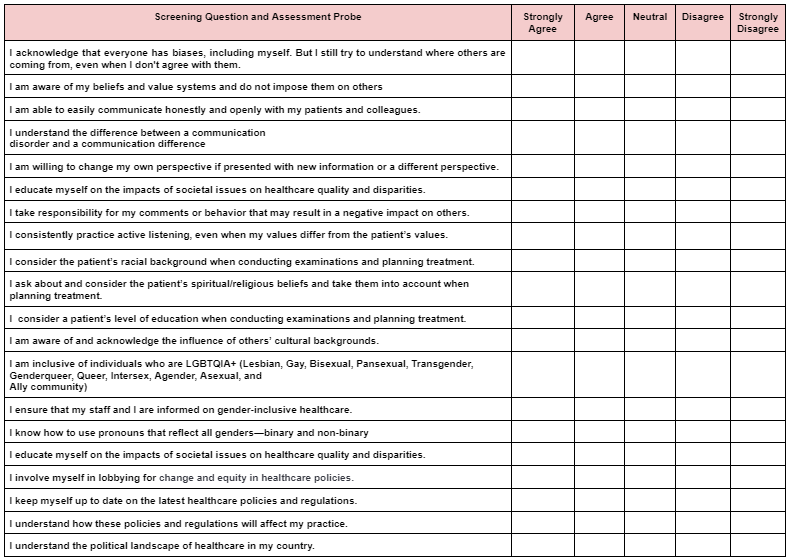
NB- This self-assessment tool is designed to help individuals explore their awareness/ understanding of cultural and structural
competency when interacting with others in a diverse environments. It was developed and adapted by borrowing components from
the American Speech-Language-Hearing Association checklist.Step 2: Respond
Based on the self-assessment results prepare a reflection piece of 300 - 350 words that addresses the following key components:
- Identify any personal strengths and weaknesses you have in interacting or working with others in a diverse environment.
- Discuss how you plan to continue developing and practicing your cultural humility (i.e., how you plan to enhance your dialogue or communication skills, self-reflection skills, and skills to respond and relate to others of different ethnicities, cultures, and socio-economic backgrounds).
- Discuss the importance of developing these skills for your practice and/or professional development to ensure healthcare equity and effectively construct treatment plans that are patient-centered and culturally sensitive.
Step 3: Share
To share your work, click on the “Add a new discussion topic” button under this post and paste your work into the “Message” box. Make sure to reference others’ intellectual property when necessary. All references should follow 7th Edition APA formatting. For further instructions, see the resource on the Himmelfarb Health Sciences Library: APA citation resource (N.B.: references are excluded from word counts).
Step 4: Interact
To complete the activity, you will need to reply to at least two posts made by your peers in a respectful and professional manner. Be sure that your post engages your peers' ideas by including a reflection on their comments, sharing ideas on other potential difficulties and parties involved, or asking thought-provoking questions. If a peer comments on your posting, please reply. To post a reply, click “Reply” on a particular discussion, write your feedback and then click on “Post to forum.”
OPTIONAL Step 5: Interact (10 minutes)
If you would like to, you can reply to your peers' posts in a respectful and professional manner. Ensure that your post engages your peers' ideas by including a reflection on their comments, sharing ideas of other potential difficulties and parties involved, or asking thought-provoking questions. If a peer comments on your posting, please reply. To post a reply, click “Reply” on a particular discussion, write your feedback and then click on “Post to forum.”
-
Students mustView
Read the entire article. (11 minutes)
National Center for Biotechnology Information, U.S. National Library of Medicine, National Institutes of Health - 2020
-
Read the entire article. (31 minutes)
Science Direct - Journal of Professional Nursing - 2020
-
Students mustView
Read the contents under the headings "Introduction", "Individual Level: Self-Reflection and Awareness", "Interpersonal Level: Patient Assessment and Care Planning", "Clinic/Institutional Level: Diverse Hiring and Staff Training", "Community Level: Collaboration", and "Summary". (13 minutes)
PMC - 2022
-
 Competencies covered in this module:
Professionalism (AAMC)
Demonstrate a commitment to carrying out professional responsibilities and an adherence to ethical principles. (AAMC 5)
Demonstrate a commitment to ethical principles pertaining to provision or withholding of care, confidentiality, informed consent, and business practices, including compliance with relevant laws, policies, and regulations. (AAMC 5.6)Systems-Based Practice (AAMC)
Demonstrate an awareness of and responsiveness to the larger context and system of health care, as well as the ability to call effectively on other resources in the system to provide optimal health care. (AAMC 6)
Personal and Professional Development (AAMC)
Demonstrate the qualities required to sustain lifelong personal and professional growth. (AAMC 8)
Provide leadership skills that enhance team functioning, the learning environment, and/or the health care delivery system. (AAMC 8.6)Professionalism: HUMANISTIC BEHAVIOR (AACOM)
Demonstrate humanistic behavior, including respect, compassion, probity, honesty, and trustworthiness. (AACOM V. 2)
Demonstrate openness, honesty, and trustworthiness during direct communication with patients and their families and in the writing of reports, the signing of forms, and the provision of evidence in litigation or other formal inquiries. (AACOM V. 2d)Systems-Based Practice (AACOM)
Demonstrate understanding of how patient care and professional practices affect other health care professionals, health care organizations, and society. (AACOM VII. 2)
Demonstrate understanding of how current issues in the world are affecting the delivery of health care to patients and to the community. (AACOM VII. 2g)(AACN)
Engage in ethical reasoning and actions to provide leadership in promoting advocacy, collaboration, and social justice as a socially responsible citizen. (AACN I. 6)
-
Students mustView
Read the entire article. (8 minutes)
American Association of Medical Colleges - 2017
-
Read the entire article. (13minutes)
In-Training.org - 2016
-
Students mustView
Read the entire article. (12 minutes)
Springer Nature Limited - 2018
-
Students mustView
Read the entire article. (16 minutes)
Journal of Patient Experiences - 2017
-
Students mustView
Read the articles related to humanism in healthcare. (16 minutes)
Gold Foundation for Humanistic Healthcare - 2022
-
Students mustViewReceive a gradeReceive a passing grade
To access the quiz, click on the name of the quiz provided above. On the following screen, click the attempt quiz button to respond to the questions.
-

To take the final exam, you must complete all quizzes and complete all the required activities. The final exam consists of 40 questions, and you will have 40 minutes to complete it. When the time is over, you will have two minutes to submit your attempt before it expires, and your progress is discarded. You will not be able to answer additional questions in the grace period.
To access the exam, click on the name of the exam provided below. On the following screen, click the attempt quiz button to respond to the questions.
-
Students mustViewReceive a gradeReceive a passing grade
-
-
 In this section, you can provide feedback about this course to help us make NextGenU.org better. Once evaluations are completed, you will be able to download your certificate of completion.
-
Course Evaluation Questionnaire
-
Self Evaluation Questionnaire
-
-
-
Students mustMark as done
-
-