Section: Module 4: Phase 1 | Depression Counseling | NextGenU.org

  •  6Congratulations on completing Module 3 on The Style of A HAP Counsellor! You have now revised the main aspects of collaborative counselling, including maintaining session structure, focusing on action, being non-judgemental, acknowledging the patient’s experience, encouraging progress, expressing warmth and being genuine.

    In this module, you will learn about the first phase of the HAP.

    • Module 4: Lesson 1: Overview of Phase 1

      Phase 1 is delivered in 1-2 sessions. Watch the video lecture in the activities section below to learn about the structure of Phase 1.

      Required Learning Resources
    • Watch the video lecture to learn about the structure of Phase 1

    • Module 4: Lesson 2: Introducing Yourself

      Getting started is a conversation – not a lecture – wherein the patient shares information about his/her life, challenges, goals, and values, and you share information about depression and how to deal with it with HAP by making connections between the patient’s life and experiences.

      Prepare yourself before the session, greet the patient and explain about confidentiality. You can begin by asking the patient what brought him/her to the clinic, and after he/she shares their complaint, assure them that the physical problem will be addressed by the doctor. You must also explain that his/her scores show that he/she might have some stress-related emotional difficulties as well and that if he/she allows, you could address these.

    • Module 4: Lesson 3: Establishing Length of the First Session

      Most patients will not have planned for a counselling session and some may not be able to stay for the required 30-40 minutes. It is important to check with the patient and together plan how to go forward. 

      If the patient agrees, we go ahead with a full first session outline by setting an agenda. If the patient says he/she is unable to wait for the entire session, we follow the brief session outline. 

    • Module 4: Lesson 4: Setting an Agenda

      In the first session, introduce the patient to agenda setting by making a list of items we would like to cover, including:

      • Asking about the patient’s problem/s
      • Explaining counselling and how it can help them
      • Making a plan for future sessions
      • Setting the next session date

      Always ask the patient if he/she agrees and if there is something to add. Many patients are not used to being active participants, so in the first session you can take the lead in setting the agenda. In later sessions, however, you can first invite the patient to list agenda items to which you then add yours. 

      Watch the role play video in the activities section below to learn how to set the agenda

      Required Learning Resources
    • Watch the role play video to learn how to set the agenda with the patient during the session

    • Written transcript of the role play video

    • Module 4: Lesson 5: Getting to Know your Patient
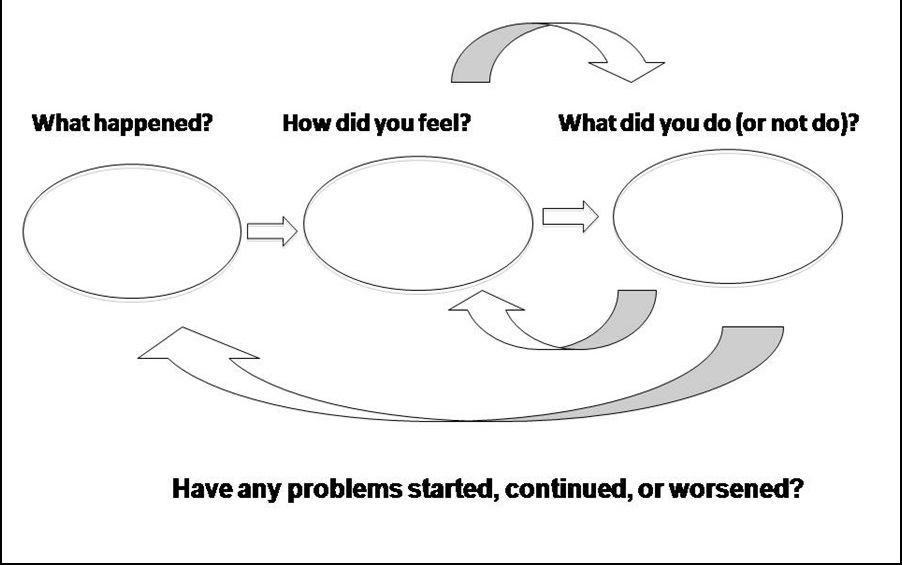
      Model of Depression

      The Healthy Activity model offers a guide to what depression is and how to treat it. You can use this when getting to know the patient and explaining the counselling process to them.

      Keep the structure of the session in mind but also allow the patient to share thoughts and feelings without feeling hurried. 

    • Module 4: Lesson 6: The First Question

      The first question we ask is: “What happened?”

      To identify factors that either played a part in starting depression or maintaining it, it helps to identify events or stressors in the patient’s life. However, biological factors are important to acknowledge too.

      Often, it is helpful to say, “We think about depression as occurring because of things that happen in your life. Did anything happen when you started feeling down (or stressed)? Or has anything been going on in your life now that makes your life more stressful or harder (or that keeps you feeling down)?” If the patient has difficulty identifying such factors, we can offer possibilities of common factors. We might say, “It’s common for people who are feeling down/ stressed to have struggles with things such as…” A common list of factors might include:

      • Severe stress, defined as a difficult event (e.g. death of a loved one, loss of a job, serious accident or injury)
      • Long-term stress, defined as problems the patient has been dealing with for a long time (e.g. work-related or relationship problems; lack of safety in one’s neighbourhood or home; long-term financial problems; or having to care for a sick family member)
      • Harmful childhood experience (e.g. abuse, neglect or trauma)
    • Module 4: Lesson 7: The Second Question

      It is important to understand the patient’s experience of going through difficult situations, what their experience is like now, and what emotions or feelings are experienced in the body. So, you can ask, “When you experience such events (e.g., tension with your husband), how do you feel?”

      Common experiences with patients under stress are:

      • Sadness and/or irritability
      • Low interest or motivation
      • Decreased energy - feeling tired and fatigued
      • Lowered attention and concentration - inability to study or keep at one task for long
      • Thoughts of hopelessness, worthlessness and helplessness

      If the patient has difficulty remembering, go back to the items of the PHQ 9 that were scored positive and ask about these experiences. It is very important to explain that these feelings are normal in the face of life’s challenges.

    • Module 4: Lesson 8: The Third Question

      You must then identify how the patient responded to the events and feelings that followed. It is helpful to ask: “When you are feeling stressed (sad, tired, etc.), what do you do (or not do)?” It is helpful to explain that is common for people to start or stop doing certain activities that can include:

      • Not meeting or talking to friends and family
      • Not going to work
      • Doing routine activities, e.g. sleeping, eating, hygiene routines, in disorderly ways
      • Stopping or reducing physical activity (staying in bed, not exercising, etc.)
      • Increasing conflict with people close to them
      • Thinking again and again about their problems

      If the patient does not easily describe activities, you can ask: “Are there activities you were doing earlier that you have stopped doing since your stress began?”

    • Module 4: Lesson 9: The Fourth Question

      Watch the role play video in the activities section below to learn how to describe the HAP model to the patient

      Talk about ways in which a patient’s actions, or lack of them, may be keeping them stuck in depression. We can say: “It makes sense that you want to withdraw when you are feeling down, but the problem with this kind of behaviour is that it keeps you stuck in feeling low/down/stressed as you are less engaged in things that make you happy.”

      Examples of activities that don’t make you feel good

      • Watching TV for hours at a time
      • Lying in bed for long periods
      • Not attending work
      • Not caring for personal appearance and hygiene

      HAP counselling works to decrease such activities. Other activities help patients cope or are helpful in their lives, and the HAP counselling works to increase such activities.

      Examples of activities that make you feel good

      • Speaking to a friend
      • Playing with a grandchild
      • Spending time in hobbies such as sewing
      • Praying or reading religious or motivational books
      • Going for a walk

      Watch the video lecture in the activities section below to learn about the cycle between behaviour and depression. Watch the role play video in the activities section below to learn about the cycle between behaviour and depression

      Required Learning Resources
    • Watch the video lecture to understand the cycle between behaviour and depression

    • Watch the role play video to learn how to introduce the patient to the HAP model

    • Written transcript of the role play video

    • Module 4: Lesson 10: Suicide Risk Assessment

      Calculate suicide risk for all patients. If you find it present, or if the suicide item is positive on the PHQ 9 questionnaire (i.e. item 9), then this becomes the immediate focus of the session. Assessment and management of suicide risk is detailed in the PREMIUM Counselling Relationship Manual.

    • Module 4: Lesson 11: Specifics of Counselling

      It is important to give the new patient some information about HAP that includes:

      • Our training and by whom you are supervised
      • How long the counselling takes – the number of sessions and over how much time
      • Where the sessions will be conducted – at home, in the clinic or over the telephone
      • How you can be contacted outside the sessions, and in what situations

      Ask the patient if they have any questions about the treatment and respond to them as best as you can.

      You can provide encouragement by asking how life would be different if their stress or tension was addressed and providing hope that through the process of counselling, they can be treated. 

      FAQs about the specifics of counselling
      FAQs Answers
      Are medicines not enough? Counselling is known to increase the chances of getting well. The benefits can last even after the sessions are completed. You can continue to receive medicines from the doctor for your other health problems during the counselling.
      What if I cannot come to the clinic to see you? We can have sessions at your home if this is ok with you. We can also speak on the phone if you are unable to come to the clinic. Let me know which option you prefer.
      Can you speak to my husband/wife/sister/mother to solve my problem with them? I will be very happy to meet your relative so he/she can understand the nature of your problem and what they may be able to do to help. Please ask them to read this handout and bring them with you when we meet next. It will be very useful to have them involved in your treatment.
      Can this counselling really help me? I am already doing so many activities but I still feel stressed We will be working together to examine these activities and see how we can use them to help you feel better. We will also discuss ways to deal with the problems in your life. This counselling has helped many people with problems like yours. Let us try it and see the results

    • Module 4: Lesson 12: Involving a Significant Other (SO)

      Significant other

      People with depression may not talk about their experiences openly and may wonder why they cannot make themselves feel better. An important part of counselling involves helping family members understand what depression is and ways to treat it.

      Here is a review from the Counselling Relationship course on ways to involve the significant other (SO), such as a close family member or friend the patient trusts:

      • Ask the patient if they would like the SO (who has come with them to the clinic) to stay for the entire session. Some may only want the SO to join in when you explain HAP and the details of counselling.
      • Discuss with the patient the possible benefits of involving the SO in counselling.
      • While it is useful to involve the SO, it is not essential.
      • If the SO attends the session, ask the person if he/she wants to provide more information on the patient’s problems and if he/she has questions.
      • Encourage the SO to read the handout and return with any questions he/she may have.
    • Module 4: Lesson 13: Eliciting Commitment

      To get the patient to commit to the treatment, we need to give him/her time to talk about their understanding, clear their doubts, and go over parts they may not have understood. 

    • Module 4: Lesson 14: Addressing Barriers

      It is important to explore problems that may interfere with the patient's participation in the treatment. In the case of a patient refusing treatment, we might dig further into their reasoning.

        Barriers  Solutions
      Patient level

      Cannot attend counselling sessions due to practical barriers such as 

      • Transport cost
      • Lack of time
      • Care-giving responsibilities
      • Age

      Home visits can be the first option, followed by telephone counselling, with flexibility in scheduling sessions.

      Discuss with the patient how to get the help of those who can take over their care-giving responsibilities in their absence
      The SO, usually the patient’s husband, does not allow counselling Invite the SO to engage in the counselling process if he/she has come with the patient to the clinic. If not, encourage the patient to share the handout with the SO and then invite him/her for participation
      No time to wait for the first session Time of the session shortened with a focus on engagement and addressing problems to follow-up
      Significant social stressors such as financial problems and does not see how ‘talking’ will help Explain that you can help address social stressors, and do so as soon as possible through referral for appropriate services or problem-solving
      Preoccupied about physical health and blames problems only on physical illness Physical illness beliefs to be taken care of. Explain the mind-body link. Stress on the role of physical symptoms in depression
      States preference for medication rather than counselling Explain that counselling is an option in addition to medical treatment, not instead of, and can further improve the chances of long-term recovery
      Uncommunicative and doesn’t open up about problems

      Spend greater amount of time in engaging and explaining how treatment will help.

      Assure the patient that all information will be confidential.

      Speak to the patient alone if he/she has come with the SO
      Suffering from personal crisis Allow time for the patient to show sadness or emotional pain. Follow the steps in dealing with a personal crisis (as learnt in the CR course) and postpone the other tasks of session 1 to later sessions
      PHC level Counsellor not seen as part of PHC team Request the doctor and other staff to encourage the patient to receive counselling
      Counsellor level Failure to engage patient

      The first session is a conversation. It is important to allow time for listening to the patient’s experience. It is also important to share your knowledge so that the patient has correct information about counselling.

      Provide patient material.

      Actively involve the SO and get their help in making sure the patient attends counselling sessions

    • Module 4: Lesson 15: Addressing the Patient's Chief Concerns

      In order to effectively engage the patient in counselling, address her/his main concerns. These may include social problems for which there are existing welfare schemes in which we can discuss how they can access these, or sleep problems that we can provide simple tips for. If there are problems that require urgent attention, begin the steps of problem solving in this session. Otherwise, reassure the patient that you will help them address this problem in future sessions. 

    • Module 4: Lesson 16: Planning Homework

      Encourage patients to do work in between sessions. 

      First, explain the homework: At the end of the first session the patient is given the booklet and the handout with information for the significant other.

      If the patient is unable to read, ask if they can request someone in their family to read it to them. 

      Then ask for problems in performing the homework and help solve them.

      At the end, remind them that in the next session you can both discuss what the patient has understood about counselling.

    • Module 4: Lesson 17: Summarising

      Summarising refers to giving a short but complete description of the session that includes the key points that were discussed and the homework for the coming week. It allows the patient to briefly describe the information so that you can understand how successfully you communicated and whether you need to correct any doubts/misunderstandings. 

      After the patient says what they have learned, repeat their ideas and, if necessary, add anything they have left out.

    • Module 4: Lesson 18: Setting the Next Session Date

      Set the time and place of the next session together with the patient, aiming to arrange it after seven days at the patient’s home. Be flexible depending on what is convenient for the patient. Arrange telephone sessions in between the home visits and clinic visits even if it is short. Note all contacts and enter the next session date in the phone diary with a reminder to call the patient before the upcoming session. 

      If the patient is not keen on a home visit, encourage them to come to the PHC. Ask if they are meant to come to the clinic for a follow up, fix an appointment to suit this timing. If neither is possible, confirm that you will have a telephone session.

      After the patient leaves, complete the clinical record form and the daily register.