Section: Module 5: Phase 2 | Depression Counseling | NextGenU.org

  • 865

    Congratulations on completing Module 4 on Phase 1 of the Healthy Activity Program! You now have an overview of the first phase of the HAP treatment. This includes introducing yourself and agreeing on the length of the session, setting an agenda, and getting to know the patient. It also involves asking important questions about the patient’s problem, assessing suicide risk, talking about counselling, involving a significant other, addressing problems, and the patient’s chief concerns, planning homework, and summarising. 

    In this module, you will learn about the second phase of the HAP treatment.

    • Module 5: Lesson 1: Overview

      Phase 2 is delivered in 2-6 sessions over two parts – Learning Together, and Getting Active and Solving Problems.

      The goal of learning together is to identify activation targets. The phase includes checking progress, setting an agenda, going over homework, learning together, encouraging activation, involving a significant other in learning together, planning homework (including addressing barriers), summarising, setting the next session date and keeping records.

      During phase 2, select treatment targets by defining the patient’s goals and helping him/her achieve them.

    • Module 5: Lesson 2: Learning Together

      ·       Counselling2Review progress
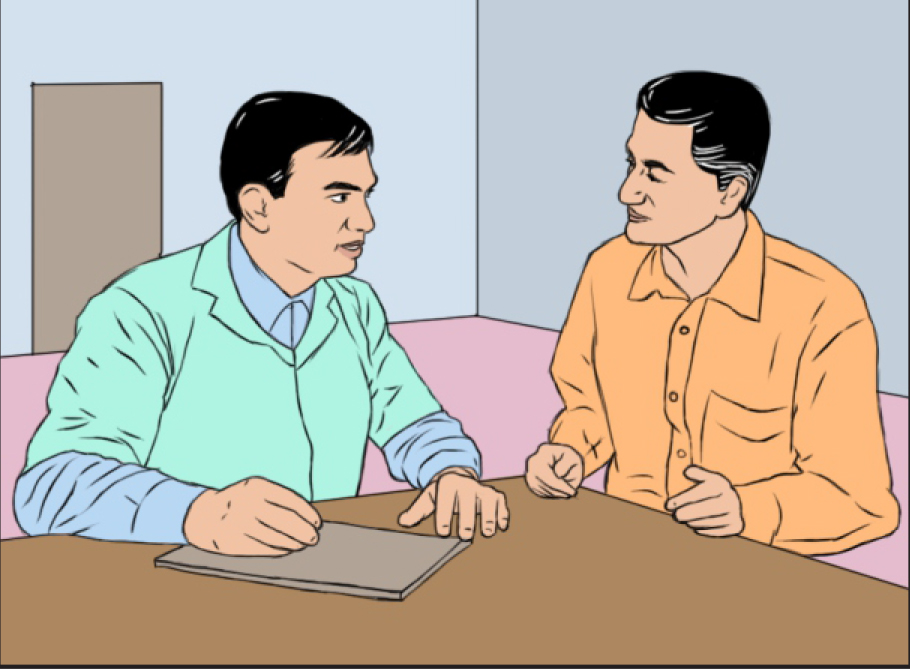
      First, review the patient’s progress by comparing the current PHQ-9 score with the one from the previous visit and provide feedback to the patient. Remember to assess and manage suicide risk as a priority based on the patient’s current score.

      ·        Set the agenda

      Then, explain the importance of setting an agenda and mention that the patient ought to actively participate with you in the HAP treatment process. Give them time to add suggestions to the agenda or ask questions. Go over the problems discussed in session 1 and ask if the patient needs to talk about any of them.

      Go over new problems and ask if the patient would like to discuss any of them. List agenda items including discussing homework, recording the patient’s activities and how he/she feels when doing them, planning to identify at least one activity that can help them feel better and scheduling it until the next session, setting the next session date, and asking the patient if they agree with the list and have anything else to add.

      ·        Review homework

      Ask directly if they did the homework or have any questions about what they read. You can ask them to describe what they understood about the treatment and fill in the gaps or correct any misunderstanding. If the patient did not do the homework, ask directly but non-judgementally what happened.

      This helps understand what obstacles the patient is facing and leads towards helping them overcome these obstacles. It is common for patients to not complete the homework. You can complete the assignment during the session so the responsibility of completion is shared and the patient feels supported.

      Required Learning Resources
    • Watch the role play video to learn how to go over homework with the patient

    • Written transcript of the role play video

    • 5.2a Collaborative Learning and the HAP Model

      The counsellor and patient know which activities will help the patient feel better, solve problems and achieve goals by learning together to identify links between the patient’s activity and mood. Go over the activities the patient is involved in and how they affect his/her mood. You can then plan how to increase the activities that make them feel better and decrease the ones that don’t through problem solving. Use terms like ‘things that make you happy’ or ‘things that make you sad’ to help them understand better.

      You can identify these activities through:

      1. The HAP model: When patients come to sessions with concerns about the period since the previous session (such as times when they felt down), ask about the situations, specifically about the parts of the Healthy Activity Program: ‘What happened?’, ‘How did you feel?’, ‘What did you do or not do?’, ‘What connections were present between what you did and how you felt?’
      2. Activity Calendar: Record the patient’s activities and moods at the time of doing the activities. Explain why filling the calendar is important by reminding them about the HAP model and how activities can affect mood and stress. Go through the patient’s day with him/her and how they felt at each point. If the patient uses words in physical terms such as ‘tension’ or 'feeling well/unwell', use the same words to explain the mood rating. Identify any links between activity and mood with the patient.

      MOOD LADDER
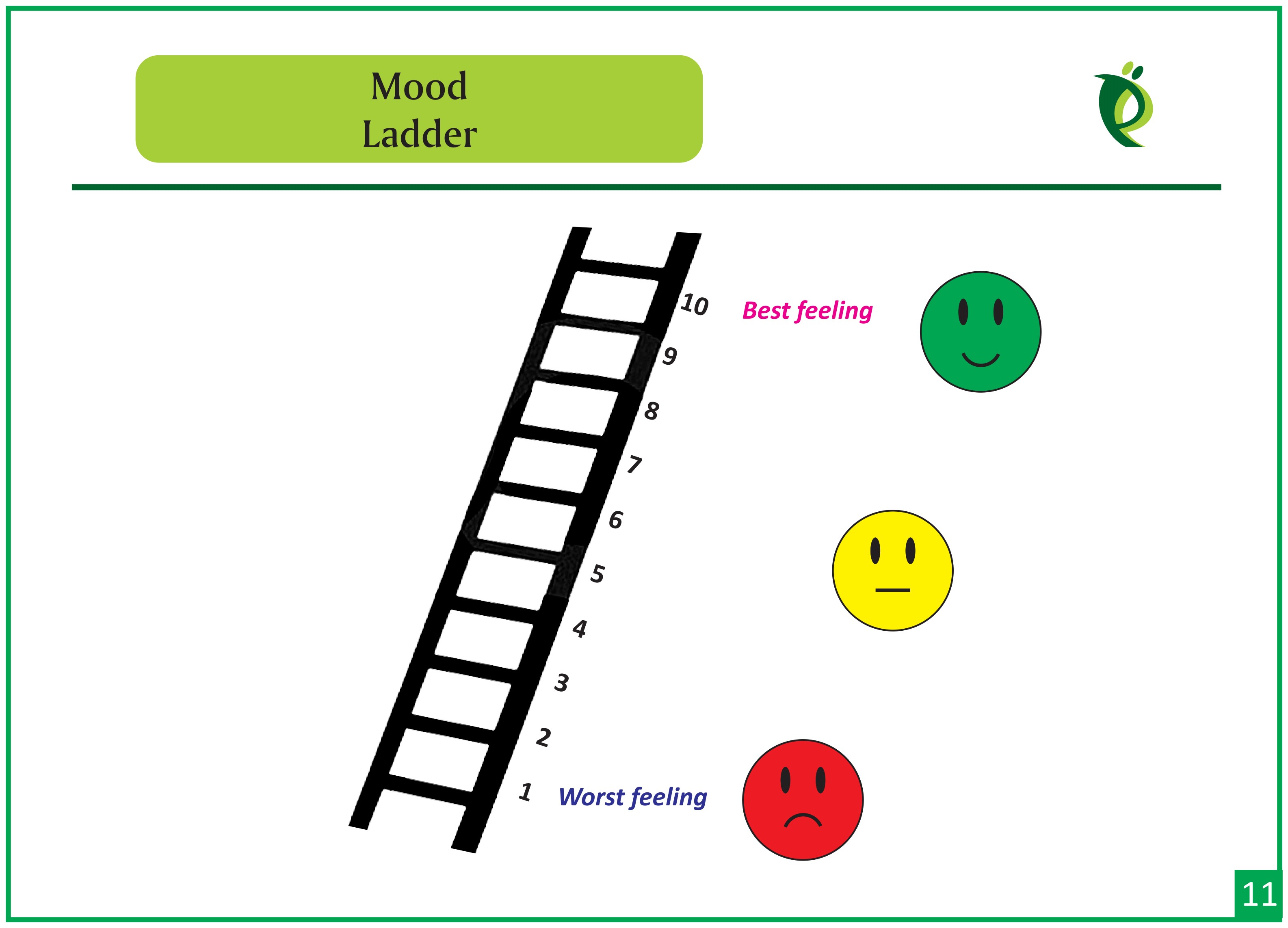
      • Mood ladderAsk the patient to rate his/her mood along the steps of the calendar, with the lowest step as the worst he/she has felt and the top step the best.
      • Good/Bad: For those who do not report strength of mood in detail, ask them to choose whether they feel ‘happy or sad’ or ‘good or bad’.
      • Emoticons: For those who cannot read or write, use icons to identify how they are feeling.
      • Tick and cross: Use a tick mark to show positive mood and a cross to show a negative mood.
    • 5.2b Involving a Significant Other

      • For the elderly or those who cannot read/write, if the SO has been involved in the treatment process, discuss the option of having the SO write the activity calendar for the patient.
      • The SO can remind the patient at regular times to fill in the activity calendar and encourage them to do the planned activity that helps them feel better.
    • 5.2c Planning Homework and Overcoming Barriers

      Based on the activity calendar, identify one activity that helps the patient feel better and together discuss a specific plan to do this activity at home. Encourage the patient to follow it at scheduled times until the next session and fill in the calendar. Explain that noting the activity and rating the mood will help them see the relationship between doing activities and feeling better.

      Prepare the patient for possible barriers by thinking of solutions with them.

      Barriers Challenges
      Difficulty in remembering to do the activity or fill the chart

      Link the activity and completing the chart to another routine activity such as meal time.

      Use reminders such as stickers in prominent places.

      Involve the SO to remind the patient.
      No time to do the activity and/or fill the chart

      Help the patient identify a possible time when he/she may be more likely to do the activity and/or fill the chart.

      Ask the patient to fill the chart only once in the day 
      Patient cannot read/write

      Help the patient identify an SO to fill the chart.

      Use a chart with pictures.
      Does not understand the reason to do the activity and/or fill the chart Revisit the Healthy Activity Program, the link between activities and mood, and the idea of activities that make them feel better and those that don’t

    • Module 5: Lesson 3: Getting Active and Solving Problems

      The goals in these sessions are to strengthen the understanding of the HAP and apply it to daily life, encourage activation, identify barriers to activation and learn how to overcome them, and help patients solve or cope with life problems. Like before, these sessions include keeping a check on progress, setting an agenda, going through homework, getting active, solving problems, involving the SO, dealing with problems, planning homework, summarising, setting the next session date and completing documents.

      In these sessions, patients will learn the skills they need to get active and address problems through homework.

      • Review progress as before, along with suicide assessment
      • Set an agenda

      Ask the patient about the homework that was to be done, go over the activity chart together and select activities that can help the patient. Plan to perform these activities and discuss ways to deal with problems the patient is facing.

      • Review homework

      Ask the patient whether he/she has filled the activity plan and the experience he/she has had. Find out about links between the activities and the patient’s mood, any patterns that you notice, how well routine activities support the patient’s mood. In later sessions in the same phase, you can ask about specific activities they were meant to do. Encourage progress the patient has made on the action plan, and go over what was done or not done in detail.

      Watch the role play video in the activities section below Dealing with Barriers in Completing Homework.

      Required Learning Resources
    • Watch the role play video that discusses barriers in completing homework and how to overcome them

    • Written transcript of the role play video

    • Module 5: Lesson 4: Solutions to Overcome Barriers and Complete the Activity Plan

      Barriers/Challenges Solutions
      Does not fill the activity plan or says he/she cannot fill the plan

      Explore the reasons why.

      Explain in detail why he/she should fill the plan.

      Try filling the plan in the session.
      Writes an activity, such as ‘at work’, that is not specific for a large duration

      Ask detailed questions – ‘what he/she was doing’, ‘with whom’, ‘for how long’ – to define the behaviour.

      Tell the patient you want to learn enough about their activities that you could repeat the actions based on the description, such as making ‘rice and fish curry and chicken for the children’s treat’, instead of simply ‘making dinner’.
      Reports an activity that might be causing problems but you are not certain how important it is for the patient’s mood Ask more about how often they do the activity and for how long, and whether there has been an increase or decrease.
      Reports feeling worse during an activity but you do not understand what led to the worsened mood Ask more questions to understand the situation the activity occured in. For example, through further questioning, you can learn that a woman may say she has more anxiety whenever she enters the kitchen because her mother-in-law made a negative remark that caused her to give up and go to bed.
      Did not carry out the activities as planned despite attempting to do so

      Go over the activity plan and cut back on the number and/or frequency of activities.

      Change the activity to something that is easier.

    • Module 5: Lesson 5: Getting Active

      The target activity is identified through a joint effort of assessment. It is helpful to begin with activities that make the patient feel better and that the patient is more likely to do. Even though the first actions do not address the main problems, they help the patient feel more positive and prepared to tackle bigger problems. 

      Watch the role play video in the activities section below to learn how to get a patient do activities

      Required Learning Resources
    • Watch the role play video to learn how to get the patient to do activities

    • Written transcript of the role play video

    • Module 5: Lesson 6: Breaking Down the Activity

      Focus on helping patients break down more complex behaviours. For example, to spend more time with the family, the patient could return home from work an hour earlier, sit and read a newspaper in the same room where the children are playing, watch the children at play and participate in play with them. 

    • Module 5: Lesson 7: Timing the Activity

      Watch the video lecture in the activities section below to learn how to time the activity with the patient.

      Required Learning Resources
    • Watch the video lecture to learn how to time the activity with the patient

    • Module 5: Lesson 8: Solutions to Overcome Difficulties in Doing an Activity

      Barriers/Challenges Solutions
      No time to do the activity

      Help the patient plan a particular time and day for the activity.

      Help the patient think of how they can reduce other tasks and make time for the activity
      The patient says they may forget to fill the chart/do the activity

      Keep the plan in a place where it is easily seen at home.

      Involve the SO in reminding the patient.

      Set an alarm/reminder on a clock/telephone.
      Lacks confidence about doing the activity, says they may feel too low/stressed

      Highlight how the activity will help the patient feel better, go over the Healthy Activity Program briefly.

      Discuss who may be able to help him/her with the activity.

      Involve the SO in encouraging the patient to do the activity.

      Go over the activity and break it down into smaller steps, and encourage the patient to start with one step at a time.

      Watch the role play demonstration video in the activities section below to understand how to tackle the barriers in doing an activity.

      Required Learning Resources
    • Watch the role play video to understand how to monitor activities

    • Written transcript of the role play video

    • Module 5: Lesson 9: Solving Problems

      Patients with depression often face problems to do with finance, relationships, health or difficulty in doing routine activities. Their experience of these problems is often closely linked to their symptoms, so problem solving is an important form of activation for many patients.

      Watch the video lecture in the activities section below to learn about problem solving.

      Required Learning Resources
    • Watch the video lecture to learn how to teach the patient to solve problems

    • Module 5: Lesson 10: Case study

      Watch the role play demonstration to understand more about problem solving.

      Required Learning Resources
    • Watch the role play video to learn how to teach the patient problem solving

    • Written transcript of the role play video

    • Module 5: Lesson 11: Possible Solutions to Common Problems

      Problem Possible Solutions
      Family member has a drinking problem
      • Person concerned can be encouraged to seek treatment by asking the patient to share the hazardous drinking brochure
      • People close to the family member can encourage and support him/her to stop drinking
      Physically abusive spouse
      • Seek the help of someone who may be able to speak to the spouse
      • Discuss safety measures
      • Referral to support agencies
      Patient does not have a job
      • Explore options of job opportunities such as ads for vacancies
      • Ask friends and family to explore their network
      • Share information about government employment schemes
      Illness in the family
      • Encourage the family to seek the right treatment
      • Follow medical advice
      • Refer the person to a specialist/agency/hospital
      • Care for the person’s needs suitably
      • Seek support for oneself to deal with the burden of care
      Relationship difficulties
      • Identify ways of communicating better
      • Ask the person close to the patient to come for a session
      • Involve a third person who can help the patient
      Financial difficulties
      • Look for better job opportunities
      • Refer to government schemes such as pension schemes
      • Explore ways of saving
      • Seek help from friends/family
      A person in the family with special needs
      • Seek professional help to support the person
      • Gather information and enhance skills to care for the person
      • Seek support for oneself to deal with the burden of care
      • Refer to an agency
      Difficulty in coping with work stress
      • Learn useful ways to cope with stress, such as taking short breaks
      • Time management
      • Improve skills that will help with work performance
      • Seek support from seniors/co-workers
      Stress and loneliness caused by living away from home and family
      • Maintain regular communication with family
      • Create a support network of friends
      • Join community activities
      Elderly patients with no family support
      • Explore possibility of building a support network
      • Provide information about government schemes
      • Refer to agency

    • Module 5: Lesson 12: Involve SO in Activation and Problem Solving

      The SO can help:

      • Identify activities that make the patient feel better and those that do not, in addition to what the patient may have reported
      • Identify a problem and generate solutions when attempting to solve problems in the patient’s life
      • Support the patient in doing the activities
      • Help the patient record the activities in the chart
      • Support the patient in coming for sessions and come along with them if required
    • Module 5: Lesson 13: Planning Homework

      The homework will focus on helping the patient get active with doing activities that make them feel good and/or doing activities related to solving problems. Develop specific homework together with the patient based on an assessment of the links between activities and mood of the patient.

      List out the agreed activities in the chart in the patient booklet, against which the patient puts a tick when it has been performed during the week. They also record their mood. Fill in the chart at the next session if the patient has not filled it at home.

      Measure the degree of activation by listing out the activities and asking the patient to share feedback on what extent they were performed on a 4-point scale given in the clinical record form. Remember to plan for problems or barriers and help the patient understand that he/she may not complete all of the activity due to these.

      Finally, summarise, set the next session date and complete the documentation once the patient leaves.