

Section: Module 12: From Cultural Competency to Cultural Humility: Habits of Respectful Curiosity | Humanism in Health and Healthcare | NextGenU.org
-
 Competencies covered in this module:
Knowledge for Practice (AAMC)
Demonstrate knowledge of established and evolving biomedical, clinical, epidemiological, and social-behavioral sciences, as well as the application of this knowledge to patient care. (AAMC 2)
Apply principles of epidemiological sciences to the identification of health problems, risk factors, treatment strategies, resources, and disease prevention/health promotion efforts for patients and populations. (AAMC 2.4)
Apply principles of social-behavioral sciences to provision of patient care, including assessment of the impact of psychosocial and cultural influences on health, disease, care seeking, care compliance, and barriers to and attitudes toward care. (AAMC 2.5)Professionalism (AAMC)
Demonstrate a commitment to carrying out professional responsibilities and an adherence to ethical principles. (AAMC 5)
Demonstrate accountability to patients, society, and the profession. (AAMC 5.4)
Demonstrate sensitivity and responsiveness to a diverse patient population, including but not limited to diversity in gender, age, culture, race, religion, disabilities, and sexual orientation. (AAMC 5.5)Professionalism: Cultural Competency (AACOM)
Demonstrate awareness of and proper attention to issues of culture, religion, age, gender, sexual orientation, and mental and physical disabilities. (AACOM V. 7)
Treat all patients, colleagues, and others fairly, ensuring that no group is favored at the expense of any other. (AACOM V. 7a)
Openly discuss cultural issues, and be responsive to cultural cues. (AACOM V. 7c)
Demonstrate how to cope with differences in people in a constructive way. (AACOM V. 7d)
Demonstrate an understanding of the scope of culture and the elements that form and define it. (AACOM IX. 1)
Recognize personal and professional tendencies toward bias and stereotyping and work to counter them. (AACOM IX. 2)
Understand the public health implications of cultural competence in health care. (AACOM IX. 3)
Demonstrate familiarity with basic religious and cultural beliefs that affect patients’ understanding of the etiology of their illness and/or the efficacy of their treatment. (AACOM IX. 4)
Use the cultural profile and history with individual patients to assess healthcare needs in the community. (AACOM IX. 11)
Essential VII: Clinical Prevention and Population Health (AACN)- Assess health/illness beliefs, values, attitudes, and practices of individuals, families, groups, communities, and populations. (AACN 3)
Essential VIII: Professionalism and Professional Values (AACN)
- Reflect on one’s own beliefs and values as they relate to professional practice. (AACN 6)
- Communicate to the healthcare team one’s personal bias on difficult healthcare decisions that impact one’s ability to provide care. (AACN 8)
-
Students mustView
Read the Abstract, Introduction, Discussion, Conclusion. (8 minutes)
Springer Link - Journal of General Internal Medicine - 2019
-
Students mustView
Read the entire article. (10 minutes)
National Center for Biotechnology Information, U.S. National Library of Medicine, National Institutes of Health - 2019
-
Students mustViewStart discussions: 1
General Instructions
In this activity, you will complete the checklist below and reflect on key aspects as it relates to your knowledge, skills, and awareness in interacting with others. You will also discuss ways of enhancing cultural humility and structural competency.
Step 1: Review and Reflect
Review the relevant learning materials for this lesson and complete the self-assessment checklist included below.
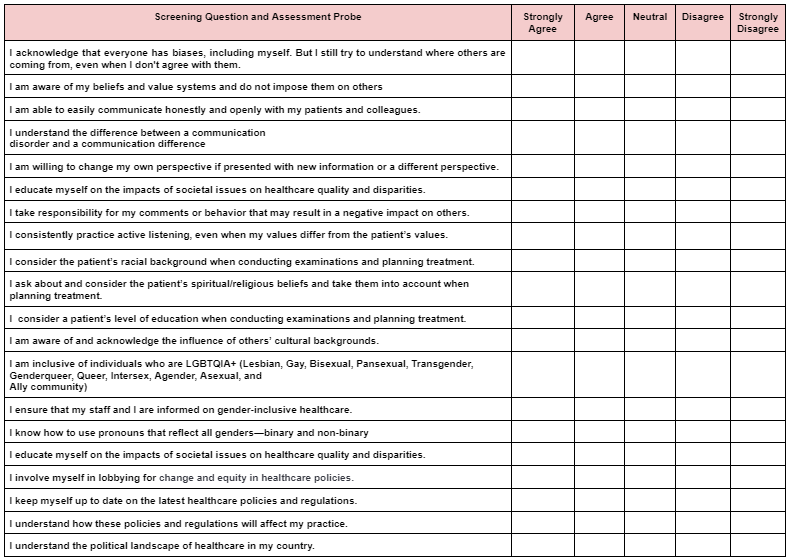
NB- This self-assessment tool is designed to help individuals explore their awareness/ understanding of cultural and structural
competency when interacting with others in a diverse environments. It was developed and adapted by borrowing components from
the American Speech-Language-Hearing Association checklist.Step 2: Respond
Based on the self-assessment results prepare a reflection piece of 300 - 350 words that addresses the following key components:
- Identify any personal strengths and weaknesses you have in interacting or working with others in a diverse environment.
- Discuss how you plan to continue developing and practicing your cultural humility (i.e., how you plan to enhance your dialogue or communication skills, self-reflection skills, and skills to respond and relate to others of different ethnicities, cultures, and socio-economic backgrounds).
- Discuss the importance of developing these skills for your practice and/or professional development to ensure healthcare equity and effectively construct treatment plans that are patient-centered and culturally sensitive.
Step 3: Share
To share your work, click on the “Add a new discussion topic” button under this post and paste your work into the “Message” box. Make sure to reference others’ intellectual property when necessary. All references should follow 7th Edition APA formatting. For further instructions, see the resource on the Himmelfarb Health Sciences Library: APA citation resource (N.B.: references are excluded from word counts).
Step 4: Interact
To complete the activity, you will need to reply to at least two posts made by your peers in a respectful and professional manner. Be sure that your post engages your peers' ideas by including a reflection on their comments, sharing ideas on other potential difficulties and parties involved, or asking thought-provoking questions. If a peer comments on your posting, please reply. To post a reply, click “Reply” on a particular discussion, write your feedback and then click on “Post to forum.”
OPTIONAL Step 5: Interact (10 minutes)
If you would like to, you can reply to your peers' posts in a respectful and professional manner. Ensure that your post engages your peers' ideas by including a reflection on their comments, sharing ideas of other potential difficulties and parties involved, or asking thought-provoking questions. If a peer comments on your posting, please reply. To post a reply, click “Reply” on a particular discussion, write your feedback and then click on “Post to forum.”
-
Students mustView
Read the entire article. (11 minutes)
National Center for Biotechnology Information, U.S. National Library of Medicine, National Institutes of Health - 2020
-
Read the entire article. (31 minutes)
Science Direct - Journal of Professional Nursing - 2020
-
Students mustView
Read the contents under the headings "Introduction", "Individual Level: Self-Reflection and Awareness", "Interpersonal Level: Patient Assessment and Care Planning", "Clinic/Institutional Level: Diverse Hiring and Staff Training", "Community Level: Collaboration", and "Summary". (13 minutes)
PMC - 2022