

Section: Module 7: Testing of Hypotheses | Intro to Statistics | NextGenU.org
-
 Competency covered in this module:
- MCAT: Use data to answer research questions and draw conclusions.
- MCAT: Identify testable research questions and hypotheses.
- MCAT: Identify conclusions that are supported by research results and determine the implications of results for real-world situations.
- MCAT: Distinguish between results that do and do not support generalizations about populations.
-
Students mustView
Read entire page: Introduction to Hypothesis Testing. (8 minutes)
Rice University - 2021
-
Students mustView
Watch the video: Introduction to Hypothesis Testing. (11 minutes)
Rice University - 2021
-
Students mustView
Read entire page - Section 8.1: Elements of Hypothesis Testing. (15 minutes)
LibreTexts - UC Davis - 2022
-
Students mustView
Read entire page: Significance Testing. (6 minutes)
Rice University - 2021
-
Students mustView
Watch video: Significance Testing. (6 minutes)
Rice University - 2021
-
Students mustView
Read entire page: Type I and Type II Errors. (5 minutes)
Rice University - 2021
-
Students mustView
Watch video: Type I and Type II Errors. (8 minutes)
Rice University - 2021
-
Students mustView
Read entire page: One- and Two-Tailed Tests. (5 minutes)
Rice University - 2021
-
Students mustView
Watch the video: One- and Two-Tailed Tests. (6 minutes)
Rice University - 2021
-
Students mustView
Read entire Page - Section 8.2: Largel Sample Test for the Mean. (20 minutes)
LibreBooks -UC Davis - 2022
-
Students mustView
Read Entire Page - Section 8.4: Small Sample Test for the Mean. (20 minutes)
LibreBooks -UC Davis - 2022
-
Students mustView
Read entire page - Section 8.5: Large Sample Test for the Population Proportion. (25 minutes)
LibreBooks -UC Davis - 2022
-
Quiz: Module 7: Lessons 1 & 2
To access the quiz, click on the name of the quiz provided above. On the following screen, click the attempt quiz button to respond to the questions.
TO PASS THIS QUIZ YOU MUST OBTAIN A SCORE OF 80%.
-
Students mustView
Read entire page - Section 9.1: Comparison of Two Population Means - Large, Independent samples. (20 minutes)
LibreBooks -UC Davis - 2022
-
Students mustView
Read entire page - Section 9.3: Comparison of two population means, Paired Samples. (25 minutes)
LibreBooks -UC Davis - 2022
-
Students mustView
Read entire page - Section 9.4: Comparison of Two Population Proportions. (20 minutes)
LibreBooks -UC Davis - 2022
-
Students mustView
Read entire page: The Chi-Square Distribution. (5 minutes)
Rice University - 2021
-
Students mustView
Watch the video: Chi-Square Distribution. (3 minutes)
Rice University - 2021
-
Students mustView
Read entire page: Section - 11.3: Chi Square Test for Independence. (6 minutes)
Eberly College of Science, Penn State University - 2022
-
Students mustView
Read entire page: Worked example. (8 minutes)
Eberly College of Science, Penn State University - 2022
-
Students mustView
Watch the entire lecture video. (27 minutes)
-
Students mustView
Read entire page: Section - 11.2: Chi Square Goodness-of-Fit Test. (7 minutes)
Eberly College of Science, Penn State University - 2022
-
Students mustView
Read entire page - Section 11.2.1 -Five-Step Procedure. (7 minutes)
Eberly College of Science, Penn State University - 2022
-
Students mustView
Watch video. (7 minutes)
Eberly College of Science, Penn State University - 2022
-
Students mustView
Read entire page. (9 minutes)
Eberly College of Science, Penn State University - 2022
-
Students mustViewStart discussions: 1
Student Learning Outcome (Module 7 Lesson 4): Perform and interpret a Chi-Square Test for Independence.
Step 1. Review
Review the learning resources for this lesson before studying the case problem.
Step 2. Analyze
Analyze the case problem below.
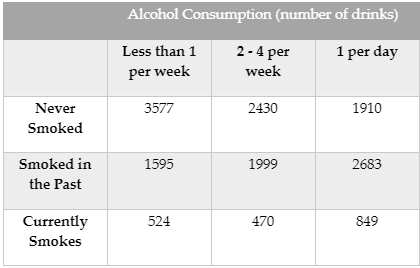
The following table is based on data from 21,870 physicians aged 40 – 84 who are participating in the Physicians Health Study (“Light-to-Moderate Alcohol Consumption and Risk of Stroke Among US Physicians,” New England Journal of Medicine [2019]: 1557 - 1564):
-
Calculate row proportions by dividing each observed count by the corresponding row total. Are the proportions falling in each of the alcohol consumption categories similar for the three smoking categories?
-
Test the hypothesis using 𝛼 = 0.05 that Smoking Status and Alcohol Consumption are independent.
-
Is your test result in Part 2 consistent with what you expected based on your answer to Part 1? If not, explain why your initial impression based on the proportions may not have been accurate.
Step 3. Respond
Respond to the case problem by writing answers to Parts 1, 2, and 3.
Step 4. Share
To share your work, access to the first post below and click on the “Reply” button under this post and paste your work into the “Message” box. Make sure to reference others’ intellectual property when necessary. All references should follow 7th Edition APA formatting. For further instructions, see the resource on the Himmelfarb Health Sciences Library: APA citation resource (N.B. references are excluded from word counts).
OPTIONAL Step 5: Interact (10 minutes)
If you would like to, you can reply to your peers' posts in a respectful and professional manner. Ensure that your post engages your peers' ideas by including a reflection on their comments, sharing ideas of other potential difficulties and parties involved, or asking thought-provoking questions. If a peer comments on your posting, please reply. To post a reply, click “Reply” on a particular discussion, write your feedback and then click on “Post to forum.”
-
-
Students mustViewReceive a gradeReceive a passing grade
To access the quiz, click on the name of the quiz provided above. On the following screen, click the attempt quiz button to respond to the questions.
-
Quiz: Module 7
To access the quiz, click on the name of the quiz provided above. On the following screen, click the attempt quiz button to respond to the questions.
TO PASS THIS QUIZ YOU MUST OBTAIN A SCORE OF 80%.