

Section: Module 6: Program Management and Evaluation | Global Health | NextGenU.org
-
Competencies covered in this module:
- Apply monitoring and evaluation techniques to global health programs, policies, and outcomes.
-
Students mustView
Read the content under the heading:
What Is a Community Health Assessment? (3 minutes)CDC - 2021
-
Students mustView
Read the content under the heading: Conduct a Needs Assessment. (3 minutes)
Rural Health Information Hub - 2017
-
Students mustView
Read the following sections of the article: Introduction, Discussion (11 minutes)
Health Research Center, School of Public Health, West Virginia University - 2020
-
Students mustView
Read the first four paragraphs of the paper. (5 minutes)
National Academy of Medicine - 2015
-
Students mustView
Read the entire page. (9 minutes)
National Institute for Children Health Quality - 2020
-
Students mustView
Read the entire content. (15 minutes)
Compass/ USAID - 2021
-
Students mustView
Read the entire page. (17 minutes)
GrassCollective organization - 2021
-
Peer Activity 7 - A Country-Specific SWOT Analysis (300 minutes) Forum
In this activity, you will select a health situation in a specific country and use situational analysis to gain a deeper understanding of the opportunities, challenges, and barriers to change the health situation.
Step 1. Explore
Explore this country profile health metric and evaluation website: https://www.healthdata.org/results/country-profiles. Select one country of interest in the dropdown menu under the heading COUNTRY PROFILES. Keep in mind that you will continue working with the same country in the next lesson.
Example: JAPAN- Nagasaki.
Step 2. Study
Study the health metric data of the chosen country. Focus on the following areas:
- Life expectancy, mortality, morbidity
- Causes of mortality, morbidity, and disability
- Risk factors
- More data (optional)
Step 3. Select and Assess
From the health data of the country, select one health issue, problem or behavior that spans across a range of cultural, economic, and health environments that you want to address. Then conduct a brief situational analysis. The situational analysis must answer the following questions:
- What is the current health situation here that demands an intervention? (Understand the broad context)
- What are potential challenges within the country?
- What is the country’s capacity to address this problem? Consider different cultural, economic, and health environments.
- What are the best ways to reach priority groups associated with the current health situation?
Step 4. Conduct
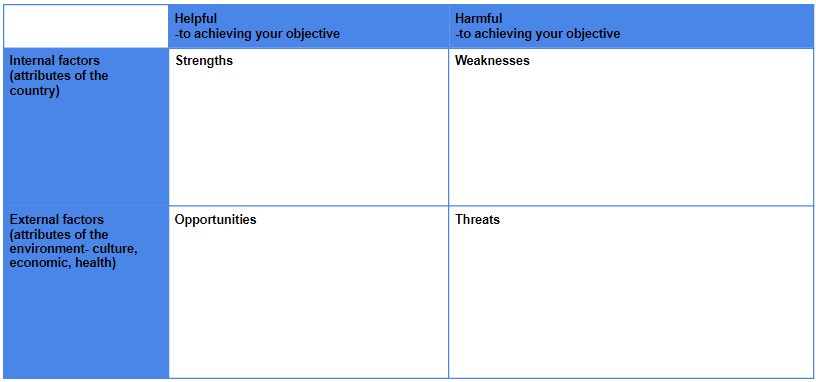
Conduct a situational analysis by presenting your findings using this framework:
Step 4. Share
To share your work, click on the “Add a new discussion topic” button under this post and paste your operational assessment table, including the summary in the “Message” box. Make sure to reference others’ intellectual property when necessary. All references should follow 7th Edition APA formatting. For further instructions, see the resource on the Himmelfarb Health Sciences Library: APA citation resource (N.B. references are excluded from word counts).
Step 5: Interact
Evaluate and categorize the work from one of your peers based on items A - E of this rubric. Provide a rationale for the grade you’ve provided, as well as comments or suggestions for improvement. To post a reply, click “Reply” on a particular discussion, write your feedback and then click on “Post to forum.” You can use the list below as an example:
Item A is .…. because…. My suggestions for improvement are….
Item B is .…. because…. My suggestions for improvement are….
Item C is .…. because…. My suggestions for improvement are….
Item D is .…. because…. My suggestions for improvement are….
Item E is .…. because…. My suggestions for improvement are…. -
Read the content under the section SECTION 2: Plan for community needs assessment. (25 minutes)
CDC - 2013
-
Students mustView
Read the entire page. (11 minutes)
Havard University
-
Students mustView
Read the entire document. (7 minutes)
Public health Ontario - 2021
-
Students mustView
Read the entire page. (7 minutes)
Center for family research & evaluation - 2020
-
-
Students mustView
Read the following contents of the document: Using the Logical Framework for Project Design pages 12-22. (25 minutes)
EU Integration Office - 2011
-
Students mustView
Read the entire page, including the content of the following hyperlink:
Gantt chart: Plan-do-check-act (PDCA) cycle. (12 minutes)American Society for Quality - 2021
-
Students mustView
Read the entire page and navigate on the tabs "Planner" and "How to" to explore tools for projects implementations. (10 minutes)
UNESCO for YOUTH - 2018
-
Students mustView
Read pages 4-7 of the document. (21 minutes)
European Coordination in Science and Technology - 2017
-
Students mustView
Read the entire page. (27 minutes)
Progect Management Institute
-
-
Peer Activity 8 - A Logical Framework Approach for Evidence-Based Program Implementation and Evaluation (360 minutes) Forum
In this activity, you will use your findings from Peer Activity 8’s situational analysis to draft a logical framework for evidence-based program implementation and evaluation.
Step 1. Review
Review the learning resources for this module, especially the ones focused on developing a log frame approach and monitoring and evaluation tools. Additionally, review the situational analysis product from Peer Activity 7. This will be used in this activity.
Step 2. Draft
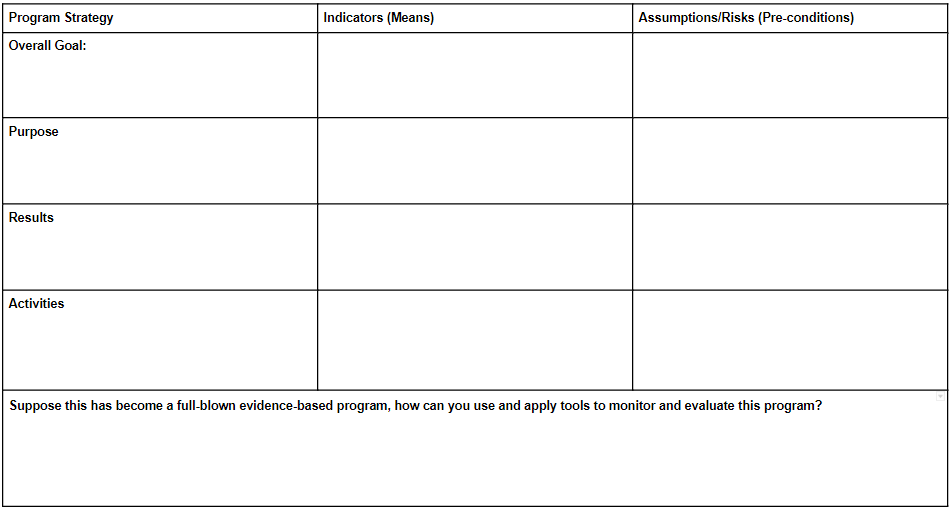
Based on your situational analysis product, draft a logical framework for evidence-based program implementation and evaluation. The log frame should list your program activities, short-term outputs, medium-term outcomes, and long-term goals to address the problem selected in peer activity 7. The logframe must summarize the following:
- The program's hierarchy of objectives.
- Indicators to measure changes connected to an intervention
- Assumptions beyond the program’s direct control that are necessary to ensure the program’s success.
Step 3. Respond
Respond by placing your drafted log frame in the table below. The contents of this table should be within 300-700 words only.
Step 4. Share
To share your work, click on the “Add a new discussion topic” button under this post and paste your operational assessment table, including the summary in the “Message” box. Make sure to reference others’ intellectual property when necessary. All references should follow 7th Edition APA formatting. For further instructions, see the resource on the Himmelfarb Health Sciences Library: APA citation resource (N.B. references are excluded from word counts).
Step 5: Interact
Evaluate and categorize the work from one of your peers based on items A - E of this rubric. Provide a rationale for the grade you’ve provided, as well as comments or suggestions for improvement. To post a reply, click “Reply” on a particular discussion, write your feedback and then click on “Post to forum.” You can use the list below as an example:
Item A is .…. because…. My suggestions for improvement are….
Item B is .…. because…. My suggestions for improvement are….
Item C is .…. because…. My suggestions for improvement are….
Item D is .…. because…. My suggestions for improvement are….
Item E is .…. because…. My suggestions for improvement are…. -
Quiz: Module 6
To access the quiz, click on the name of the quiz provided above. On the following screen, click the "Preview quiz now" button to respond to the questions.
TO PASS THIS QUIZ, YOU MUST OBTAIN A SCORE OF 80%