
-
Introduction
Show More Show LessThis Pediatric Nursing course provides information and instructions on foundational concepts and principles of nursing care related to Pediatric health concerns in the hospital and/or community settings. This includes applying knowledge and skills required in nursing care for families with children. The goal is to provide a strong foundation in nursing theory, critical thinking and clinical judgment, evidence-based practice, and safe clinical care in all settings for children’s health.
-
Students mustStudent must submit this questionnaire to complete it
-
Students mustMark as done
Show More-


DISCLAIMER: This content is designed to enhance the study of nursing. This content is generic and is not designed to take into account the specific objectives, needs, and/or circumstances of any particular region or country. To become a nurse, learners must successfully complete a program of study approved by the government or state-regulatory agency in their place of residence. We cannot guarantee that the successful completion of these materials will enable you to practice in your place of residence. Make sure that you are in compliance with the scope of practice of your regulatory body before attempting to put into use or practice any of the knowledge gained.
This Pediatric Nursing course provides information and instructions on foundational concepts and principles of nursing care related to Pediatric health concerns in the hospital and/or community settings. This includes applying knowledge and skills required in nursing care for families with children. The goal is to provide a strong foundation in nursing theory, critical thinking and clinical judgment, evidence-based practice, and safe clinical care in all settings for children’s health.
The scope of pediatric nursing practice varies widely depending on the country, the national and regional government, and professional regulatory agencies. This course addresses nursing skills and practices on several levels to be relevant to the global pediatric nursing community. It is the nurse’s responsibility to know what particular regulations apply to their practice area.
The Pediatric Nursing course is a competency-based course developed in partnership with Nurses International (N.I.) and NextGenU.org (NGU). Competencies were developed in collaboration with subject matter experts in Pediatric nursing education and practice. The Essentials: Core Competencies for Professional Nursing Education direct the course objectives. The course uses learning resources from accredited world-class organizations such as the World Health Organization (WHO), the U.S. National Institutes of Mental Health (NIMH), universities, international guidelines, and peer-reviewed journals. The Moodle Learning Management System (LMS) facilitates distance learning. The course was designed by NextGenU’s Instructional Design team and Nurses International’s team members: Kathleen Capone MS, RN CNE, EdD; Cissy Ondoma Nakyajja RN Ph.D.; Betsy Woods MSN, R.N., CPEN; Emily Pappa MSN, R.N.; Lourdes Webster RN, BSN, MSN; Rachel Loftin, MSN, R.N.; Stephanie Marfurt APRN-BC, ARNP-BC; Marija Bjegovich-Weidman RN, BSN, MSN, CCAP; Jordan Wilson MSN, RN-BC; Caitlin Cartmell MFS, BSN, R.N.; NPD-BC;
There are 6 units/modules to complete, which include:
Unit 1: Perspectives in Pediatric Nursing
Unit 2: Child Growth and development in the context of family and community
Unit 3: Therapeutic communication and cultural competence with children and families
Unit 4: Nursing care of the sick child
Unit 5: Child Maltreatment
Unit 6: Community-Based Pediatric Nursing CareInstructions:
The course consists of six (6) learning units. Included in the units are individual lessons with accompanying assigned reading resources, PowerPoint presentations with speaker notes, learner self-assessments, and interactive clinical judgment learning activities. A passing grade of 80% is required on quizzes and unit exams, as well as submission of the required activities for all case studies/reflection activities to gain access to the next lesson or section.
There is a 50-question multiple-choice exam at the end of the course. A grade of 80% is required. If a grade of 80% is not achieved, the learner may be self-remediate and take another exam. The second exam is of comparable content, and 80% is required for a passing grade.
*Kindly note that you must complete Pediatric Nursing Parts 1 and 2 in order to earn the certificate.
A certificate of completion may be downloaded upon successful completion of the course.
Engaging with this Course:
Learners may take this course at no cost for personal enrichment. There are no course prerequisites.
To obtain a certificate, the learner must successfully complete:
- All the reading requirements;
- All quizzes and unit exams with a passing grade of 80%;
- All activities and case studies;
- The final exam with a minimum of 80% and a maximum of 2 attempts, and;
- The self and course evaluation forms.
NextGenU.org is happy to provide your institution with:
- A link to, and, a description of the course training, so they can see all its components, including the co-sponsoring universities and other professional organization co-sponsors;
- Your grade on the final exam;
- Your work products (e.g. case study activities) and any other required or optional shared materials that you produce and authorize to share with them;
- Your evaluations -- course and self-assessments;
- A copy of your certificate of completion.
To obtain a degree:NextGenU.org co-sponsors degree programs with institutional partners. To obtain a full degree co-sponsored with NextGenU.org, registrants must be enrolled in a degree program as a student of a NextGenU.org institutional partner. If you think that your institution might be interested in offering a degree with NextGenU.org please feel free to contact us.
We hope that you will find this a rewarding learning experience, and we count on your assessment and feedback to help us improve this training for future students.
For Nurse Educators:
- There are teacher resources for this course, including didactic and clinical syllabi, a teacher’s guide, and suggested teaching activities.
- Nurse educators may contact info@nursesinternational.org with queries/permission to access faculty files for this course.
Technical Support for Learners and Educators:If you experience any difficulties with the technical aspects of the course or access to any course activities, please contact <strong>support@nextgenu.org</strong> for assistance.
-

Unit Objectives:
- Explain the role of the nurse in the care of children and families.
- Describe a family-centered approach to the care of children and their families.
- Analyze the structures, roles, and functions of the family and how they affect the health of children.
- Identify health care barriers affecting children and families.
- Identify legal and ethical issues related to the care of children and nurses’ role.
- Identify and define measurements used to assess health and illness in children.
-
Students mustView
Read the entire page. (2 minutes)
Cleveland Clinic
-
Students mustView
Read the Introduction and Result. (14 minutes)
Journal of medical ethics and history of medicine
-
Students mustView
Read the Newborns and Infants, Toddlers, Preschoolers, School-aged children, and Adolescents. (7 minutes)
Nurses Lab
-
-
Students mustView
Read the table containing Evidence-Based practice. (2 minutes)
Qsen Institute
-
Students mustView
Read the entire article. (12 minutes)
Rasmussen University
-
Students mustView
Read the entire page. (6 minutes)
USAHS- University of St. Augustine for Health Sciences
-
Students mustView
-
Quiz: Unit 1.1
To access the quiz, click on the name of the quiz provided above. On the following screen, click the attempt quiz button to respond to the questions.
-
Students mustView
Read the whole article. (4 minutes)
Health Resources and Services Administration, U.S Department of Health and Human Services
-
Students mustView
Open ‘Child Growth and Development' and read about family structures from pages 311-316. (13 minutes)
‘Child Growth and Development - ECE 101’ by College of the Canyons
-
Students mustView
Read the article from section ‘Becoming a grandparent’ to ‘Grandparents as parents’. (12 minutes)
Association of Child Psychotherapists
-
Students mustView
Read the fourth and fifth paragraphs of the section ‘Conditions for and consequences of grandparent involvement’. (3 minutes)
Journal of Academy of Social Sciences
-
Students mustView
Read the entire article. (2 minutes)
Federal Student Aid, An Office of the U.S. Department Education
-
Students mustView
Read the entire article. (3 minutes).
New South Wales Government
-
Students mustView
Read the section ‘Issues of Concern’. (5 minutes)
StatPearls [Internet]
-
Students mustView
Read the entire article. (1 minute)
American Psychological Association
-
Students mustView
Identify different diseases that run in the family. (2 minutes)
Genetic Alliance, Washington
-
Students mustView
Read the entire article. (5 minutes)
American Academy of Pediatrics
-
Students mustView
Read the key points in the box. (1 minute)
Canadian Pediatric Society
-
Students mustView
Read first paragraph of ‘Under-five mortality’. (1 minute)
UNICEF
-
Students mustView
Read the section ‘How Do Families Influence Child Health?’. (17 minutes)
The Future of Children Journal
-
Students mustView
Read from ‘Breastfeeding’ to the second paragraph of ‘Contingent Responsiveness of Parents’. (35 minutes)
‘Parenting Matters: Supporting Parents of Children Ages 0-8’ by National Academies of Sciences, Engineering, and Medicine
-
Quiz: Unit 1.2
To access the quiz, click on the name of the quiz provided above. On the following screen, click the attempt quiz button to respond to the questions.
-
Students mustView
Read the entire page. (3 minutes)
University of Florida Health
-
Students mustView
Read section ‘Family-Centered Care’. (4 minutes)
Pediatrics and Neonatal Nursing Journal
-
Students mustView
Read the section ‘Core Principles of Patient- and Family-Centered Care’. (4 minutes)
Pediatrics Journal
-
Students mustView
Read the section ‘What is Family-Centered Care?’. (5 minutes)
Maternal and Child Health Journal
-
Students mustView
Read from ‘Model Components’ to ‘Discussion’. (11 minutes)
BMC Health Services Research
-
Students mustView
Read ‘Children and Youth with Special Health Care Needs (CYSHCN)’ and ‘Our Approach to CYSHCN’. (2 minutes)
Health Resource & Services Administration, Maternal and Child Health
-
Students mustView
Read ‘Definitions’, ‘Macro Level’, and ‘Micro Level’. (5 minutes)
Archives of Pediatrics and Adolescent Medicine
-
Students mustView
Read the section ‘Synthesis of Findings’. (13 minutes)
Journal of Hospice and Palliative Nursing
-
Students mustView
-
Quiz: Unit 1.3
To access the quiz, click on the name of the quiz provided above. On the following screen, click the attempt quiz button to respond to the questions.
-
Students mustView
Read the definition for mortality. (1 minute)
National Cancer Institute
-
Students mustView
Read the first paragraph of section ‘Section 2: Morbidity Frequency Measures’. (1 minute)
Centers for Disease Control and Prevention
-
Students mustView
Read the definitions of different mortality indicators of the sub-section Definition of indicators’ of the section ‘Notes on the data’. (1 minute)
UNICEF
-
Students mustView
Read the section ‘The neonatal period is the most vulnerable time for a child’. (1 minute)
UNICEF
-
-
Students mustView
Read the sections ‘About Infant Mortality' and ‘Causes of Infant Mortality. (2 minutes).
Centers for Disease Control and Prevention
-
-
Students mustView
Read the section ‘Under-five mortality’. (1 minute)
UNICEF
-
Students mustView
Read the sections ‘Key facts’. (2 minutes)
WHO
-
Students mustView
Read the entire section ‘The challenge’. (3 minutes).
UNICEF
-
Students mustView
-
Quiz: Unit 1.4
To access the quiz, click on the name of the quiz provided above. On the following screen, click the attempt quiz button to respond to the questions.
-
Students mustView
Read the sections ‘What are ethics?’ and ‘What are applied ethics?’. (5 minutes)
Government of Canada
-
Students mustView
Read the entire section of ‘Results’. (12 minutes)
Journal of Medical Ethics and History of Medicine
-
Students mustView
Read the abstract. (1 minute)
Journal of Business Ethics
-
Students mustView
Read the section ‘Discussion’. (5 minutes)
Ethics & Behavior Journal
-
Students mustView
Read the entire section ‘Overview of Core Ethical Principles in Modern Western Medicine’. (14 minutes)
StatPearls[Internet]
-
-
Students mustView
Read pages 7, 8, 12, 15, and 18. (8 minutes)
International Council of Nurses
-
Students mustView
Read the section ‘The Phenomenon of Moral Distress’. (5 minutes).
The Online Journal of Issues of Nursinh
-
Students mustView
Read the journal article starting from the section ‘Moral distress: barriers to ethical action in pediatric intensive care’,to the section ‘Confronting moral distress and promoting moral courage and resilience - "in our team, everyone has a voice".’. (19 minutes)
Rev Bras Ter Intensiva Journal
-
Students mustView
Read the entire article ‘Doctors share ethical issues that worry them most’. (25 minutes)
Contemporary PEDs Journal
-
Students mustView
Read the section ‘Results’. (8 minutes)
Child and Adolescent Social Work Journal
-
Students mustView
Read the section ‘Results’. (7 minutes)
BMC Medical Ethics
-
-
Students mustView
-
Quiz: Unit 1.5
To access the quiz, click on the name of the quiz provided above. On the following screen, click the attempt quiz button to respond to the questions.
-

Unit Objectives:
- Identify normal developmental changes occurring in children (0-17yrs).
- Assess health and development of child (0-17) years.
- Discuss the nutritional requirements of children based on their developmental stage.
- Apply knowledge and understanding of theories of psychological development.
- Identify and discuss social, cultural, and environmental/ community factors that influence child development.
-
Students mustView
Read Chapter 3. (1 hour and 50 minutes)
College of Lake County Foundation
-
Students mustView
Read the Developmental Theories of Eriksons, Piaget’s, Sigmund Freud. (30 minutes)
College of the Canyons
-
Students mustView
Read Figure number 3. (8 minutes)
NIH: Revista latino-americana de enfermage
-
Students mustView
-
Students mustView
-
Students mustView
-
Students mustView
-
Students mustView
-
Students mustView
-
Quiz: Unit 2.1
To access the quiz, click on the name of the quiz provided above. On the following screen, click the attempt quiz button to respond to the questions.
-
-
-
Students mustView
Read chapter 4 Physical Development of Infant and Toddlers. (20 minutes)
-
Students mustView
Read the entire page. (4 minutes)
Better Health
-
Students mustView
Read the pages from 1 to 9. (22 minutes)
-
Students mustView
Read the entire page. (6 minutes)
American Heart Association
-
Students mustView
Read the entire page. (15 minutes)
J PaediatrNursSci -
Students mustView
Read the section “Discussion”. (15 minutes)
Revista latino-americana de enfermagem
-
Students mustView
-
Students mustView
-
Students mustView
-
Students mustView
-
Students mustView
-
Quiz: Unit 2.2
To access the quiz, click on the name of the quiz provided above. On the following screen, click the attempt quiz button to respond to the questions.
-
Students mustView
Read chapter 7 Physical Development of Early Childhood. (30 minutes)
-
Students mustView
Read the pages from 1 to 9. (22 minutes)
-
Students mustView
Read the entire page. (6 minutes)
American Heart Association
-
Students mustView
Read the entire page. (15 minutes)
J PaediatrNursSci -
Students mustView
Read the section “Discussion”. (15 minutes)
Revista latino-americana de enfermagem
-
Students mustView
-
Students mustView
-
Students mustView
-
Students mustView
-
Students mustView
-
Quiz: Unit 2.3
To access the quiz, click on the name of the quiz provided above. On the following screen, click the attempt quiz button to respond to the questions.
-
-
-
-
-
Students mustView
Open the book on 'Child Growth and Development' by clicking on PDF link. Read pages 238-244, 249-253, 269-273, 302-303, 306-309. (40 minutes)
‘Child Growth and Development - ECE 101’ by College of the Canyons
-
Students mustView
-
Students mustView
-
Students mustView
-
Students mustView
-
Quiz: Unit 2.4
To access the quiz, click on the name of the quiz provided above. On the following screen, click the attempt quiz button to respond to the questions.
-
Students mustView
Read the entire article. (6 minutes)
American Heart Association
-
Students mustView
Read chapter 6. (1 hour 15 minutes)
College of Lake County Foundation
-
Students mustView
Read the entire article. (20 minutes)
College of the Canyons
-
Students mustView
-
Students mustView
-
Students mustView
-
Students mustView
-
Quiz: Unit 2.5
To access the quiz, click on the name of the quiz provided above. On the following screen, click the attempt quiz button to respond to the questions.
-
-
Students mustView
Read the section “Risk of Injuries and Stages of Development”. (12 minutes)
The California Childcare Health Program
-
Students mustView
Read the entire page. (18 minutes)
Niagara Region -
Students mustView
Read the entire page. (12 minutes)
SafeHome.Org
-
Students mustView
Read the "Abstract". (2 minutes)
Crit Care Nurs Clin North Am -
Students mustView
-
Quiz: Unit 2.6
To access the quiz, click on the name of the quiz provided above. On the following screen, click the attempt quiz button to respond to the questions.
-
Students mustView
Read the section “ Pediatric History” and “ Physical Examination of the Infant and Child”. (20 minutes)
Government of Canada
-
Students mustView
Read the entire page. (20 minutes)
Better Care
-
Students mustView
Read the entire page. (9 minutes)
Stanford Children’s Health
-
Students mustView
-
Quiz: Unit 2.7
To access the quiz, click on the name of the quiz provided above. On the following screen, click the attempt quiz button to respond to the questions.
-
-
-
-
Students mustView
Read the entire page. (12 minutes)
Centers for Disease Control and Prevention.
-
Students mustView
Read the section “ What is herd immunity?”. (2 minutes)
Association for Professionals in Infection Control and Epidemiology
-
Students mustView
Read the entire page. (2 minutes)
The OpenLearn Create
-
-
Students mustView
Read the section “ Barrier to childhood vaccines and possible solution”. (7 minutes)
Missouri medicine
-
Students mustView
Read the entire page. (4 minutes)
The Chicago School
-
Students mustView
-
Students mustView
-
Students mustView
-
Students mustView
-
Students mustView
-
Students mustView
-
Students mustView
-
Students mustView
-
Quiz: Unit 2.8
To access the quiz, click on the name of the quiz provided above. On the following screen, click the attempt quiz button to respond to the questions.
-
Students mustView
Read the sections "Introduction" and "Factors Affecting Growth and Development." (5 minutes)
StatPearls Publishing
-
Students mustView
Read the entire page. (9 minutes)
National Institute of Health.
-
Students mustView
Read the sections “Family Influence, Peer Influence, School Influence and Conclusion”. (13 minutes)
World Journal of Education. -
-
Students mustView
Read the section “ Community”. (10 minutes)
Institute of Medicine (US) and National Research Council (US) Committee on the Science of Adolescence
-
Students mustView
Read the entire page. (1 minute)
Child Information Gateway
-
Students mustView
Read the entire page. (12 minutes)
Maryville University -
Quiz: Unit 2.9
To access the quiz, click on the name of the quiz provided above. On the following screen, click the attempt quiz button to respond to the questions.
-
Combined Unit Exam 1 Quiz
To access the exam, click on the name of the exam provided above. On the following screen, click the attempt quiz button to respond to the questions.
-
Unit Objectives:
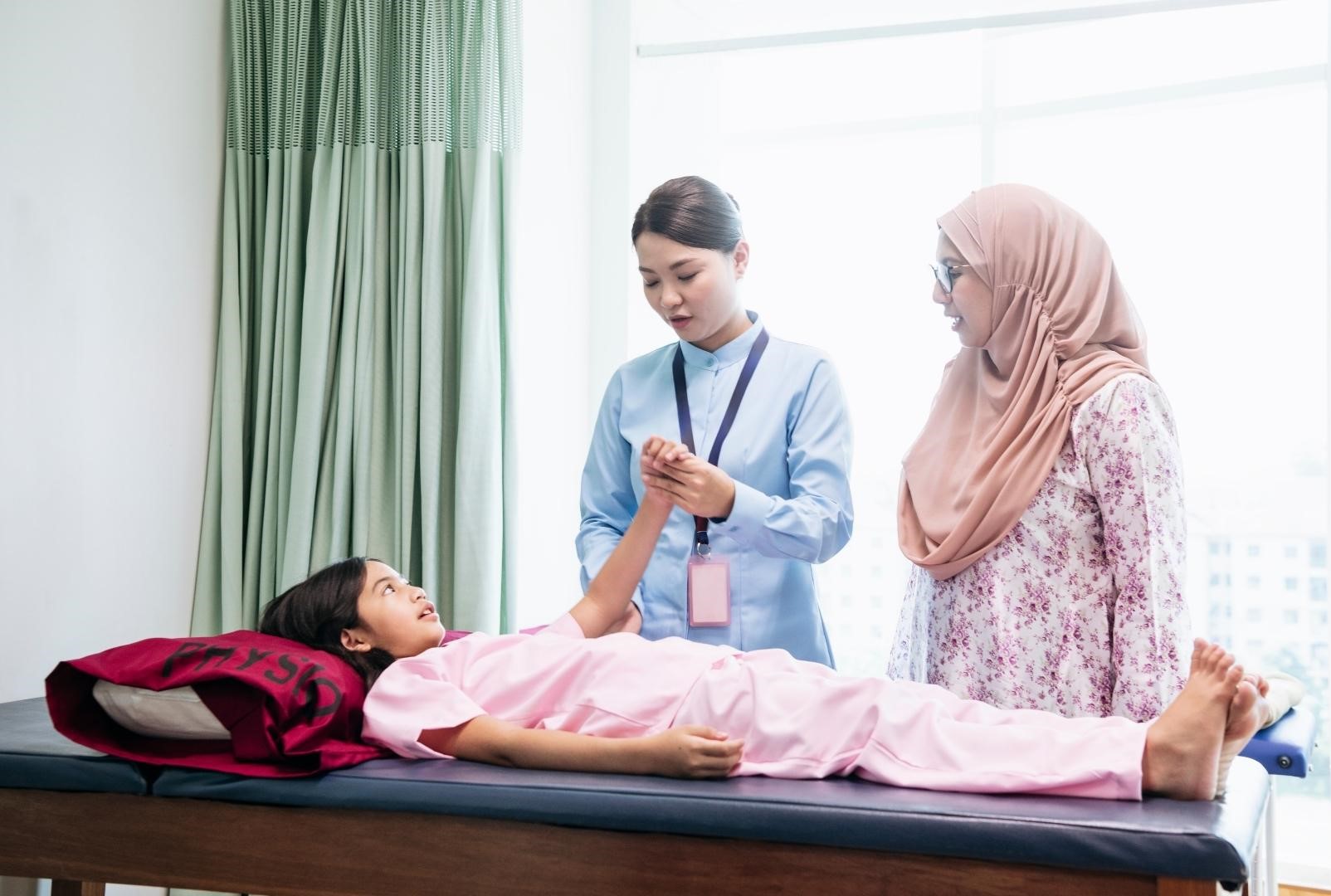
- Demonstrate appropriate and effective communication techniques/skills with child and family based on their age, ability, language, culture, and another relevant contexts.
- Discuss barriers to effective communication with the child and family.
- Identify strategies nurses can apply to foster effective therapeutic communication.
-
Students mustView
Read "Communication with Patients". (25 minutes)
Wisconsin Technical College System
-
Students mustView
Read the Chapter 2: Communication strategies, Non-verbal communication, Cultural considerations. (14 minutes)
Press Books
-
Students mustView
Go to the link, download the file, and read Chapter 1 and Chapter 14. (1 hour 15 minutes)
Texas Children’s Hospital
-
Students mustView
-
Quiz: Unit 3.1
To access the quiz, click on the name of the quiz provided above. On the following screen, click the attempt quiz button to respond to the questions.
-
Students mustView
Read from ‘Communicating Within the Family System’ to end of ‘Cognitive Orientations and Communication’. (29 minutes)
Oxford Research Encyclopedia of Communication
-
Students mustView
Read from ‘Family Communication Patterns’ to end of ‘Laissez-faire’. (6 minutes)
The LibreTexts libraries
-
Students mustView
Read from ‘Family Communication Processes’ to ‘Key Takeaways’. (12 minutes)
University of Minnesota
-
Students mustView
Read the entire article. (9 minutes)
Raising Children Network
-
Students mustView
Read ‘3. Communication process’, ‘5. Types of communication’, and ‘8. Improving communication’. (3 minutes)
Intechopen
-
Students mustView
Read pages 13-1, 50-55, 68, 92-96, 215-219. (1 hour and 30 minutes)
‘Communicating with Pediatric Patients and their Families: The Texas Children’s Hospital Guide for Physicians, Nurses and other Healthcare Professionals’ by Texas Children’s Hospital
-
Students mustView
Open ‘FCS Sheet 8: Effective communication in family-centred service’ and read pages 3-4. (4 minutes)
CanChild, McMaster University
-
Students mustView
-
Quiz: Unit 3.2
To access the quiz, click on the name of the quiz provided above. On the following screen, click the attempt quiz button to respond to the questions.
-
Students mustView
Read the section ‘Definition of the nurse’. (1 minute)
International Confederation of Nurses
-
Students mustView
Read the entire section ‘Patient Education’. (4 minutes)
‘Holland-Frei Cancer Medicine’ 6th edition
-
Students mustView
Read the article from the section ‘WHY IS PATIENT EDUCATION IMPORTANT’ to the section ‘HOW ARE PATIENTS DIFFERENT?’. (5 minutes)
Arkansas State University
-
Students mustView
Read sections ‘Expected Beneficial Outcomes’ and ‘Other Potential Beneficial Outcomes’. (1 minute)
University of Wisconsin Population Health Institute, 2019
-
Students mustView
Read first paragraph of the section ‘Background’, and the entire section ‘Educating children, adolescent, and young adult patients’. (13 minutes).
eviQ, NSW Government
-
Students mustView
Read the article from section ‘Patient-teaching techniques that work’ to the section ‘Asking key assessment questions’. (9 minutes)
‘Nursing’ Journal -
Students mustView
Read the entire article. (21 minutes)
Lippincott Nursing Center
-
Students mustView
Read the entire article. (4 minutes)
Emporia State University
-
Students mustView
Read the entire article. Texts in enclosed boxes are optional. (5 minutes)
‘GSC Lesson Planning 101’ by Deborah & Shumway-Pitt -
Students mustView
Read the entire article. (3 minutes)
A.D.A.M. Inc.
-
Students mustView
Read the entire article. (6 minutes)
A.D.A.M. Inc.
-
Students mustView
-
Quiz: Unit 3.3
To access the quiz, click on the name of the quiz provided above. On the following screen, click the attempt quiz button to respond to the questions.
-
Students mustMark as done
Read the entire article. (4 minutes)
University of Minnesota
-
Students mustMark as done
Read the entire article. (15 minutes)
Canadian Pediatric Society
-
Students mustMark as done
Read the entire article. (17 minutes)
‘Nursing’ Journal
-
Students mustMark as done
Read the entire article. (4 minutes)
Nursing Made Incredibly Easy! Wolters Kluwer Health
-
Students mustMark as done
Read the sections ‘Communication’ and ‘Provider Opennes and Awareness’. (7 minutes)
Pediatrics and Neonatal Nursing
-
Students mustMark as done
Read the sections ‘Barriers reported by practitioners’, ‘Facilitators reported by practitioners’, and ‘Facilitators reported by patients/caregivers’. (22 minutes)
BMC Health Services Research
-
Students mustMark as done
Read the entire article. (16 minutes)
NebGuide, Nebraska Extension Publications
-
Students mustMark as done
Read chapter 28 ‘Communicating across Cultural Differences’. (40 minutes)
Texas Children’s Hospital
-
Students mustMark as done
-
Read the entire article. (41 minutes)
University of Minnesota
-
Quiz: Unit 3.4
To access the quiz, click on the name of the quiz provided above. On the following screen, click the attempt quiz button to respond to the questions.
-
-
Students mustViewStart discussions: 1Post replies: 1
In this activity, you will complete a branching case study and reflect on the decisions you have made throughout the case study.
Step 1: Complete the branching case study.
Based on the context of the case study provided, make decisions by choosing the best answer options. Continue making decisions and reflecting-in until you make it to the last scenario of the case study.
Step 2: Reflect
In a minimum of 200 words, reflect on the decisions you have made throughout the case study, what you have learned, and explain how you might use this information for your future practice to assure safe client care.
Step 3: Share
To share your work, click on the “Add a new discussion topic” button under this post and paste your work in the “Message” box. Make sure to reference others’ intellectual property when necessary. All references should follow 7th Edition APA formatting. For further instructions, see the resource on the Himmelfarb Health Sciences Library: APA citation resource (N.B. references are excluded from word counts).
Step 4: Interact
To complete this activity, you will need to reply to at least one post made by your peers in a respectful and professional manner. Be sure that your post engages your peers' ideas by providing feedback on their comments, sharing ideas of other potential problems/solutions, or asking thought-provoking questions. If a peer comments on your posting, please reply. To post a reply, click “Reply” on a particular discussion list below, write your feedback and then click on “Post to forum.”
If you are the first learner attempting the activity and there is no other post from peers to reply to, contact support@nextgenu.org to request access to the next activity manually.
-
Students mustViewComplete the activity
-
-
-
Students mustViewStart discussions: 1
-
Feedback: Case Study 1 - Part 1 Forum
-
Students mustViewStart discussions: 1
-
Feedback: Case Study 1 - Part 2 Forum
-
Students mustViewStart discussions: 1
-
Feedback: Case Study 1 - Part 3 Forum
-
Students mustViewStart discussions: 1
-
Feedback: Case Study 1 - Part 4 Forum
-
Students mustViewStart discussions: 1
-
Feedback: Case Study 2 - Part 1 Forum
-
Students mustViewStart discussions: 1
-
Feedback: Case Study 2 - Part 2 Forum
-
Students mustViewStart discussions: 1
-
Feedback: Case Study 2 - Part 3 Forum
-
-
 In this section, after completion of the required activities, students can access the password for part 2 of this course. Please let us know if you face issues accessing the Pediatric Nursing Part 2 at info@nextgenu.org.
 -
-
Students mustMark as done
-
Students mustMark as done
-
Students mustMark as done
-
Students mustMark as done
-
