You do not have permission to view discussions in this forum.
-
Introduction
Show More Show LessWelcome to the Organic Chemistry 2 course, part of the series for the Pre-Health Sciences Training Certificate. This course and the certificate are designed primarily for learners interested in preparing for and gaining entry to health-related programs and to help address the prerequisites for the Medical College Admission Test (MCAT). Our Organic Chemistry 2 course provides learners with a comprehensive overview of the fundamental principles of chemistry.
-
Students mustStudent must submit this questionnaire to complete it
-
Students mustViewReceive a grade
Show More-
Organic Chemistry 2 Homepage
Highlighted

Welcome to the Organic Chemistry 2 course, part of the series for the Pre-Health Sciences Training Certificate. This course and the certificate are designed primarily for learners interested in preparing for and gaining entry to health-related programs and to help address the prerequisites for the Medical College Admission Test (MCAT). Our Organic Chemistry 2 course provides learners with a comprehensive overview of the fundamental principles of chemistry.
This course covers basic principles and concepts of Organic Chemistry, such as carboxylic acids, aldehydes, ketones, synthesis, the reactivity and chemistry of enolates, and the techniques used for the separation of mixtures, among others.
The Organic Chemistry 2 course is sponsored in part by the International Development Research Centre and the University of the Incarnate Word School of Osteopathic Medicine. Like all NextGenU.org courses, it is competency-based, using competencies based on the Association of American Medical Colleges’ Medical College Admission Test. It uses learning resources from accredited, academic, professional, and world-class organizations and universities, such as Rice University. This course was designed by Alixandria Ali, B.Sc.; Kabiru Gulma, B. Pharm, Ph.D. M.Sc., MBA; Sherian Bachan, M.Sc., B.Sc.; Marco Aurelio Hernandez, Ph.D., MSc; MSc; BSc.; and Felix Emeka Anyiam, MPH, MScPH, DataSc.
For publications on the efficacy of NextGenU.org’s courses, see NextGenU.org’s publication page.
There are seven (7) modules to complete, which provide an introduction to:
Module 1: Carboxylic Acids
Module 2: Aldehydes and Ketones
Module 3: Enolate Chemistry and Aldols
Module 4: Aromatic Systems and Amines
Module 5: Nitrogen-and Phosphorus-Containing Compounds
Module 6: Spectroscopy
Module 7: Separations and PurificationsThe completion time for this course is estimated at 69 hours, comprising 21 hours of learning resources, 41 hours of studying and assimilation of the content, and 7 hours of participating in learning activities and quizzes to assist learners in synthesizing learning materials. This course is equivalent to 1 credit hour in the U.S. undergraduate/bachelor’s degree system.
The course requires the completion of all quizzes, discussion forums, and practical activities to receive a course certificate. Practice quizzes are available throughout the course and contain ten multiple-choice questions each. After completing each module, quiz, and learning activity, at the end of the course, you will have access to a final exam consisting of 40 multiple-choice questions and a chance to evaluate this course. Participants have up to three opportunities to take the final exam and achieve the required passing score of >=70%. Once you have passed the final exam and completed the evaluations, you can download a certificate of completion from NextGenU.org and our course’s co-sponsoring organizations.
We keep your personal information confidential, never sell any of your information, and only use anonymized data for research purposes. Also, we are happy to report your testing information and share your work with anyone (your school, employer, etc.) at your request.
Engaging with this Course:
This free course is for students who have graduated from high school and want to prepare to become a health professional and/or pass the MCAT exam. You may also browse this free course for your personal enrichment. There are no requirements.
To obtain a certificate, a learner must first register for the course and then successfully complete the following:
- The pre-test,
- All the reading requirements,
- All quizzes and pass with 80% with unlimited attempts,
- All learning activities,
- The final exam with a minimum of 80% and a maximum of 3 attempts, and
- The self and course evaluation forms.
To obtain credit:
- Complete all requirements listed above for the certificate, and
- Your learning institution or workplace should approve the partner-university-sponsored NextGenU.org course for educational credit, as they usually would for their learner taking a course anywhere.
NextGenU.org is happy to provide your institution with the following:
- A link to the description of the course training so they can see all of its components, including the co-sponsoring institution,
- Your grade on the final exam,
- Your work products (e.g., discussion forum responses) and any other required or optional shared materials you produce and authorize to share with them,
- Your evaluations -- course and self-assessments, and
- A copy of your certificate of completion with the co-sponsoring organizations listed.
To obtain a degree, NextGenU.org co-sponsors degree programs with institutional partners. To obtain a full degree co-sponsored with NextGenU.org, registrants must be enrolled in a degree program as a student of a NextGenU.org institutional partner. If you think your institution might be interested in offering a degree with NextGenU.org, contact us.
We hope you will find this a rewarding learning experience, and we count on your assessment and feedback to help us improve this training for future students.
Here are the next steps to take the course and earn a certificate:
- Complete the registration form,
- Take the pre-test, and
- Begin the course with Module 1: Carboxylic Acids. In each lesson, read the description, complete all required readings and any required activity, as well as take the corresponding quizzes.
-
 Instructional Goals covered in this module:
- Understand the structure, composition, synthesis, reactivity, and nomenclature of carboxylic acids.
-
Students mustView
Read the section on carboxylic acids.(25 minutes)
Virtual Textbook of Organic Chemistry Michigan State - 2013
-
Students mustView
Read the entire section. (7 minutes)
ChemLibre Text - 2020 -
Students mustView
Read the sections on Derivatives of Carboxylic Acids. (31 minutes)
Virtual Textbook of Organic Chemistry Michigan State - 2013
-
Students mustView
Read the sections on Amine reactivity. (20 minutes)
Virtual Textbook of Organic Chemistry Michigan State - 2013
-
Students mustView
Read the sections on Reactions of Amines. (15 minutes)
Virtual Textbook of Organic Chemistry Michigan State - 2013
-
Students mustView
Read the sections on The Leuckart Reaction and Pyrolytic syn-Elimination. (5 minutes)
Virtual Textbook of Organic Chemistry Michigan State - 2013
-
Students mustView
Read the entire page. (25 minutes)
Chemistry LibreText - 2022
-
-
Students mustView
Read the entire page. (20 minutes)
Chemistry LibreText - 2022
-
Students mustView
Read the entire page. (20 minutes)
Chemistry LibreText - 2022
-
-
Students mustViewStart discussions: 1
General Instructions:
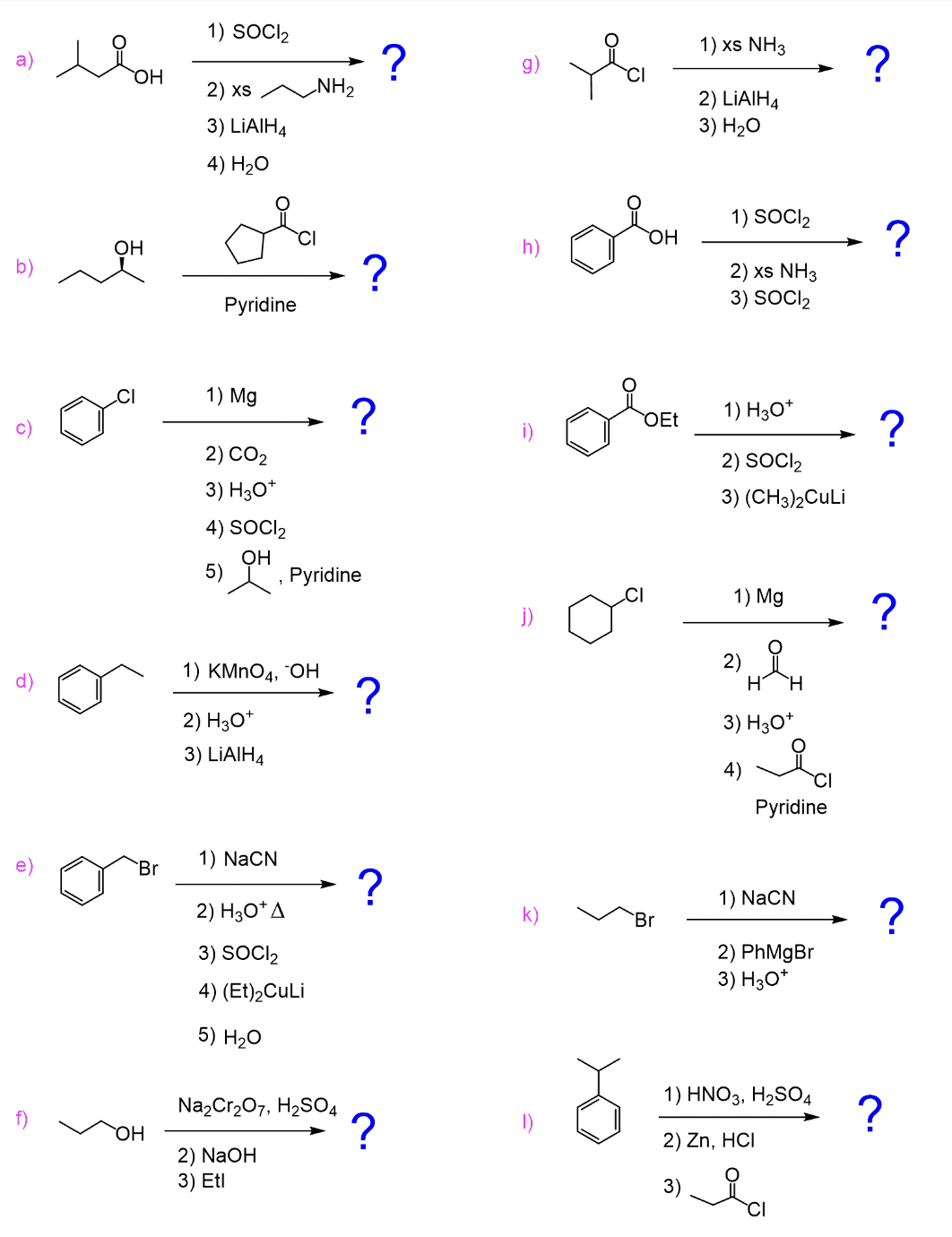
In this activity, you will demonstrate your understanding of the synthesis of carboxylic acids, their derivatives, and their various reactions.
Step 1: Select and Reflect
Select one of the topics below and demonstrate your understanding of them in theoretical and practical settings:
Carboxylic Acids
Synthesis of Carboxylic Acids
Carboxylic Acid Derivatives
Alpha Substitution Reactions
Carbonyl Condensation Reactions
Step 2: Respond
Answer any one of the following questions:
Name the following carboxylic acids and derivatives.
Using balanced chemical equations, show and describe the steps involved in the acid-catalyzed synthesis of an ester from a carboxylic acid and an alcohol.
Predict the major organic product(s) for each of the following reactions:
Step 3: Share
To share your work, click on the “Add a new discussion topic” button under this post and paste your work into the “Message” box. Make sure to reference others’ intellectual property when necessary. You do not need to share your drawings that were done in the chemistry tool, but you can discuss them if needed. All references should follow 7th Edition APA formatting. For further instructions, see the resource on the Himmelfarb Health Sciences Library: APA citation resource (N.B.: references are excluded from word counts).
Step 4: Interact
To complete the activity, evaluate and categorize the work from one of your peers based on items A - E of the rubric below. Provide a rationale for the grade you have provided and comments or suggestions for improvement. To post a reply, click “Reply” on a particular discussion, write your feedback, and click “Post to forum.” You can use the list below as an example:
Item A is….. because ….. My suggestions for improvement are …..
Item B is ….. because ….. My suggestions for improvement are…..
Item C is ….. because ….. My suggestions for improvement are…..
Item D is ….. because …… My suggestions for improvement are ……
Item E is ….. because ….. My suggestions for improvement are …..
OPTIONAL Step 5: Interact (10 minutes)
If you would like to, you can reply to your peers' posts in a respectful and professional manner. Ensure that your post engages your peers' ideas by including a reflection on their comments, sharing ideas of other potential difficulties and parties involved, or asking thought-provoking questions. If a peer comments on your posting, please reply. To post a reply, click “Reply” on a particular discussion, write your feedback and then click on “Post to forum.”
-
Quiz: Module 1
To access the quiz, click on the name of the quiz provided above. On the following screen, click the "Preview quiz now" button to respond to the questions.
TO PASS THIS QUIZ YOU MUST OBTAIN A SCORE OF 80%.
-
 Instructional Goals covered in this module:
- Understand the structure, composition, synthesis, reactivity, and nomenclature of aldehydes and ketones and the nomenclature of physical and chemical properties of aldehydes and ketones.
-
Students mustView
Read the entire page. (25 minutes)
Chemistry LibreText - 2019
-
Students mustView
Read the entire page. (15 minutes)
Chemistry LibreText - 2021
-
Students mustView
Read the entire page. (20 minutes)
Chemistry LibreText - 2022
-
Students mustView
Read the entire page. (20 minutes)
Chemistry LibreText - 2021
-
Students mustView
Read the entire page. (20 minutes)
Chemistry LibreText - 2019
-
Students mustView
Read the entire page. (10 minutes)
Chemistry LibreText - 2023
-
Students mustView
Read the entire page. (20 minutes)
Chemistry LibreText - 2020
-
Students mustView
Read the entire page. (20 minutes)
Chemistry LibreText - 2023
-
Students mustView
Read the entire page. (25 minutes)
Chemistry LibreText - 2019
-
Students mustView
Read the entire page. (15 minutes)
Chemistry LibreText - 2019
-
Students mustView
Read the entire page. (20 minutes)
Chemistry LibreText - 2023
-
Students mustView
Read the entire page. (10 minutes)
Chemistry LibreText - 2022
-
Students mustViewStart discussions: 1
General Instructions:
In this activity, you will demonstrate your understanding of the synthesis of carboxylic acids, their derivatives, and their various reactions.
Step 1: Select and Reflect
Select one of the topics below and demonstrate your understanding of them in theoretical and practical settings:
Synthesis of Aldehydes and Ketones
Reactivity of Aldehydes and Ketones
Step 2: Respond
Answer any one of the following questions:
What is the name of the reaction in the diagram below? Explain the role of the catalysts and show (with chemical structures) the three steps involved, from the reactants to the formation of the final products.
With the aid of appropriate chemical reactions, show how the addition of water affects the formation of stable hydrates and hemiacetals from aldehydes and ketones.
a. Name the natural sources of the following aldehydes and ketones:
b. Name the following reactions, draw the structures of the products, and name the structures (you can use the chemistry tool to draw out any structures or mechanisms to help you answer).
Step 3: Share
To share your work, click on the “Add a new discussion topic” button under this post and paste your work into the “Message” box. Make sure to reference others’ intellectual property when necessary. You do not need to share your drawings that were done in the chemistry tool, but you can discuss them if needed. All references should follow 7th Edition APA formatting. For further instructions, see the resource on the Himmelfarb Health Sciences Library: APA citation resource (N.B.: references are excluded from word counts).
Step 4: Interact
To complete the activity, evaluate and categorize the work from one of your peers based on items A - E of the rubric below. Provide a rationale for the grade you have provided and comments or suggestions for improvement. To post a reply, click “Reply” on a particular discussion, write your feedback, and click “Post to forum.” You can use the list below as an example:
Item A is….. because ….. My suggestions for improvement are …..
Item B is ….. because ….. My suggestions for improvement are…..
Item C is ….. because ….. My suggestions for improvement are…..
Item D is ….. because …… My suggestions for improvement are ……
Item E is ….. because ….. My suggestions for improvement are …..
OPTIONAL Step 5: Interact (10 minutes)
If you would like to, you can reply to your peers' posts in a respectful and professional manner. Ensure that your post engages your peers' ideas by including a reflection on their comments, sharing ideas of other potential difficulties and parties involved, or asking thought-provoking questions. If a peer comments on your posting, please reply. To post a reply, click “Reply” on a particular discussion, write your feedback and then click on “Post to forum.”
-
Quiz: Module 2
To access the quiz, click on the name of the quiz provided above. On the following screen, click the "Preview quiz now" button to respond to the questions.
TO PASS THIS QUIZ YOU MUST OBTAIN A SCORE OF 80%.
-
 Instructional Goals covered in this module:
- Understand the synthesis, reactivity, and chemistry of enolates.
-
Students mustView
Read the entire page. (5 minutes)
University of Calgary
-
-
Students mustView
Read the entire page. (25 minutes)
Chemistry LibreText - 2019
-
Students mustView
Read the entire page. (20 minutes)
Chemistry LibreText - 2021
-
Students mustView
Read the entire page. (20 minutes)
Chemistry LibreText - 2023
-
Students mustView
Read from the beginning of the webpage to the end of the section "Enols and Enolate Anions". (15 minutes)
Chemistry LibreText - 2023
-
Students mustView
Read the entire webpage. (20 minutes)
Chemistry LibreText - 2022
-
Students mustView
Read the entire webpage. (10 minutes)
Chemistry LibreText - 2022
-
Students mustView
Read the entire webpage. (10 minutes)
Chemistry LibreText - 2020
-
Students mustView
Read the entire webpage. (5 minutes)
Chemistry LibreText - 2022
-
Students mustView
Read the entire webpage. (5 minutes)
Chemistry LibreText - 2022
-
Students mustView
Read the entire webpage, Paying specific attention to Boron aldol reaction and Mukaiyama reaction. (25 minutes)
Chemistry LibreText - 2020
-
Quiz: Module 3
To access the quiz, click on the name of the quiz provided above. On the following screen, click the "Preview quiz now" button to respond to the questions.
TO PASS THIS QUIZ YOU MUST OBTAIN A SCORE OF 80%.
-
 Instructional Goals covered in this module:
- Explain the concept of aromaticity and identify aromatic compounds using Hückel’s rule.
- Analyze the mechanism of electrophilic substitution of benzene for nitration, halogenation, alkylation, acylation, protonation, and sulfonation.
- Analyze the influence a substituent exerts on the reactivity of a benzene ring and the orientation of electrophilic aromatic substitution.
-
Students mustView
Read the introduction on aromatic hydrocarbons. (20 minutes)
Chemistry LibreText - 2021
-
Students mustView
Read the section on naming aromatic compounds. (10 minutes)
Chemistry LibreText
-
-
-
Students mustView
Read the entire page. (10 minutes)
Chemistry Libre texts
-
Students mustView
Read the entire section. (13 minutes)
Chemistry Libre texts
-
Students mustView
Read the sections on Substitution Reactions of Benzene and Other Aromatic Compounds. (15 minutes)
Virtual Textbook of Organic Chemistry Michigan State - 2013
-
Students mustView
Read the section on electrophilic substitution of disubstituted benzene rings. (3 minutes)
Virtual Textbook of Organic Chemistry Michigan State - 2013
-
Students mustView
Read the section on substituent groups. (10 minutes)
Virtual Textbook of Organic Chemistry Michigan State - 2013
-
Students mustView
Read the section on Fused benzene rings. (2 minutes)
Virtual Textbook of Organic Chemistry Michigan State - 2013
-
Students mustView
Read the sections on Nucleophilic Substitution, Elimination & Addition Reactions. (10 minutes)
Virtual Textbook of Organic Chemistry Michigan State - 2013
-
Students mustViewStart discussions: 1
General Instructions:
In this activity, you will demonstrate your understanding of aromatic systems and amines, their derivatives, and their various reactions.
Step 1: Select and Reflect
Select one of the topics below and demonstrate your understanding of them in theoretical and practical settings:
Nomenclature, Aromaticity, and Aromatic Structure
Structure and Stability of Benzene
Electrophilic Aromatic Substitution, Aromatic Nitration, Aromatic Sulfonation
Step 2: Respond
Answer any one of the following questions:
Using the chemistry tool, draw the structures of the products formed by the following reactions and state their names using IUPAC nomenclature.
*In the case of reaction at the bottom, what will be the final product if H2 + Ni are added under high temperature and pressure?
Which of the following structures is more stable? State your reasons.
Explain what happens in steps one and two and the formation of the sigma complex of the reaction below.
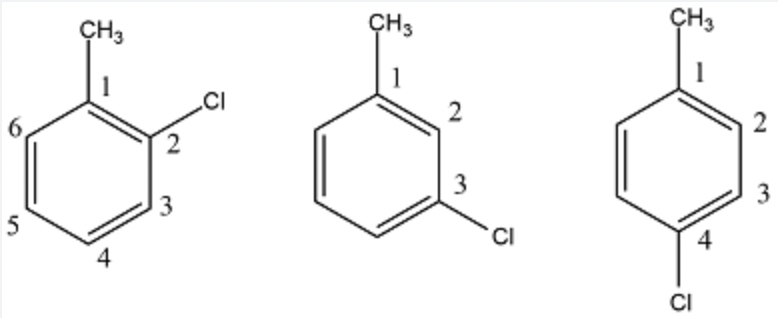
Name the position of the chloride in each of the following diagrams and state the names of the compounds using IUPAC nomenclature.
Step 3: Share
To share your work, click on the “Add a new discussion topic” button under this post and paste your work into the “Message” box. Make sure to reference others’ intellectual property when necessary. You do not need to share your drawings that were done in the chemistry tool, but you can discuss them if needed. All references should follow 7th Edition APA formatting. For further instructions, see the resource on the Himmelfarb Health Sciences Library: APA citation resource (N.B.: references are excluded from word counts).
Step 4: Interact
To complete the activity, evaluate and categorize the work from one of your peers based on items A - E of the rubric below. Provide a rationale for the grade you have provided and comments or suggestions for improvement. To post a reply, click “Reply” on a particular discussion, write your feedback, and click “Post to forum.” You can use the list below as an example:
Item A is….. because ….. My suggestions for improvement are …..
Item B is ….. because ….. My suggestions for improvement are…..
Item C is ….. because ….. My suggestions for improvement are…..
Item D is ….. because …… My suggestions for improvement are ……
Item E is ….. because ….. My suggestions for improvement are …..
OPTIONAL Step 5: Interact (10 minutes)
If you would like to, you can reply to your peers' posts in a respectful and professional manner. Ensure that your post engages your peers' ideas by including a reflection on their comments, sharing ideas of other potential difficulties and parties involved, or asking thought-provoking questions. If a peer comments on your posting, please reply. To post a reply, click “Reply” on a particular discussion, write your feedback and then click on “Post to forum.”
-
Quiz: Module 4
To access the quiz, click on the name of the quiz provided above. On the following screen, click the "Preview quiz now" button to respond to the questions.
TO PASS THIS QUIZ YOU MUST OBTAIN A SCORE OF 80%.
-
 Instructional Goals covered in this module:
- Understand the structure and reactivity of proteins, amino acids, and polypeptides.
-
Students mustView
Read the entire page. (30 minutes)
Chemistry Libre texts - 2015
-
Students mustView
Watch the entire video. (10 minutes)
AK lectures YouTube - 2015
-
Students mustView
Read the entire page. (10 minutes)
Chemistry Libre texts - 2023
-
Students mustView
Read the entire page. (10 minutes)
Chemistry Libre texts - 2022
-
-
-
Students mustView
Read the sections on Amino Acids. (35 minutes)
Virtual Textbook of Organic Chemistry Michigan State University - 2013
-
Students mustView
Read the entire page. (10 minutes)
Chemistry Libre texts - 2019
-
Students mustView
Read the entire page. (20 minutes)
Chemistry Libre texts - 2022
-
Students mustView
Click on each of the links,"Properties of Phosphorus Compounds", "Reactivity of Phosphorus Compounds" and "Synthesis of Phosphorus Compounds" to access the information for this lesson. (30 minutes)
Chemistry Libre texts - 2020
-
Students mustViewStart discussions: 1
General Instructions:
In this activity, you will demonstrate your understanding of nitrogen and phosphorous-containing compounds, their derivatives, and their various reactions.
Step 1: Select and Reflect
Select one of the topics below and demonstrate your understanding of them in theoretical and practical settings:
Amino Acids
Phosphorous-Containing Compounds
Step 2: Respond
Answer any one of the following questions:
Given an amino acid with the amino group at pH 6 and the carboxyl group at pH 4, what is the charge state of the amino acid at pH 7, and what is the isoelectric point of the peptide? Describe how you arrived at your answer.
Describe what nucleophilicity and reducing character mean for phosphorous compounds. Give examples of phosphorous compounds that act as nucleophiles or reducing agents in organic synthesis. Explain how their nucleophilicity and reducing character depend on their oxidation state and structure.
Describe how ylides are prepared from phosphonium salts and name some common ylide reagents and their applications in organic synthesis.
Step 3: Share
To share your work, click on the “Add a new discussion topic” button under this post and paste your work into the “Message” box. Make sure to reference others’ intellectual property when necessary. You do not need to share your drawings that were done in the chemistry tool, but you can discuss them if needed. All references should follow 7th Edition APA formatting. For further instructions, see the resource on the Himmelfarb Health Sciences Library: APA citation resource (N.B.: references are excluded from word counts).
Step 4: Interact
To complete the activity, evaluate and categorize the work from one of your peers based on items A - E of the rubric below. Provide a rationale for the grade you have provided and comments or suggestions for improvement. To post a reply, click “Reply” on a particular discussion, write your feedback, and click “Post to forum.” You can use the list below as an example:
Item A is….. because ….. My suggestions for improvement are …..
Item B is ….. because ….. My suggestions for improvement are…..
Item C is ….. because ….. My suggestions for improvement are…..
Item D is ….. because …… My suggestions for improvement are ……
Item E is ….. because ….. My suggestions for improvement are …..
OPTIONAL Step 5: Interact (10 minutes)
If you would like to, you can reply to your peers' posts in a respectful and professional manner. Ensure that your post engages your peers' ideas by including a reflection on their comments, sharing ideas of other potential difficulties and parties involved, or asking thought-provoking questions. If a peer comments on your posting, please reply. To post a reply, click “Reply” on a particular discussion, write your feedback and then click on “Post to forum.”
-
Quiz: Module 5
To access the quiz, click on the name of the quiz provided above. On the following screen, click the "Preview quiz now" button to respond to the questions.
TO PASS THIS QUIZ YOU MUST OBTAIN A SCORE OF 80%.
-
 Instructional Goals covered in this module:
- Understand how instrumental techniques such as nuclear magnetic resonance (NMR) spectroscopy, infrared (IR) spectroscopy, ultraviolet-visible (UVVis) spectroscopy, and mass spectrometry (MS) are used to characterize and provide molecular information about organic compounds.
-
Students mustView
Read the entire webpage. (20 minutes)
Chemistry Libre texts - 2019
-
Students mustView
Read the entire page. (30 minutes)
Chemistry Libre texts - 2021
-
Students mustView
Read the entire page. (25 minutes)
Chemistry Libre texts - 2021
-
Students mustView
Read the entire page. (25 minutes)
Chemistry Libre texts - 2021
-
Students mustView
Read the entire page. (15 minutes)
Chemistry Libre texts - 2022
-
-
Students mustView
Read the entire page. (20 minutes)
Chemistry Libre texts - 2022
-
Students mustView
Read the entire page. (20 minutes)
Chemistry Libre texts - 2022
-
Students mustView
Read the entire page. (25 minutes)
Chemistry Libre texts - 2019
-
Students mustView
Read the entire page. (5 minutes)
Chemistry Libre texts - 2019
-
Students mustView
Read the entire page. (25 minutes)
Chemistry Libre texts - 2022
-
Students mustView
Read the entire page. (25 minutes)
Chemistry Libre texts - 2022
-
Quiz: Module 6
To access the quiz, click on the name of the quiz provided above. On the following screen, click the "Preview quiz now" button to respond to the questions.
TO PASS THIS QUIZ YOU MUST OBTAIN A SCORE OF 80%.
-
 Instructional Goals covered in this module:
- Understand the techniques used for the separation of mixtures.
-
Students mustView
Read the entire page. (10 minutes)
Chemistry Libre texts - 2022
-
Students mustView
Read the entire page. (10 minutes)
Chemistry Libre texts - 2021
-
Students mustView
Read the entire page. (25 minutes)
Chemistry Libre texts - 2022
-
Students mustView
Read the entire page. (25 minutes)
Chemistry Libre texts - 2020
-
Students mustView
Read the entire article. (15 minutes)
NIH - 2016
-
Students mustView
Watch the entire video. (4 minutes)
Youtube
-
Students mustViewStart discussions: 1
General Instructions:
In this activity, you will demonstrate your understanding of separations and purifications, their derivatives, and their various reactions.
Step 1: Select and Reflect
Select one of the topics below and demonstrate your understanding of them in theoretical and practical settings:
Amino Acids
Phosphorous-Containing Compounds
Step 2: Respond
Answer any one of the following questions:
You are performing a liquid-liquid extraction of a sample containing a mixture of aqueous and organic compounds. You are using a separatory funnel to separate the two layers. The sample contains 2-butanol and acetic acid. Which of the two solutes, 2-butanol or acetic acid, is more likely to dissolve in the aqueous layer within the separatory funnel? Discuss your answer with relevant facts.
A research lab is looking to separate a mixture of ethanol and water. The researchers have the option to use either simple or fractional distillation to complete the task. The lab is debating which method is best for the given task.
Questions:
1. How does simple distillation differ from fractional distillation?
2. What are the advantages of using fractional distillation over simple distillation?
3. What type of mixtures is each method most effective for?
4. What is the main difference in the process of each distillation method?
Discuss the necessary environmental and physical conditions for distillation to be the most efficient and effective separatory technique.
Step 3: Share
To share your work, click on the “Add a new discussion topic” button under this post and paste your work into the “Message” box. Make sure to reference others’ intellectual property when necessary. You do not need to share your drawings that were done in the chemistry tool, but you can discuss them if needed. All references should follow 7th Edition APA formatting. For further instructions, see the resource on the Himmelfarb Health Sciences Library: APA citation resource (N.B.: references are excluded from word counts).
Step 4: Interact
To complete the activity, evaluate and categorize the work from one of your peers based on items A - E of the rubric below. Provide a rationale for the grade you have provided and comments or suggestions for improvement. To post a reply, click “Reply” on a particular discussion, write your feedback, and click “Post to forum.” You can use the list below as an example:
Item A is….. because ….. My suggestions for improvement are …..
Item B is ….. because ….. My suggestions for improvement are…..
Item C is ….. because ….. My suggestions for improvement are…..
Item D is ….. because …… My suggestions for improvement are ……
Item E is ….. because ….. My suggestions for improvement are …..
OPTIONAL Step 5: Interact (10 minutes)
If you would like to, you can reply to your peers' posts in a respectful and professional manner. Ensure that your post engages your peers' ideas by including a reflection on their comments, sharing ideas of other potential difficulties and parties involved, or asking thought-provoking questions. If a peer comments on your posting, please reply. To post a reply, click “Reply” on a particular discussion, write your feedback and then click on “Post to forum.”
-
Quiz: Module 7
To access the quiz, click on the name of the quiz provided above. On the following screen, click the "Preview quiz now" button to respond to the questions.
TO PASS THIS QUIZ YOU MUST OBTAIN A SCORE OF 80%.
-

To take the final exam, you must complete all quizzes and complete all the required activities.
To access the exam, click on the name of the exam provided below. On the following screen, click the attempt quiz button to respond to the questions.
-
Final Exam Quiz
To take the final exam, you must complete all quizzes and complete all the required activities. The final exam consists of 40 questions, and you will have 40 minutes to complete it. When the time is over, you will have two minutes to submit your attempt before it expires, and your progress is discarded. You will not be able to answer additional questions in the grace period.
To access the exam, click on the name of the exam provided above. On the following screen, click the attempt quiz button to respond to the questions.
-
-

In this section, you can provide feedback about this course to help us make NextGenU.org better. Once evaluations are completed, you will be able to download your certificate of completion.
-
Course Evaluation Questionnaire
-
Self Evaluation Questionnaire
-
-