

Section: Module 1: Introduction to Public Health Communications | Public Health Communications | NextGenU.org
-
Competency covered in this module:

- Apply theory and strategy-based communication principles across different settings and audiences.
- Select communication strategies for different audiences and sectors.
-
Students mustView
Read the entire webpage. (2 minutes)
Society for Health Communication - 2018
-
-
Students mustView
Read Chapter 1 "Introduction to Public Health Communication". (18 minutes)
Parvanta, David E. Nelson - 2017
-
Students mustView
Read the entire article. (11 minutes)
PUBLIC HEALTH AND MANAGEMENT - 2014
-
Students mustView
Read the entire webpage. (10 minutes)
Centers for Disease Control and Prevention - 2011
-
Students mustViewStart discussions: 1
In this activity, you will write a petition campaign that discusses the importance of public health communications for public health workers.
Step 1: Decide
Decide which current issue/problem in public health can be benefited by public health communication; this will be the central theme of your petition. Then, select your target audience to address your petition.
Example:
Current Issue/Problem: Covid-19 Vaccination Misinformation Problem
Audience: Public Health Agencies
Step 2: Respond
Give the petition a title, so your target audience would know immediately what it is about.
Then, write a 300-900 word statement describing: the problem your petition campaign is addressing, how it can help improve the response to the problem, and the response you would like to get from the audience. Follow this format:
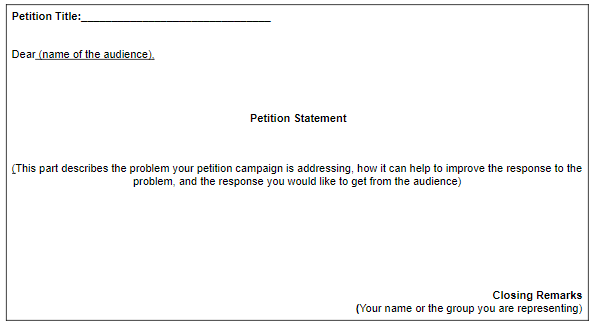
Step 3: Share
To share your work, click on the "Reply" button under this post and paste your work in the "Message" box. Make sure to reference others' intellectual property when necessary. All references should follow 7th Edition APA formatting. For further instructions, see the Himmelfarb Health Sciences Library resource: APA citation resource (N.B. references are excluded from word counts).
Step 4: Interact
To complete the activity, you will need to reply to at least two posts made by your peers in a respectful and professional manner. Be sure that your post engages your peers' ideas by including a reflection on their comments, sharing ideas of other potential difficulties and parties involved, or asking thought-provoking questions. If a peer comments on your posting, please reply. To post a reply, click "Reply" on a particular discussion, write your feedback and then click on "Post to Forum."
OPTIONAL Step 5: Interact (10 minutes)
If you would like to, you can reply to your peers' posts in a respectful and professional manner. Ensure that your post engages your peers' ideas by including a reflection on their comments, sharing ideas of other potential difficulties and parties involved, or asking thought-provoking questions. If a peer comments on your posting, please reply. To post a reply, click “Reply” on a particular discussion, write your feedback and then click on “Post to forum.”
-
Students mustView
Read the content under Chapter 1 "Communication" from pages 1-9, and under the sub-headings "Theories of Communication," "A Model of Communication," "Objectives of Communications," "Elements of Communication Process," "Principles of Communication," and "Forms of Communication." (25 minutes)
Pramilaa R
-
Students mustView
Read the entire article. (17 minutes)
Thulane University, School of Public Heath and Tropical medicine - 2020
-
Students mustView
Read from the content under the heading "Purpose and background." on page 3 (2 minutes)
2017
-
Students mustView
Read the entire article. (15 minutes)
iMedPub Journals - 2017
-
Students mustViewStart discussions: 1
In this activity, you will assess the effectiveness of different vaccine communication strategies for specific audiences
Step 1: Review
Study the given scenario:
You are the health education and promotions officer in your locality. In the past months, there has been well-documented evidence of vaccine hesitancy across your locality which is often fuelled by online and offline misinformation surrounding the importance, safety, or effectiveness of COVID-19 vaccines.
In this regard, your lead officer assigned you to explore and conduct an assessment of the effectiveness of three existing vaccine communication campaigns, as seen below:
The assessment of these three campaigns will be helpful since you will re-model your vaccine campaign based on these data to increase vaccination statistics in your locality.
Step 2: Respond
Questions:After exploring the links for these existing vaccine communication strategies, complete an assessment of the effective communication in the table below, and answer follow-up questions.
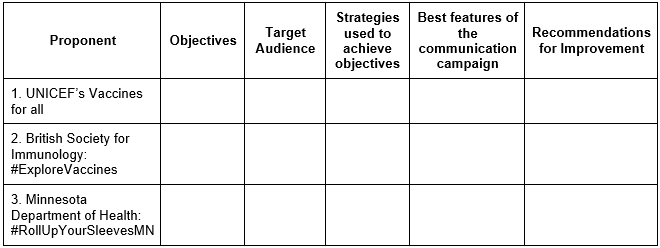
Why is the implementation of effective communication strategies especially significant during the COVID-19 pandemic? Cite specific instances where its relevance is observed.
How important are these communication principles/theories: accessibility, actionability, credibility, relevance, timeliness, and relatedness in countering misinformation about COVID-19 vaccines for specific audiences (kids, adults, older adults)?
Step 3: Self-Analysis and Enhancement
Before you submit, engage in an introspective self-analysis by systematically reviewing each component of your work. Reflect on what aspects of your work were executed well and what could be enhanced. Proceed to refine these elements in your work.
Step 4: Submit
To submit your work, click on the “Reply” button under this post and paste either the picture of your work or the shareable link of your work (if it is a google document) in the “Message” box. Make sure to reference others’ intellectual property when necessary. All references should follow 7th Edition APA formatting. For further instructions, see the Himmelfarb Health Sciences Library resource: APA citation resource (N.B. references are excluded from word counts).
OPTIONAL Step 5: Interact (10 minutes)
If you would like to, you can reply to your peers' posts in a respectful and professional manner. Ensure that your post engages your peers' ideas by including a reflection on their comments, sharing ideas of other potential difficulties and parties involved, or asking thought-provoking questions. If a peer comments on your posting, please reply. To post a reply, click “Reply” on a particular discussion, write your feedback and then click on “Post to forum.”
-
Quiz: Module 1
To access the quiz, click on the name of the quiz provided above. On the following screen, click the "Preview quiz now" button to respond to the questions.
TO PASS THIS QUIZ, YOU MUST OBTAIN A SCORE OF 80%