

Section: Module 2: Ethics and Public Health Communcations | Public Health Communications | NextGenU.org
-
Competency covered in this module:

- Describe the importance of cultural competence in communicating public health content.
- Apply legal and ethical principles to the use of information technology and resources in public health settings.
-
Students mustView
Read pages 7-8 of the document. (5 minutes)
National Territory of Department of Education- Australia - 2014
-
Students mustView
Read the content under the headings "What is Cultural Competence?" and "What's the Difference? Cultural Competence, Awareness, and Sensitivity." (3 minutes)
National Prevention Information Network
Centers for Disease Control and Prevention - 2020 -
Students mustView
Read the content from the heading "Components of Intercultural Communication Competence" up to the heading "Key Takeaways." (11 minutes)
Minnesota Libraries - 2016
-
Students mustView
Read the entire sections of the "Introduction" and "Discussion." (8 minutes)
Journal of Primary Care & Community Health-SAGE - 2021
-
Students mustView
Read the entire document. (9 minutes)
National Association of State Mental Health Program Directors - 2012
-
Students mustView
Read the content under the heading "Introduction," and from the heading "Communicating COVID-19 health messages: challenges faced by CALD communities" to the end of the article. (11 minutes)
Public Health Research & Practice - 2021
-
Students mustViewStart discussions: 1
In this activity, you will review sample case studies in public health and exemplify how cultural competence can improve communications in these case studies.
Step 1: Review and Analyze
Review these five (5) case studies. Then, choose three (3) and analyze how cultural competence can improve public health communications in the selected case studies.
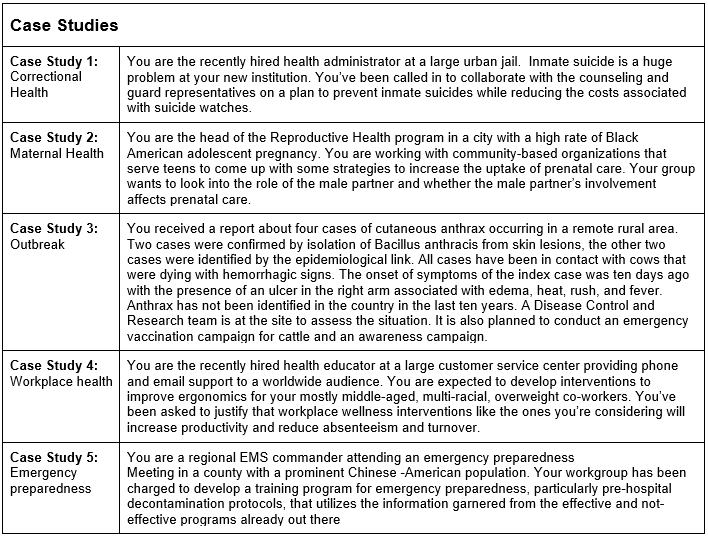
Step 2: Respond
After selecting three case studies, write a 600-900 word expository essay (200-300 words for each case study). In your essay, address the following questions:
- What are some of the issues reflected in each case study?
- How can cultural competence provide guidance in addressing this situation?
- As a public health practitioner, what can you do to increase your understanding of the patient's culture so that you can get the patient into care & treatment?
Step 3: Share
To share your work, click on the "Reply" button under this post and paste your work in the "Message" box. Make sure to reference others' intellectual property when necessary. All references should follow 7th Edition APA formatting. For further instructions, see the Himmelfarb Health Sciences Library resource: APA citation resource (N.B. references are excluded from word counts).
Step 4: Interact
To complete the activity, you will need to reply to at least two posts made by your peers in a respectful and professional manner. Be sure that your post engages your peers' ideas by including a reflection on their comments, sharing ideas of other potential difficulties and parties involved, or asking thought-provoking questions. If peer comments on your posting, please reply. To post a reply, click "Reply" on a particular discussion, write your feedback and then click on "Post to the forum."
OPTIONAL Step 5: Interact (10 minutes)
If you would like to, you can reply to your peers' posts in a respectful and professional manner. Ensure that your post engages your peers' ideas by including a reflection on their comments, sharing ideas of other potential difficulties and parties involved, or asking thought-provoking questions. If a peer comments on your posting, please reply. To post a reply, click “Reply” on a particular discussion, write your feedback and then click on “Post to forum.”
-
Students mustView
Read the entire page. (7 minutes)
USF Health Morsani Collage of Medicine - 2021
-
Students mustView
Read the entire article. (17 minutes)
NCBI - 2020
-
Students mustView
Read the entire document. (11 minutes)
CDC - 2015
-
Students mustView
Read the content under the headings "Summary," "Introduction: Why Are Ethical Considerations a Pivotal Part of Communication for Health Promotion Interventions?" and "Moral and Practical Reasons." (8 minutes)
Oxford University Press - 2017
-
Students mustView
Read the entire article. (8 minutes)
Americal Journal of Public Health - 2020
-
Students mustView
Read from the "Abstract" up until the heading "Translating ethical values into practice: Five examples of online platforms for health data sharing." (32 minutes)
BMC - 2017
-
Students mustView
Read ALL of the content under the following sections (required for the Peer Activity): "Types of Ethical Concerns Regarding Health Promotion Communication Interventions," "How to Identify and Consider Ethical Issues: Drawing on Ethical Frameworks and Precepts," "Ethical Approaches of Caring and Connectedness" and "Digital Media in Health Promotion: Issues of Privacy and Democracy." (69 minutes)
Oxford Research Encyclopedia - 2017
-
Students mustViewStart discussions: 1
In this activity, you will examine different types of ethical concerns for public health communication and assess how the ethical principles/ precepts can be useful to address ethical issues.
Step 1: Read and Examine
Read the following sections of this article: Ethical Issues in Health Promotion and Communication Interventions.
- Types of Ethical Concerns Regarding Health Promotion Communication Interventions
- How to Identify and Consider Ethical Issues: Drawing on Ethical Frameworks and Precepts
- Ethical Approaches of Caring and Connectedness
- Digital Media in Health Promotion: Issues of Privacy and Democracy
While reading these sections, examine the different types of ethical concerns highlighted in the articles, such as patient privacy and consent, patient safety, ethical dilemmas resulting from data availability and sharing, justice, equity, etc.
Step 2: Assess
After examining these ethical concerns, think of one prominent ethical issue in your research area. Then, analyze how the ethical principles, frameworks, and precepts discussed in the article are useful in addressing these ethical issues/concerns in public health communication.
Some Ethical Principles, Frameworks, and Precepts in Public Health Communication
- Principle of non-maleficence
- Principle of beneficence
- Principle of autonomy and privacy
- Principle of justice and equality
- Principle of impossibility
- Principle of integrity
Step 3: Respond
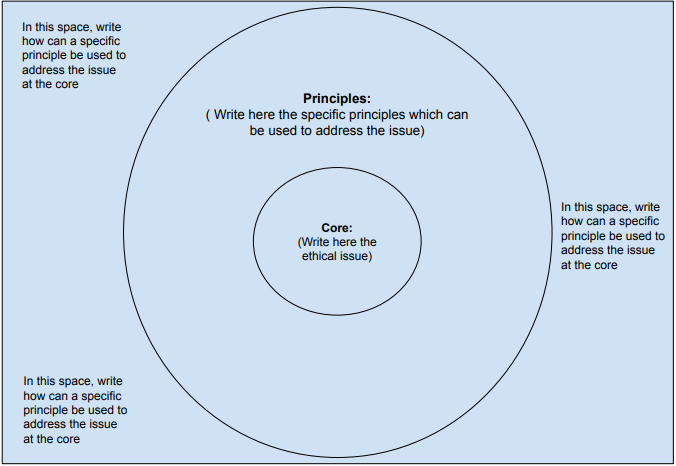
Assess how the ethical principles, frameworks, and precepts can be useful to address one prominent ethical issue in your research area by filling in this circle map with at least three (3) principles.
Step 3: Self-Analysis and Enhancement
Before you submit, engage in an introspective self-analysis by systematically reviewing each component of your work. Reflect on what aspects of your work were executed well and what could be enhanced. Proceed to refine these elements in your work.
Step 4: Submit
To submit your work, click on the “Reply” button under this post and paste either the picture of your work or the shareable link of your work (if it is a google document) in the “Message” box. Make sure to reference others’ intellectual property when necessary. All references should follow 7th Edition APA formatting. For further instructions, see the Himmelfarb Health Sciences Library resource: APA citation resource (N.B. references are excluded from word counts).
OPTIONAL Step 5: Interact (10 minutes)
If you would like to, you can reply to your peers' posts in a respectful and professional manner. Ensure that your post engages your peers' ideas by including a reflection on their comments, sharing ideas of other potential difficulties and parties involved, or asking thought-provoking questions. If a peer comments on your posting, please reply. To post a reply, click “Reply” on a particular discussion, write your feedback and then click on “Post to forum.”
-
Quiz: Module 2
To access the quiz, click on the name of the quiz provided above. On the following screen, click the "Preview quiz now" button to respond to the questions.
TO PASS THIS QUIZ, YOU MUST OBTAIN A SCORE OF 80%
-
Read the entire article. (15 minutes)
Life Sciences, Society, and Policy - 2018