Section: Module 1: Carboxylic Acids | Organic Chemistry 2 | NextGenU.org

  • Instructional Goals covered in this module:
    • Understand the structure, composition, synthesis, reactivity, and nomenclature of carboxylic acids.
    • Module 1: Lesson 1: Carboxylic Acids

      Student Learning Outcomes:

      Upon completion of this module, students you will be able to:

      • Compare the physical properties and reactivity of carboxylic acids.
      • Describe the reaction mechanisms that demonstrate the processes by which carboxylic acids are synthesized.
      • Identify common reactions of carboxylic acids.
      • Describe the sequences to synthesize and transform carboxylic acids from starting materials to demonstrate an understanding of carboxylic acid reactions.

      Approximate time required for the readings for this lesson (at 144 words/minute): 1 hour and 15 minutes.

      Required Learning Resources and Activities
    • Read the section on carboxylic acids.(25 minutes)

       Virtual Textbook of Organic Chemistry Michigan State - 2013

    • Module 1: Lesson 2: Synthesis of Carboxylic Acids

      Student Learning Outcomes:

      Upon completion of this module, students you will be able to:

      • Explain the underlying cause of the relatively high acidity of carboxylic acids.
      • Predict the effects of additional substituents on the acidity of a carboxylic acid.
      • Rank the acidity of comparable carboxylic acids based on their structure.

      Approximate time required for the readings for this lesson (at 144 words/minute): 21 minutes.

      Required Learning Resources and Activities
    • Read the entire section. (7 minutes)
      ChemLibre Text - 2020

    • Module 1: Lesson 3: Carboxylic Acid Derivatives

      Student Learning Outcomes:

      Upon completion of this module, students you will be able to:

      • Apply the IUPAC rules for naming carboxylic acid derivatives, including the nomenclature for the cyclic version of the molecule.
      • Identify the reactant types used in acyl substitution reactions to form the major carboxylic acid derivatives, such as amides and esters.
      • Describe the mechanism of nucleophilic acyl substitution reactions.
      • Identify the conditions that would lead to spontaneous decarboxylation of a carboxylic acid.
      • Predict the products of an acyl substitution reaction.
      • Order carboxylic acid derivatives (anhydrides, esters, and amides) based on their reactivity.
      • Explain how strong acid and strong base conditions would impact the mechanism of hydrolysis of an amide.
      • Identify the nucleophile and electrophile within nucleophilic acyl substitution reactions.

      Approximate time required for the readings for this lesson (at 144 words/minute): 3 hours and 33 minutes.

      Required Learning Resources and Activities
    • Read the sections on Derivatives of Carboxylic Acids. (31 minutes)

      Virtual Textbook of Organic Chemistry Michigan State - 2013

    • Read the sections on Amine reactivity. (20 minutes)

      Virtual Textbook of Organic Chemistry Michigan State - 2013

    • Read the sections on Reactions of Amines. (15 minutes)

      Virtual Textbook of Organic Chemistry Michigan State - 2013

    • Read the sections on The Leuckart Reaction and Pyrolytic syn-Elimination. (5 minutes)

      Virtual Textbook of Organic Chemistry Michigan State - 2013

    • Module 1: Lesson 4: Alpha Substitution Reactions

      Student Learning Outcomes:

      Upon completion of this module, students you will be able to:

      • Identify the species that act as nucleophiles and electrophiles in aldol condensations.
      • Describe a condensation reaction.
      • List the reaction types associated with aldol condensation.
      • Describe the conditions, reactants, and products involved in a retro-aldol reaction.
      • Identify an alpha carbon.

      Approximate time required for the readings for this lesson (at 144 words/minute): 1 hours and 15 minutes.

      Required Learning Resources and Activities
    • Read the entire page. (25 minutes)

      Chemistry LibreText - 2022

    • Module 1: Lesson 5: Carbonyl Condensation Reactions

      Student Learning Outcomes:

      Upon completion of this module, students you will be able to:

      • Identify the role of the beta hydroxide group in the general mechanism for an aldol addition reaction.
      • Describe the general mechanism for decarboxylation of beta-carboxy ketone or aldehyde.
      • Identify the three steps (deprotonation or decarboxylation, attack, leaving/ collapse groups) involved with the Claisen condensation reaction.
      • Describe the two steps (attack and collapse/ leaving groups) involved in the retro-Claisen reaction.
      • Illustrate the general mechanism for conjugation addition (of a carbon nucleophile for a Michael addition) and beta-elimination reactions.
      • Describe the general mechanism for the carboxylation of an enolate.

      Approximate time required for the readings for this lesson (at 144 words/minute): 6 hours and 26 minutes.

      Required Learning Resources and Activities
    • Read the entire page. (20 minutes)

      Chemistry LibreText - 2022

    • Read the entire page. (20 minutes)

      Chemistry LibreText - 2022

    • Read the entire page.  (20 minutes)

      Chemistry LibreText - 2022

    • Read the entire page.  (20 minutes)

      Chemistry LibreText - 2022

    • General Instructions:

      In this activity, you will demonstrate your understanding of the synthesis of carboxylic acids, their derivatives, and their various reactions.

      Step 1: Select and Reflect

      Select one of the topics below and demonstrate your understanding of them in theoretical and practical settings:

      • Carboxylic Acids

      • Synthesis of Carboxylic Acids

      • Carboxylic Acid Derivatives 

      • Alpha Substitution Reactions

      • Carbonyl Condensation Reactions

      Step 2: Respond

      Answer any one of the following questions:

      1. Name the following carboxylic acids and derivatives.

      1. Using balanced chemical equations, show and describe the steps involved in the acid-catalyzed synthesis of an ester from a carboxylic acid and an alcohol.

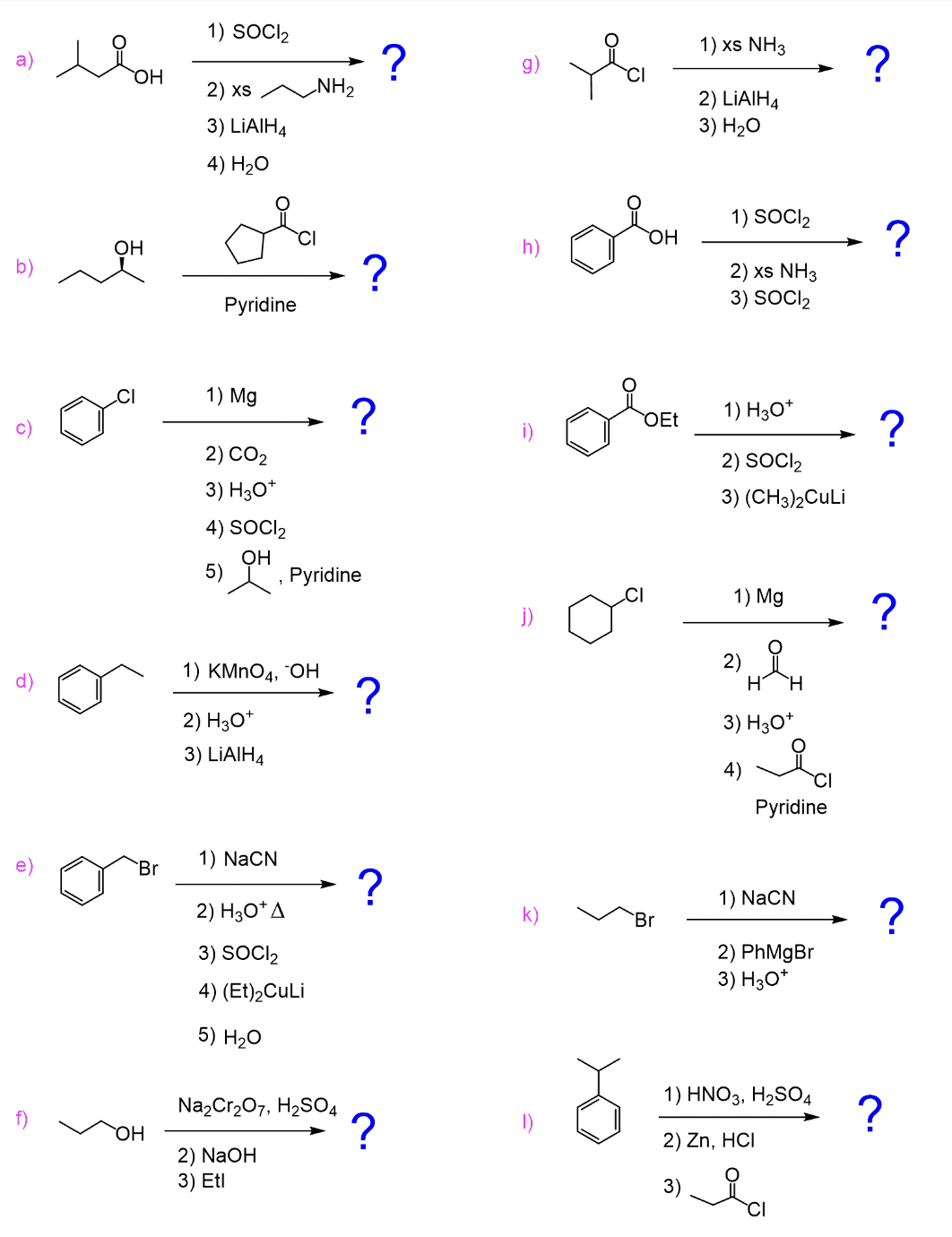
      2. Predict the major organic product(s) for each of the following reactions:

      Step 3: Share 

      To share your work, click on the “Add a new discussion topic” button under this post and paste your work into the “Message” box. Make sure to reference others’ intellectual property when necessary. You do not need to share your drawings that were done in the chemistry tool, but you can discuss them if needed. All references should follow 7th Edition APA formatting. For further instructions, see the resource on the Himmelfarb Health Sciences Library: APA citation resource (N.B.: references are excluded from word counts).

      Step 4: Interact 

      To complete the activity, evaluate and categorize the work from one of your peers based on items A - E of the rubric below. Provide a rationale for the grade you have provided and comments or suggestions for improvement. To post a reply, click “Reply” on a particular discussion, write your feedback, and click “Post to forum.” You can use the list below as an example:


      Item A is….. because ….. My suggestions for improvement are …..

      Item B is ….. because ….. My suggestions for improvement are…..

      Item C is ….. because ….. My suggestions for improvement are…..

      Item D is ….. because …… My suggestions for improvement are ……

      Item E is ….. because ….. My suggestions for improvement are …..

      OPTIONAL Step 5: Interact (10 minutes)

      If you would like to, you can reply to your peers' posts in a respectful and professional manner. Ensure that your post engages your peers' ideas by including a reflection on their comments, sharing ideas of other potential difficulties and parties involved, or asking thought-provoking questions. If a peer comments on your posting, please reply. To post a reply, click “Reply” on a particular discussion, write your feedback and then click on “Post to forum.”


    • quiz icon
      Quiz: Module 1

      To access the quiz, click on the name of the quiz provided above. On the following screen, click the "Preview quiz now" button to respond to the questions.

      TO PASS THIS QUIZ YOU MUST OBTAIN A SCORE OF 80%.