

Section: Module 2: Fundamentals of Health Behavior Change | Lifestyle Medicine | NextGenU.org
-
This module provides in-depth exploration of behavior change theories, models, and practical applications essential for supporting patients in modifying health behaviors. It covers psychological, social, and environmental factors influencing behavior change across all lifestyle medicine pillars, with emphasis on motivation, self-efficacy, goal-setting, and the critical role of social support and relationships in sustaining change.
Knowing is not enough—we must apply. Willing is not enough—we must do. — Johann Wolfgang von Goethe
MOODY AIR FORCE BASE, Ga. -- Airmen use different types of cardiovascular machines Jan. 5. Cardiovascular exercises develop your heart and lungs; many consider it to be the most important component in a workout program. (U.S. Air Force photo/Senior Airman Stephanie Mancha)(RELEASED)
Instructional Goals covered in this module:
- Fundamentals of Health Behavior Change.
Approximate time required for the readings for this module (at 144 words/minute): 34 hours and 16 minutes.
-
In this document, we summarized key topics of the module to help you study. Please note that these notes do not cover all of the material in its entirety; you are still encouraged to read and study all of the required learning resources.
323.0 KB -
Here are specialized flashcards designed to reinforce and test your knowledge throughout this course.
-
To refresh your mind and body before taking this module, let's start with some stretching exercises:
-
Module 2: Lesson 1: Tools for Health Behavior Change
Student Learning Objectives:

Upon completion of this lesson, you will be able to:
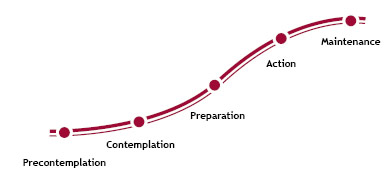
- Understand the gap between clinical guidelines and patient behavior; know how to apply the transtheoretical model of health behavior change.
- Demonstrate key elements of conducting patient readiness assessment and stage matched responses.
Required Learning Resources and Activities
-
-
-
Students mustMark as done
The lesson summaries provide a detailed overview of the key concepts and information covered in the external resources. However, learners are encouraged to explore the linked materials for a deeper understanding and more comprehensive analysis of the topics.
274.7 KB -
Students mustView
Read the entire article. (5 minutes)
Advanced Management - 2024
-
Students mustView
Read the entire excerpt. (15 minutes)
StatPearls Publishing - 2025
-
Students mustView
Read under headlines: (15 minutes)
- Introduction
- Discussion
- Conclusions
NIH National Library of Medicine - 20251
-
Students mustView
Read the entire content and download the AMA's "Care for Substance Use Disorder How-To Guide" (PDF). (16 minutes)
American Medical Association (AMA) - 2021
-
Students mustView
Read slides 8-29. (21 minutes)
Governors State University
-
Students mustView
Read the entire content. (28 minutes)
NIH National Library of Medicine - 2023
-
Students mustView
Read the entire content. (11 minutes)
Science Direct - 2021
-
Students mustView
Read: Improving Health (Chapter 8). (17 minutes)
The Association of Faculties of Medicine of Canada (AFMC) - 2024
-
Students mustView
Read under the headline: Summary of the Evidence. (20 minutes)
Society of Behavioral Medicine - 2023
-
Students mustView
Read the complete content. (12 minutes)
Fullscript: INTEGRATIVE MEDICINE - 2022
-
Students mustView
Read the entire content. (13 minutes)
American Medical Association (AMA) - 2024
-
Students mustView
Read pages 5-12. (10 minutes)
Henley Business School - 2021
-
Read the entire content. (30 minutes)
MAX HealthCare
-
Module 2: Lesson 2: Motivational Interviewing, Cognitive Behavioral and Positive Psychology Techniques
Student Learning Objectives:
Upon completion of this lesson, you will be able to:
- Apply motivational interviewing, cognitive behavioral, and positive psychology techniques.
Required Learning Resources and Activities
-
-
Students mustMark as done
The lesson summaries provide a detailed overview of the key concepts and information covered in the external resources. However, learners are encouraged to explore the linked materials for a deeper understanding and more comprehensive analysis of the topics.
274.1 KB -
Students mustView
Read the entire content. (5 minutes)
Harvard Health Publishing - 2023
-
Students mustView
Read the entire content. (6 minutes)
Psychology Today - 2022
-
Students mustView
Read under headlines: (15 minutes)
- Lifestyle Medicine for Mental Health
- The Current State of Lifestyle Medicine Research
- Mental and Behavioral Health Disciplines
- Mental Health and Physical Health: Important Overlap
- Mental Health Considerations for Lifestyle Medicine
American College of Lifestyle Medicine - 2021
-
Students mustView
Read the entire article. (20 minutes)
Springer Nature Limited - 2024
-
Students mustView
Read under the headline: (15 minutes)
- Abstract
- Behavioral and psychological outcomes
- Discussion
Scientific Reports - 2023
-
Students mustView
Read the entire text. (7 minutes)
Clarion University of Pennsylvania
-
Students mustView
Read the entire content. (5 minutes)
Investopedia: Caroline Banton - 2024
-
Students mustView
Read the entire article interact with the links to access the entire reading material. (17 minutes)
University of California, San Francisco (UCSF) - 2024
-
Students mustView
Watch the entire video. (8 minutes)
Lifesum - 2021
-
Students mustView
Watch the entire video. (3 minutes)
Your Personal Nutrition Guide - 2020
-
Students mustView
Read the entire document and the Resource: 5 A’s Behavior Change Model Adapted for Self-Management Support Improvement. (15 minutes)
National Institute of Diabetes and Digestive and Kidney Diseases - 2015
-
Students mustView
Read the entire document. (5 minutes)
Health and Safety Fund - 2023
-
Students mustView
Read the entire article. (15 minutes)
Journal of Advanced Nursing - 2024
-
Students mustView
Read the entire article. (20 minutes)
Progress in Cardiovascular Diseases - 2023
-
Students mustView
Read pages 25-40. (30 minutes)
Community Care of North Carolina - 2017
-
Students mustView
Read the entire article. (25 minutes)
Baqiyatallah University of Medical Sciences - 2016
-
Students mustView
Read the entire article. (30 minutes)
NIH National Library Medicine - 2023
-
Watch the entire video. (3 minutes)
Lifesum - 2019
-
Read the entire article. (25 minutes)
Mental Health Academy - 2025
-
-
Students mustMark as done
The lesson summaries provide a detailed overview of the key concepts and information covered in the external resources. However, learners are encouraged to explore the linked materials for a deeper understanding and more comprehensive analysis of the topics.
273.0 KB -
Students mustView
Read the entire article. (5 minutes)
ANDY LAZRIS MD, CMD. - 2021
-
Students mustView
Read the entire article. (13 minutes)
NIH National Library of Medicine - 2020
-
Students mustView
Read the entire web page and watch the videos. (30 minutes)
Health Navigator Charitable Trust - 2022
-
Module 2: Lesson 4: Maintain Healthy Behaviors
Student Learning Objectives:

Upon completion of this lesson, you will be able to:
- Describe strategies for helping patients maintain healthy behaviors.
- Develop a written action plan based on the treatment prescription adjusted for the appropriate stage of change.
Required Learning Resources and Activities
-
-
Students mustMark as done
The lesson summaries provide a detailed overview of the key concepts and information covered in the external resources. However, learners are encouraged to explore the linked materials for a deeper understanding and more comprehensive analysis of the topics.
245.2 KB -
Students mustView
Read the web page. (5 minutes)
Practical Health Psychology - 2020
-
Students mustView
Read the web page. (7 minutes)
American Medical Association (AMA) - 2024
-
Students mustView
Read the entire article. (13 minutes)
Patient Education and Counseling - 2024
-
Read the entire document. (10 minutes)
BMC Family Practice volume - 2019
-
Download the Document pdf and read the entire article. (21 minutes)
Journal of Human Sport and Exercise - 2020
-
Students mustViewStart discussions: 1
Applying the Transtheoretical Model: Bridging the Clinical-Behavioral Gap
Brief Description
Students will analyze a complex health behavior change scenario and develop a comprehensive intervention plan that bridges the gap between clinical guidelines and patient behavior using the transtheoretical model and evidence-based techniques.
Instructions for Students
You are a health professional working with Jamie, a 42-year-old patient recently diagnosed with metabolic syndrome. Clinical guidelines recommend multiple lifestyle changes including dietary modifications, increased physical activity, stress management, and medication adherence. In your initial assessment, you notice Jamie expresses understanding of these recommendations but shows varying levels of readiness to implement different changes.
Your task is to develop a comprehensive written analysis that demonstrates your ability to apply behavior change frameworks in a patient-centered manner. Your response should integrate principles from the transtheoretical model, motivational interviewing, and cognitive-behavioral approaches.
Critical Thinking Prompts
Analyze the potential gaps between clinical recommendations and Jamie's behavior, considering psychological, social, environmental, and systemic factors that might create barriers to change.
Assess Jamie's stage of change for each recommended behavior modification (diet, exercise, stress management, medication). What specific indicators would you look for to determine readiness?
Design stage-matched interventions for each behavior, explaining your rationale for selecting specific techniques and how they address the identified barriers.
Develop a detailed motivational interviewing approach for the behavior where Jamie shows the most resistance. Demonstrate how you would navigate ambivalence and elicit change talk.
Create a maintenance strategy that anticipates potential relapse triggers and builds resilience. How would this strategy evolve as Jamie progresses through the stages of change?
Reflection Prompt
Reflect on a time when you experienced a gap between knowing what health behaviors you should adopt and actually implementing them. How does this personal experience inform your approach to working with patients facing similar challenges?
Written Assignment:
Comprehensive Behavior Change Intervention Plan
Submit
Submit your completed comprehensive written analysis through the course learning management system. Your submission should include your behavior change assessment, stage-matched interventions, motivational interviewing approach, and maintenance strategy. Ensure all references follow 7th Edition APA formatting.
-
Quiz: Module 2
To access the quiz, click on the name of the quiz provided above. On the following screen, click the attempt quiz button to view the case studies and respond to the questions.
TO PASS THIS QUIZ YOU MUST OBTAIN A SCORE OF 80%.